The rhythm of the train
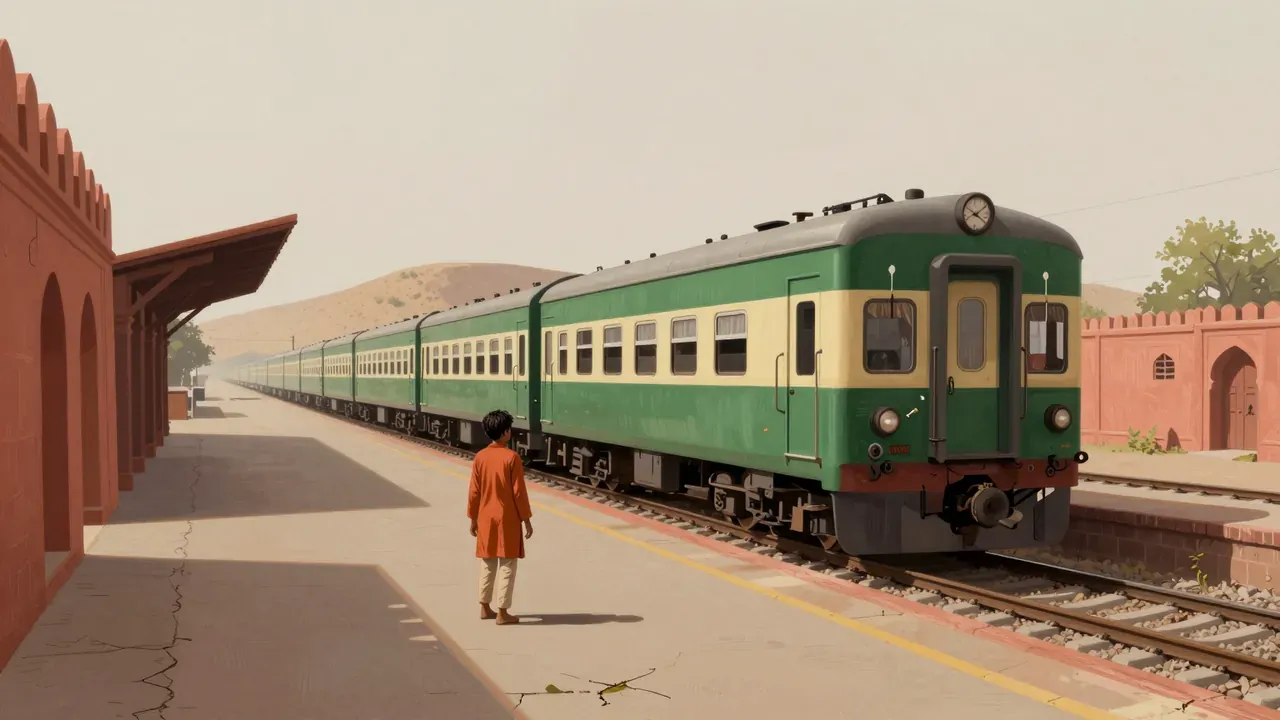
The Darjeeling Limited is a tightly composed drama about three American brothers travelling by rail across Rajasthan one year after their father’s death, attempting — and failing — to contain their grief within ritual, itinerary, and aesthetic control. It is trying to locate spiritual clarity not in revelation but in rupture: the moment when enforced discipline gives way to unscripted human contact, when Western self-seriousness meets Indian reality on its own terms. Wes Anderson co-wrote the film with Roman Coppola and Jason Schwartzman, and it proceeds as a formal exercise in restraint — symmetrical framing, muted palette, deliberate pacing — while dramatising emotional collapse. The train journey is both literal and structural: a vehicle for exposition, a cage for conflict, and finally a device to eject the characters into something rawer. Its ambition lies less in cultural synthesis than in using India as an unyielding mirror — not for exoticism, but for exposure. The film assumes the audience will recognise the brothers’ performative mourning as a kind of privilege, and that their eventual humility before local grief is not redemption but reckoning. It does not seek to explain India; it uses India’s physical and social density to dissolve the brothers’ narrative self-sufficiency.
The look of it
The story moves in two distinct movements: the contained, escalating tension aboard the Darjeeling Limited, then the disorienting aftermath in the Himalayan foothills. Robert Yeoman’s cinematography keeps the colour palette desaturated but precise — ochres, dusty greys, the occasional shock of saffron — and frames every shot with architectural rigour, even during moments of chaos. Owen Wilson, Adrien Brody, and Jason Schwartzman play brothers whose grief is stratified: Francis controls, Jack observes, Peter absorbs. Their performances are calibrated to Anderson’s syntax — restrained, slightly flattened, emotionally legible only through gesture or silence. Anjelica Huston appears late but decisively, her stillness contrasting the brothers’ nervous energy. The editing by Andrew Weisblum sustains rhythm without rush, allowing pauses to settle like dust. Randall Poster’s soundtrack juxtaposes Satyajit Ray’s melancholy string themes with The Kinks and Peter Sarstedt, reinforcing the film’s central tension between inherited Western affect and immediate Indian presence. There is no score composed for the film; instead, pre-existing music is selected and placed with forensic care, making each song feel like a found object rather than underscore.
What stays with you
What lands is the cumulative weight of accumulated detail: the luggage stamped with the father’s initials, the repeated refusal to name the mother’s absence directly, the way the brothers mimic their father’s posture without realising it. The train’s departure at the opening, Peter boarding alone, establishes tone before dialogue begins — a visual thesis on motion as avoidance. The physical altercation on the train feels earned because the script has spent twenty minutes building Francis’s authoritarianism and Jack’s passive resistance. The river sequence works not because it is dramatic but because it is abrupt, unheroic, and morally ambiguous: Peter fails, and the film refuses to soften that. The convent scenes land because they reject catharsis — Patricia’s quiet return is neither forgiveness nor explanation, just presence. The final discard of the suitcases is effective not as symbolism but as physical relief: the weight gone, the posture changed. Even minor roles register — Irrfan Khan’s steward is stern but not caricatured; Waris Ahluwalia’s guide speaks plainly, never translating culture for the audience. These choices accumulate into a texture that feels observed, not imposed.
Where it holds still
What does not land is the film’s reliance on stylistic recursion — the same symmetrical compositions, the same deadpan delivery, the same inventory of props — without sufficient internal variation to justify repetition. The brothers’ arguments follow a narrow emotional range, cycling between irritation and withdrawal without deepening into new psychological territory. Some supporting characters remain schematic: Brendan the assistant exits without consequence, Natalie Portman’s cameo in Hotel Chevalier (though not part of this film) sets up expectations the main feature does not fulfil. The film’s refusal to clarify Patricia’s motives beyond her letter risks reducing her to function — the absent centre — rather than a person with agency. The spiritual journey remains metaphorical rather than experiential; we see temples but rarely sense belief, ritual, or community beyond backdrop. At times the precision curdles into preciousness, particularly in scenes where dialogue is delivered like recited scripture rather than lived speech. The film’s restraint occasionally reads as distance — not cool detachment, but a failure to grant the Indian characters the same interiority granted the Whitmans.
What it is really about
The themes that matter are inheritance without instruction, mourning as performance, and the limits of self-directed healing. The brothers carry their father’s possessions but not his language — they quote his phrases without understanding their context, wear his clothes without inhabiting his gestures. Grief here is less an emotion than a system: rules, timetables, objects, silences. The film treats spirituality not as doctrine but as infrastructure — the train, the convent, the funeral — structures that hold space until feeling catches up. Colonial residue appears obliquely: the brothers move through India with passports, itineraries, and interpreters, yet remain linguistically and emotionally isolated. Their eventual participation in a local funeral is not assimilation but surrender — to rhythm, to collective sorrow, to time measured in breaths rather than schedules. The film’s most persistent theme is the difference between witnessing and belonging: the brothers watch, then stumble into, then briefly inhabit a world whose logic they cannot master but must accept. That acceptance is not resolution — it is cessation of resistance.
Who it is for
This film is for viewers who value compositional discipline, who read silence as meaning, and who do not require emotional payoff to feel satisfied. It suits those accustomed to Anderson’s syntax — the flattened affect, the curated objects, the slow accrual of resonance — and who find comfort in repetition as form rather than flaw. It is not for viewers who need narrative propulsion, psychological realism, or cultural exposition; those seeking insight into Indian religious life or postcolonial critique will find the film deliberately withholding. Some will find its restraint alienating, its grief too mannered, its India too framed. Those who disliked The Life Aquatic or The Royal Tenenbaums on grounds of tonal uniformity will likely find this more of the same. A viewer who values character-driven naturalism over stylised construction would reasonably reject it. The verdict changes if the film were less insistent on its own grammar — if it allowed a single unframed shot, a line of improvised dialogue, a moment where the aesthetic yielded to accident.
Why it stays
Yes, it is worth your evening — provided you approach it as a crafted object rather than a story engine. Its ninety-one minutes pass without hurry but also without waste; every scene serves the architecture of loss. It rewards attention to composition, to sonic layering, to the weight of unspoken history carried in a suitcase handle or a train window reflection. It is not relaxing, nor is it demanding in the conventional sense — its challenge is perceptual, not intellectual. You do not need to know Anderson’s filmography, but you do need patience for sustained mood over plot. Those who find beauty in restraint, who trust ellipsis over exposition, will leave with images that linger — the blue wall of the convent, the boys’ bare feet on hot stone, the passports held but not returned. It earns its quiet ending not through closure but through cessation: the train moves on, the brothers do not wave, and the frame holds just long enough to register that something has shifted, though no one names it.