The length of it
Daddy Longlegs is a tightly wound, low-budget American independent film that attempts something precise: to hold steady on a father who is neither villain nor victim, but a volatile, improvising force of adult irresponsibility — and to do so without recourse to exposition, moral framing or narrative resolution. It does not seek to explain Lenny’s behaviour through backstory or psychology, nor does it soften his actions with sentimentality or redemption arcs. Instead, it treats his two-week custody period as a sustained behavioural experiment, observing how he translates his own disarray into games, distractions and escalating misjudgements in front of his sons. The film’s ambition lies in its refusal to mediate between Lenny and the viewer: there is no narrator, no score to cue feeling, no cutaways to the mother’s perspective. It asks the audience to sit with discomfort not as a device, but as a condition — one that emerges from lived rhythm, not plotted escalation. Its model is not classical drama but something closer to ethnographic duration, filtered through the grainy immediacy of digital video shot on location in Manhattan apartments, schools and subway platforms.
The man in it
The story unfolds in episodic, loosely chronological units, each anchored by a specific incident — the salamander’s death, the upstate trip, the sleeping-pill episode, the mosquito nightmare — but these are not plot points so much as pressure valves releasing accumulated tension. Ronald Bronstein’s performance as Lenny is physically restless and verbally unfiltered, built on timing, repetition and sudden shifts in register: he talks fast, interrupts himself, pivots from tenderness to provocation without warning. The boys, played by Sage and Frey Ranaldo, are not child actors in the conventional sense; their reactions are often unscripted-seeming, their silences weighted with unspoken confusion. Josh Safdie and Brett Jutkiewicz’s cinematography favours tight frames and shallow focus, keeping faces close and backgrounds blurred, while the editing — by both Safdies — avoids conventional continuity, favouring abrupt cuts and lingering holds that resist emotional payoff. Sound design is sparse and diegetic: street noise bleeds in, dialogue overlaps, music is absent except for diegetic sources like a radio or a passing siren.
The boys in it
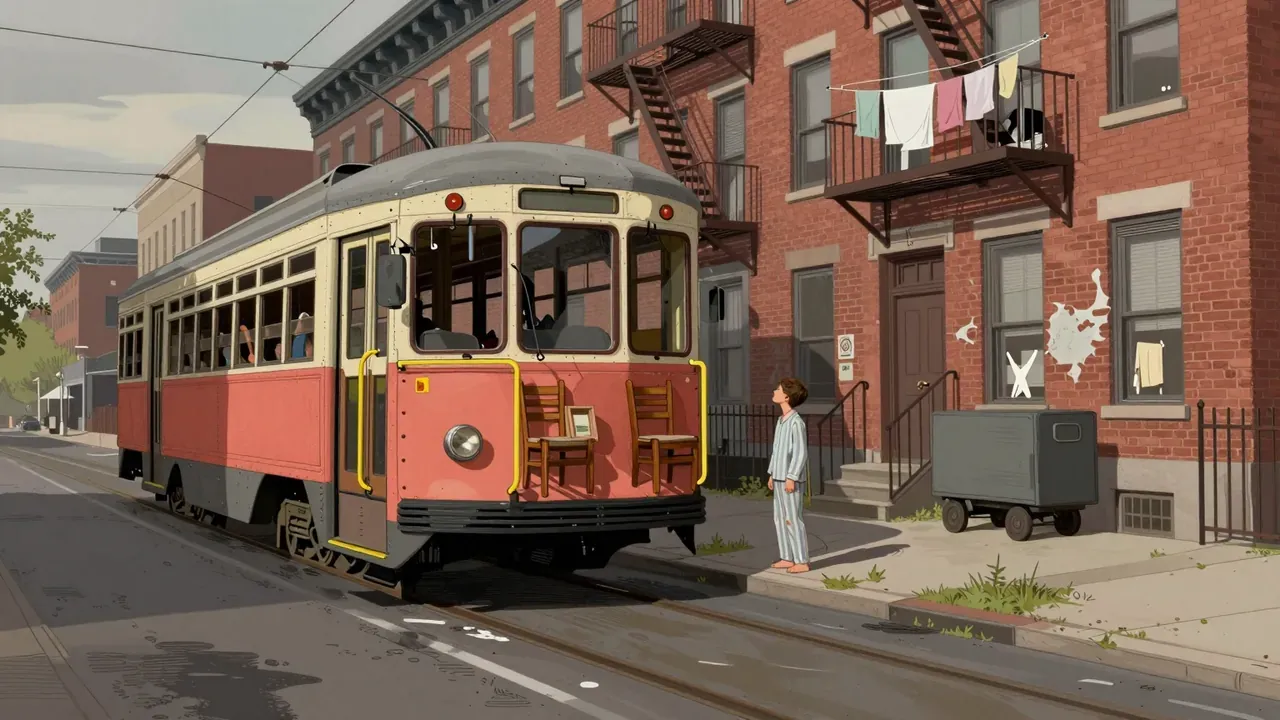
What lands most firmly is the film’s tonal consistency — its ability to sustain a mood of anxious, off-kilter intimacy across its hundred minutes. The scenes involving the boys feel unnervingly authentic, not because they mimic documentary realism, but because they refuse to flatter childhood innocence or adult competence. Lenny’s games — standing on stomachs, printing comics about boss-urination, shooting pee from a toy firetruck — land not as jokes but as symptoms: logical extensions of a mind that treats reality as malleable, rules as optional, and consequence as negotiable. The sleeping-pill sequence works precisely because it is not sensationalised: the camera stays at eye level as the boys slump, then lingers on Lenny’s face as he watches them sleep, not in panic but in weary calculation. The final abduction and sidewalk relocation also lands — not as climax but as quiet collapse, where the absurdity of carrying furniture onto a tram feels less like farce than exhaustion made visible. These moments succeed because they are underplayed, because the film trusts its rhythms over its shocks.
The look of it
What does not cohere is the film’s structural drift after the sleeping-pill episode. The second half loses some of its earlier precision, becoming more episodic and less urgent — the arrest, the nightmare, the abduction all arrive with diminishing narrative weight. The film’s refusal to explain Lenny’s motives begins to read less like rigour and more like omission: we never learn why he drugs the boys beyond ‘he doesn’t want them to wake up alone’, and that motivation feels thin against the gravity of the act. The character of Leni recedes too abruptly after her departure, and Salvie’s dangerous game, while unsettling, remains isolated rather than integrated into the film’s logic. Some scenes — particularly those involving secondary adults like Principal Puccio or Robber — feel like sketches rather than fully inhabited encounters. The film’s commitment to ambiguity starts to shade into opacity: when Lenny abducts the boys, the script offers no internal logic beyond impulse, and the absence of any counterpoint — no phone call from the mother, no legal consequence, no reflection — leaves the moment emotionally stranded rather than charged.
The care in it
The themes that matter are parental failure as performance, childhood as witness rather than subject, and care as a series of improvised, often harmful, substitutions. The film treats custody not as legal status but as temporal privilege — two weeks in which Lenny substitutes attention for stability, play for safety, chaos for continuity. His projectionist job is not metaphorical but functional: he handles reels, splices film, controls what is seen and when — a role mirrored in how he curates his sons’ experience, editing out discomfort, inserting fantasy (the mosquito), looping moments of connection until they fray. The salamander’s death is not incidental; it is the first instance of neglected life treated as background noise, a motif repeated in the sleeping pills, the abandoned furniture, the tram ride. The film’s interest lies less in diagnosing Lenny than in charting how irresponsibility replicates itself — not through malice, but through the sheer momentum of unexamined habit and the mistaken belief that energy equals engagement.
The patience it asks for
This film is for viewers who value behavioural precision over narrative closure, who can sit with prolonged discomfort without needing catharsis or explanation, and who trust that a film’s form — its pacing, framing, silence — can carry as much meaning as its plot. It suits those familiar with Cassavetes, early Harmony Korine or the Dardenne brothers, and those willing to accept that empathy need not require approval. It is not for viewers who rely on clear moral signposting, who expect children’s perspectives to be centred or protected narratively, or who find sustained ambiguity emotionally exhausting rather than clarifying. A viewer who values psychological cause-and-effect, or who expects consequences to follow actions within the frame, will likely leave frustrated. That frustration would be legitimate — the film’s restraint is a choice, not an omission — but it would not change the verdict: this is a work defined by its limits, and its power depends on holding them.
The end of it
Yes, it is worth your evening — provided you approach it as a study in duration and tone, not as a story with stakes you can resolve. Its ninety-minute runtime feels earned, not indulgent, because every scene accumulates texture rather than exposition. The film rewards attention to gesture, to the weight of a pause, to how light falls on a hallway floor at 3 p.m. on a weekday. It is not for someone seeking entertainment, uplift or even clarity — but it is for someone who wants to see how cinema can hold irresponsibility without judgment, and childhood without condescension. Those who found it alienating — like Chuck Bowen, who called it ‘abuse’ thinly disguised — would likely argue that the film mistakes provocation for insight. They would be right that it risks that confusion. But the risk is part of its point: not every father’s failure is legible, and not every child’s witnessing is narratable.