The shape of the crime
Violence at Noon is a 1966 Japanese crime drama that tests the limits of moral causality by refusing to separate motive from act, memory from evidence, or complicity from survival. Nagisa Ōshima does not aim to explain a serial killer but to dismantle the narrative frames — legal, psychological, rural communal — that would contain him. The film treats rape, suicide pact, and judicial execution not as discrete events but as sequential repetitions of the same unbroken logic: one violation begets another, each survivor inherits the weight of the dead, and every witness becomes an accomplice by choosing what to name and what to conceal. It works within the conventions of postwar Japanese cinema only to fracture them — no voiceover exposition, no stable chronology, no redemptive arc. Its ambition is structural as much as ethical: to make the viewer feel the pressure of withheld knowledge, the exhaustion of testimony, the quiet violence of silence kept for decades. This is not a film about justice delivered, but about justice deferred until it curdles into ritual.
The look of it
The story unfolds through over two thousand single shots — a formal choice that denies the comfort of montage or continuity editing, forcing attention onto gesture, pause, and the physical weight of a glance. Taijun Takeda’s script moves in fractured loops: Shino’s testimony, Eisuke’s confession, Kura’s silent years — none are privileged as truth, all are subject to revision. Saeda Kawaguchi plays Shino with minimal inflection, her stillness reading less as stoicism than as the residue of trauma too deep for expression. Kei Satō’s Eisuke is neither monstrous nor pathetic, but matter-of-fact — his violence unadorned, his remorse absent not through denial but because he has never been asked to account for himself in terms that hold. Akiko Koyama’s Kura carries the film’s moral gravity: her marriage to Eisuke is not a betrayal of Genji but an acceptance of the village’s unspoken contract — that some truths must be buried so the surface remains intact. Gordon Willis did not shoot this film; it was shot by Takashi Kawamata, whose lighting keeps faces half-submerged, interiors dimmed not for mood but for ambiguity.
The weight of memory
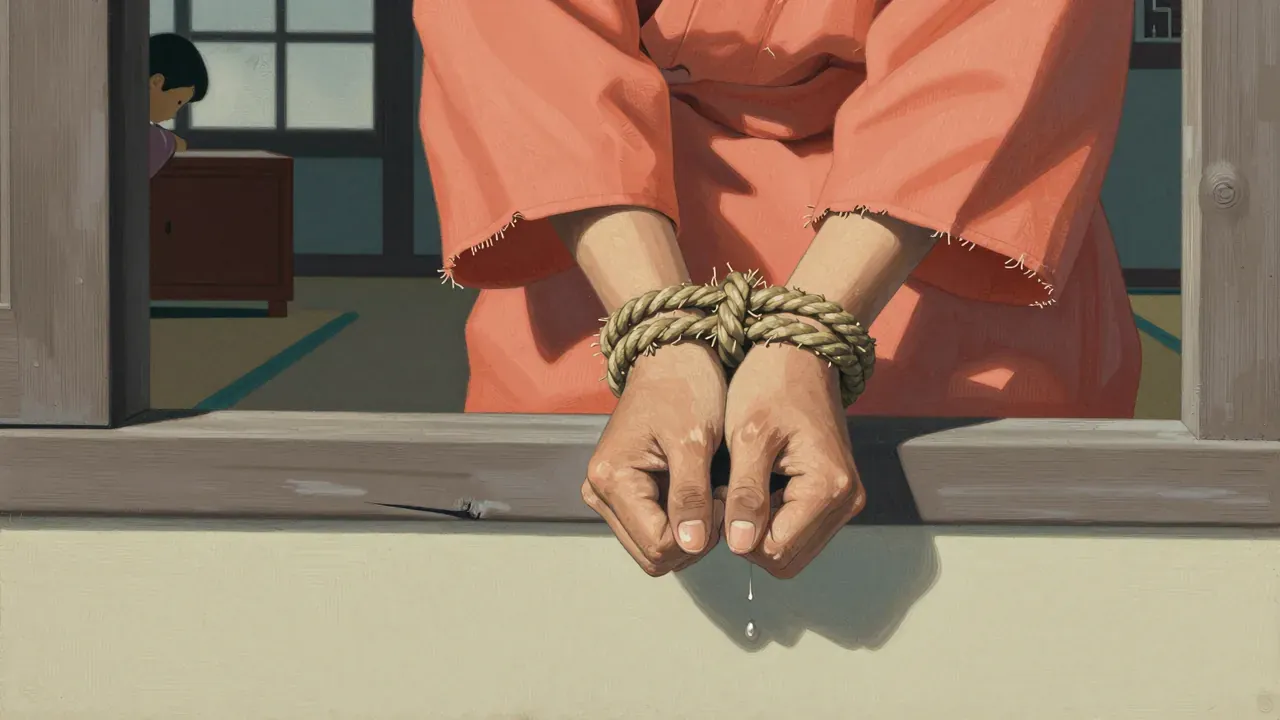
What lands is the cumulative force of repetition: the way Shino ties her own hands before confronting Kura, echoing how she was bound during the murder; the way Kura pours tea for Shino as if resuming a conversation paused twenty years earlier; the way Eisuke’s trial proceeds without surprise, as though everyone already knows the verdict but waits for the formality to catch up. The film’s editing — sharp, abrupt, resistant to rhythm — makes time feel less like progression than accumulation. Each flashback does not clarify but thickens: we learn more, yet understand less, because every new fact displaces the last. The final double suicide attempt lands not as tragedy but as logical termination — not because Shino and Kura are broken, but because the world they inhabit offers no third option between complicity and erasure. The absence of music, the flat tonal register of the performances, the refusal to linger on reaction shots: all conspire to deny catharsis, and that denial itself becomes the point.
The detective’s silence
What does not land is the detective’s role. Fumio Watanabe’s Haraguchi appears intermittently, methodical but inert — a procedural placeholder rather than a counterweight to the film’s moral density. His presence asserts a legal framework the film otherwise treats as irrelevant, and his scenes slow the momentum without adding tension or perspective. Likewise, the Osaka sequence — Shino’s journey to find Kura — feels narratively necessary but formally thin: its urban anonymity lacks the claustrophobic texture of the village flashbacks or the institutional sterility of the courtroom. The film’s commitment to austerity occasionally tips into opacity: the shinjū backstory is presented without context or emotional signposting, assuming the viewer knows the cultural weight of mutual suicide as social rupture, not romantic gesture. Without that knowledge, some of the film’s gravest turns read as arbitrary rather than inevitable. The lack of exposition is a principle, not a convenience — and it asks more of the viewer than the script always equips them to give.
The grammar of silence
The themes that matter are inheritance without consent, silence as active participation, and the impossibility of clean separation between victim and witness, perpetrator and spouse, survivor and mourner. Violence at Noon treats trauma not as something endured then overcome, but as a condition passed down like property — held in the body, spoken in half-sentences, enacted in gestures repeated across decades. The village is not a setting but a grammar: its hierarchies, its shame economies, its unspoken rules about who may speak and when, structure every decision. Kura’s marriage is not love or fear but syntax — the only sentence available to her after Genji’s death. The film also interrogates the idea of testimony itself: Shino lies to the police not out of malice but because truth, once spoken aloud, becomes public property — and public property in this world is always weaponised. There is no ‘truth’ outside the telling, and no telling that does not reshape the teller. The film’s most persistent question is not ‘who did it?’ but ‘who gets to name it — and what happens to those who do not?’
Who walks with it
This film is for viewers who treat narrative not as delivery system for meaning but as architecture for doubt — those accustomed to films where silence carries more weight than dialogue, where editing choices argue as fiercely as script. It rewards patience with structural rigour, not emotional payoff. It is not for viewers who require clear moral coordinates, character arcs, or resolution that resembles justice. Those who expect exposition to scaffold ambiguity will find it withholding; those who rely on performance cues to locate intention may misread Kawaguchi’s restraint as vacancy. A viewer expecting a crime thriller will leave frustrated; one approaching it as a forensic study of social silence will find it exacting and unsparing. The film assumes familiarity with postwar Japanese social codes — particularly around shame, obligation, and the gendered burden of memory — and without that context, its gravity risks feeling abstract rather than embodied.
The cost of attention
Yes, it is worth your evening — but only if you are prepared to sit with discomfort that does not resolve, to watch scenes that ask questions they decline to answer, and to accept that some endings are not conclusions but continuations of the same logic. It is not ‘enjoyable’ in any conventional sense, but it is rigorously honest about the costs of survival in a world that demands complicity as the price of coherence. Those who value formal precision, moral complexity, and historical specificity will find it essential. Those who seek narrative propulsion or emotional release will not. A viewer who values Ōshima’s later work — like Death by Hanging or In the Realm of the Senses — will recognise here the early crystallisation of his lifelong concern: how institutions, language, and memory conspire to make violence ordinary. To dismiss it as ‘difficult’ is to mistake its method for its message.