The fidelity of form
A Room with a View is a literary adaptation of E. M. Forster’s 1908 novel, made by Merchant Ivory Productions in 1985 and released in early 1986. It sets out to translate Forster’s quiet satire of Edwardian social constraint into visual terms — not as period spectacle, but as behavioural precision. The film treats manners as architecture: every glance, hesitation, and suppressed gesture is calibrated to reveal the pressure beneath propriety. It does not dramatise rebellion so much as the tremor before it — Lucy Honeychurch’s internal shift from dutiful acquiescence to self-possessed choice. The adaptation follows the novel closely, retaining its chapter-title structure and moral geography: Florence as sensory liberation, Surrey as suffocating decorum. Its ambition is modest but exacting — to make visible the weight of unspoken expectation, and the physical relief of its release. It assumes familiarity with no historical context beyond what the performances and settings imply; exposition is withheld, not explained. This is not a film about Italy or England, but about how place registers on the nervous system of a young woman learning to name her own desire. (158 words)
The weight of a pause
The story unfolds in measured, unhurried steps: a room swap, a fainting spell, a kiss in a poppy field, a broken engagement, a return to Florence. Ruth Prawer Jhabvala’s screenplay preserves Forster’s irony without underlining it; lines land because they are delivered with dry timing, not because they are flagged as witty. Helena Bonham Carter, eighteen and making her film debut, carries Lucy with watchful stillness — her face registers contradiction before her voice does. Julian Sands’ George Emerson is less a romantic ideal than a quiet counterweight: physically present, emotionally unguarded, unperforming. Denholm Elliott as Mr. Emerson gives warmth without sentimentality; Judi Dench’s Eleanor Lavish is sharp-tongued but never caricatured. Tony Pierce-Roberts’ cinematography favours natural light and shallow depth, keeping faces legible even in candlelit interiors. Richard Robbins’ score uses piano and strings sparingly, often pausing altogether during dialogue. Humphrey Dixon’s editing avoids rhythm for its own sake — cuts follow breath, not beat. There are no montages, no flashbacks, no subjective distortions. The craft serves the text, not the other way round. (159 words)
The quiet turn
What lands most firmly is the film’s restraint. The Sacred Lake scene — male nudity presented without eroticism or apology — works because it is treated as ordinary, unremarkable, part of the landscape’s physical logic. Similarly, the moment Lucy tears up Cecil Vyse’s letter is effective not for its drama but for its silence: she sits alone, folds the paper slowly, and places it in the fire. The film trusts the audience to read intention in posture and pause. The Florence sequences succeed because they do not exoticise: the Piazza della Signoria is shot without grandeur, just as a place where people gather, argue, and lose their balance. Even the famous kiss feels inevitable rather than climactic — a release of tension built across earlier glances and misdirected conversations. The production design and costumes earn their awards not through opulence but accuracy: the Honeychurch house has worn floorboards and mismatched china; Cecil’s London flat is tasteful but airless, all polished surfaces and no warmth. These details accumulate without emphasis, letting the social critique emerge from texture, not speech. (157 words)
Where the text resists translation
What does not land is the framing of Cecil Vyse. Daniel Day-Lewis plays him with such brittle control that he becomes difficult to read — not as a repressed aesthete, but as emotionally inaccessible. The script gives him little interiority beyond disdain, and the performance deepens that gap rather than bridging it. As a result, his function as foil to George feels schematic, not dialectical. Similarly, the Miss Alans remain decorative: their eccentricities are noted but not integrated into the film’s moral architecture. The chapter-title device, while faithful to the novel, occasionally interrupts momentum without adding structural clarity — the titles appear over static shots, but their thematic weight is not reinforced visually or narratively. The final Florence reunion also strains credulity: Lucy’s abrupt departure from Cecil, though justified in the novel by months of reflection, feels compressed here into a single afternoon’s realisation. The film’s fidelity to Forster’s pacing works against it in moments requiring psychological acceleration — it trusts the audience to infer too much, too quickly. Some viewers will find this reserve admirable; others will find it withholding. (159 words)
The grammar of restraint
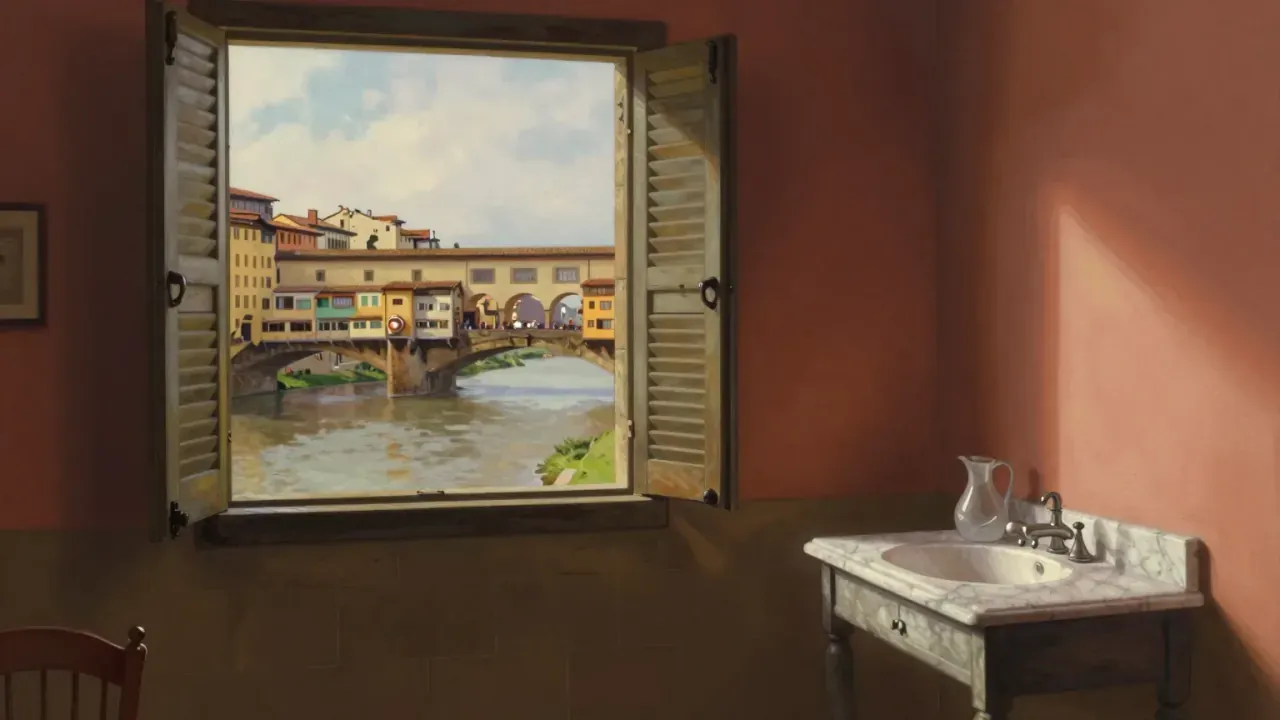
The themes that matter are not love versus duty, but perception versus prescription. Lucy’s journey is from seeing the world through others’ expectations — Charlotte’s caution, Cecil’s aesthetics, Mrs. Honeychurch’s pragmatism — to seeing it directly, unmediated. The ‘room with a view’ is literal and metaphorical: a space where light enters unfiltered, where one can look outward without permission. Class operates not as economic barrier but as grammar — the rules governing who may speak, when, and how loudly. The film treats English reserve not as virtue but as habituated suppression, and Italian spontaneity not as chaos but as unselfconscious alignment between feeling and action. Religion appears only as social scaffolding — Mr. Beebe’s sermons are background noise, his real influence exerted through quiet observation. Gender is handled without polemic: Lucy’s choices are constrained not by law but by consequence — the risk of scandal, of being unmoored from family and standing. The film’s quietest theme is courage as continuity: not dramatic rupture, but the steady refusal to lie to oneself. That is what makes it more than a romance — it is a study in epistemic integrity. (159 words)
The competent viewer
This film is for viewers who value precision over propulsion, who find tension in a held breath rather than a chase sequence. It rewards attention to posture, costume detail, and the weight of silence. It suits those familiar with British class nuance or willing to absorb it osmotically. It is not for viewers who require narrative urgency, psychological exposition, or moral clarity delivered in dialogue. Those who expect adaptation to amplify or modernise its source will find it stubbornly faithful — not inert, but deliberate in its pace. Anyone impatient with unresolved subtext or who reads restraint as emptiness will leave unsatisfied. A viewer who values character over plot, texture over twist, will find it rich. Someone who needs motivation spelled out, stakes heightened, or emotion externalised will find it distant. Its appeal is narrow but deep: it assumes competence in reading behaviour, and offers no translation. That assumption is its limit and its strength. (158 words)
The measure of its patience
Yes, it is worth your evening — provided you approach it as a sustained tone poem rather than a plotted story. Its 116 minutes pass without hurry but not without accumulation: small decisions gain gravity because the film refuses to underline them. You will not forget Lucy’s hands smoothing her skirt before speaking to George, or the way Mr. Emerson’s eyes soften when he watches his son walk away. It repays rewatching not for hidden clues but for deeper calibration — noticing how light shifts across a face, how a line of dialogue lands differently on second hearing. Those who dislike it tend to cite its slowness, but the pace is structural, not incidental. Change the rhythm and you dissolve the central tension: the conflict between inner truth and outer compliance requires time to register. It is not for everyone, but for its audience, it remains uncluttered, uncondescending, and quietly exacting. (159 words)