What the poem becomes
The Green Knight is a speculative fiction film that adapts the 14th-century alliterative poem Sir Gawain and the Green Knight into a slow, tactile, materially grounded vision of chivalric myth. It does not aim to dramatise medieval history or deliver narrative propulsion; instead, it treats the source as a vessel for examining integrity, time, and self-deception through ritualised action and symbolic recurrence. David Lowery’s version foregrounds Gawain’s interior uncertainty—not as psychological realism but as atmospheric drift—while anchoring each scene in physical texture: hand-painted backdrops, wood-grain prosthetics, linen cloaks, candlelit interiors. The film resists exposition, avoids explanatory dialogue, and declines to resolve its central bargain with moral clarity. Its ambition lies in sustaining ambiguity across 130 minutes without recourse to irony or modern detachment. It asks the viewer to sit with unease, repetition, and unresolved consequence—not as flaws, but as structural principles. This is not an adaptation that translates the poem into contemporary idiom; it re-enchants the idiom itself, making strangeness feel inevitable rather than exotic.
The look of it
The story follows Gawain’s year-long journey from Christmas feast to Green Chapel, segmented by encounters that test perception more than courage: a battlefield scavenger, a spectral saint, a lord’s household where temptation unfolds in measured domestic rhythms. Dev Patel’s performance holds the film’s gravity—not through vocal force or emotional outburst, but through stillness, hesitation, and the weight of unspoken calculation. Ralph Ineson’s Green Knight is physically imposing, his voice low and unbroken, his presence built on platformed height and organic prosthetics rather than digital augmentation. Andrew Droz Palermo’s cinematography favours deep focus and long takes, often framing Gawain within doorways or arches that compress space and amplify isolation. Daniel Hart’s score uses layered choral textures and sparse percussion to evoke liturgical dread rather than adventure. Editing by Lowery is deliberate and asymmetrical—scenes linger past comfort, then cut abruptly, denying conventional rhythm. Costume, production design, and practical effects cohere as a single vocabulary: no element feels decorative; everything bears symbolic load or historical weight, even when invented.
What holds
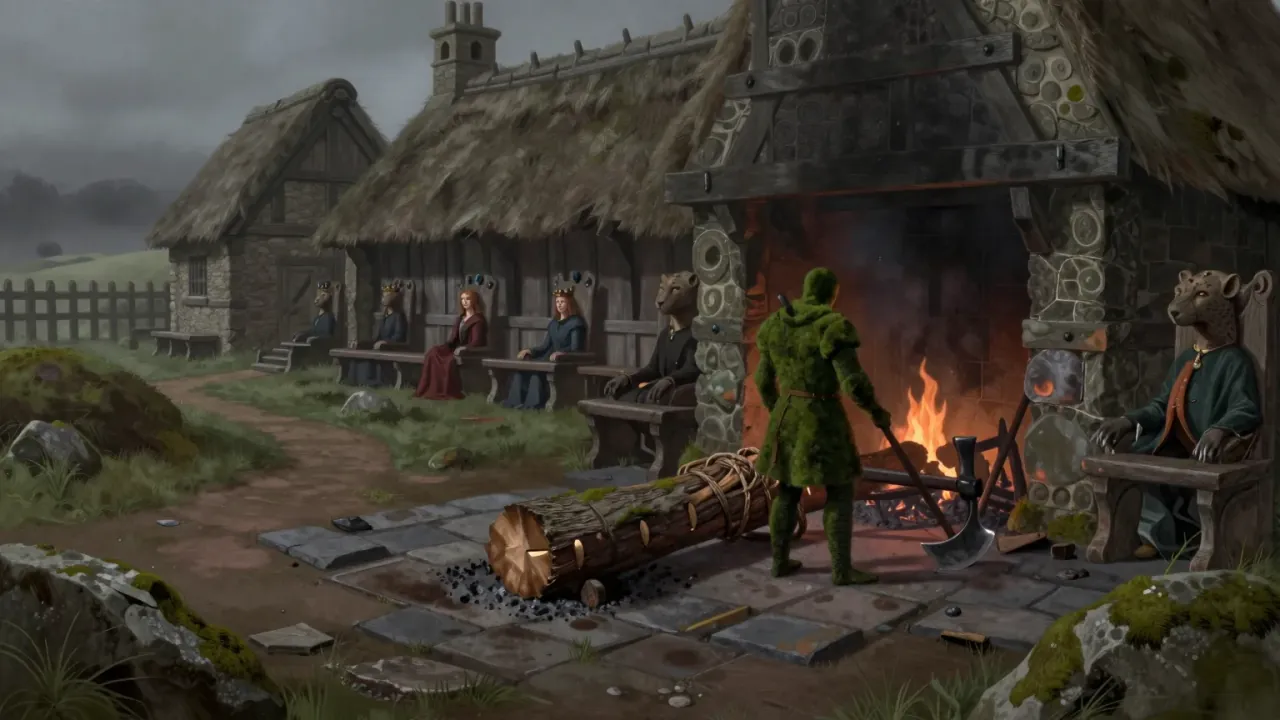
What lands is the film’s sustained tonal discipline—the way fog, silence, and candlelight accumulate meaning without explanation. The Round Table sequence works because its matte paintings and hand-stitched banners refuse photorealism, making Camelot feel like a remembered dream rather than a set. The Green Knight’s first entrance lands not through shock but through violation of scale and silence: his footsteps echo too long, his green skin absorbs light unevenly, his head remains visible in the frame after decapitation. Saint Winifred’s cottage scene succeeds because its dissolves and shallow focus recall Coppola’s Dracula, not as pastiche but as shared grammar of gothic reverence. Alicia Vikander’s dual role gains resonance not from contrast but from continuity—her voice, posture, and gaze recur across characters, binding them as facets of one destabilising force. The final confrontation at the Green Chapel lands precisely because it refuses catharsis: Gawain’s flinch, the axe’s arc, the Knight’s quiet assessment—all are rendered with physical specificity, leaving interpretation open but never arbitrary. The film earns its ambiguity by grounding every surreal beat in tangible craft.
Where it slips
What does not land is the film’s reliance on repetition as structural principle when it begins to blur rather than deepen. The threefold temptation at the lord’s castle—each day mirroring the last in pacing and framing—starts to feel less like ritual and more like editorial inertia. Some transitions lack connective tissue: Gawain’s shift from brothel to court, or from robbery to Winifred’s cottage, relies on ellipsis that occasionally reads as omission rather than economy. The highway robbery sequence, intended as an allusion to Barry Lyndon, lacks Lyndon’s ironic precision; its moral opacity feels undermotivated rather than resonant. The green girdle’s significance is established visually but never interrogated in dialogue or gesture beyond its initial gift—its power remains asserted, not demonstrated. While the decision to omit digital effects for the Green Knight in the Round Table scene strengthens presence, the later hibernation sequence—where his face subtly morphs into other actors’—feels technically accomplished but narratively unmoored, its purpose unclear beyond visual metaphor. These are not failures of execution, but moments where thematic intent outpaces dramatic necessity.
What it’s really about
The themes that matter are mortality as deferred reckoning, reputation as fragile social currency, and virtue as performative habit rather than innate quality. The film treats time not as linear progression but as cyclical pressure—the year between blows, the recurring motifs of heads severed and restored, the seasonal return of Christmas. Chivalry is shown as a system of agreed-upon fictions: Gawain wears gold not because he has earned it, but because it is expected; Arthur and Guinevere wear crowns referencing South American iconography, signalling their status as constructed ideals rather than historical figures. Morgan le Fay’s letter-based magic frames agency as textual—what is written becomes binding, what is unwritten remains negotiable. The green girdle embodies cowardice disguised as prudence; its failure is not that it breaks, but that it changes nothing—Gawain survives not because of it, but despite it. The film’s deepest concern is with the gap between intention and action, and how stories we tell ourselves about who we are slowly harden into identity—even when they are demonstrably untrue.
Who it’s for
This film is for viewers who value atmosphere over exposition, who find patience a prerequisite for engagement, and who trust craft choices to carry meaning without translation. It suits those accustomed to arthouse pacing, to films where silence lasts longer than dialogue, and where symbolism is embedded in texture rather than stated. It is not for viewers seeking narrative clarity, emotional resolution, or conventional character arcs—those expecting Gawain’s journey to yield growth or redemption will leave unsettled. It is also unlikely to satisfy fans of high-fantasy spectacle or action-driven adaptations; there are no battles, no magic spells cast mid-air, no triumphant returns. Those who require motivation to be legible, or stakes to be quantifiable, will find the film withholding. A viewer who values psychological realism over ritual, or who prefers thematic directness, would likely reject its methods—though such a rejection would stem from mismatched expectations, not flaw in execution.
Is it worth your evening?
Yes, it is worth your evening—if you approach it as a sensory and philosophical object rather than a story to be followed. Its 130 minutes unfold with unhurried insistence, rewarding attention to light, fabric, breath, and pause. It repays rewatching not for plot revelation but for shifts in emphasis: how a glance lingers, how a sound fades, how a costume’s weight alters posture. It is not entertainment in the transactional sense, but an experience calibrated to recalibrate perception—to make the familiar strange again. Those who dislike ambiguity, resist slow pacing, or expect moral payoff may find it frustrating, but that frustration is part of its design. It does not ask for agreement, only for presence. If you have ninety minutes to give to something that refuses to explain itself yet never feels obscure for obscurity’s sake—if you accept that some truths are held in silence, in green skin, in a girdle’s fold—then this film earns its duration. It is not easy, but it is exact.