The shape of time
Before Sunset is a romantic drama that follows Jesse and Céline over the course of ninety minutes in real time, as they reunite in Paris nine years after meeting in Vienna. It attempts something rare: to dramatise the weight of time passed—not through exposition or flashbacks, but through the texture of speech, hesitation, self-correction, and the quiet accumulation of what has been lived since last we saw them. The film does not seek to resolve their relationship, nor to confirm whether love endures or rekindles; instead, it holds open a space where intimacy is rebuilt sentence by sentence, gesture by gesture, in daylight that visibly fades. Its ambition lies in fidelity—to how people actually talk when they are both eager and afraid, to how memory distorts and clarifies, and to the physical reality of a city walked at human pace. It assumes the audience will attend closely, not because the stakes are high in plot terms, but because the stakes are high in emotional consequence. The film’s structure is its argument: that presence, sustained and unbroken, is itself a form of commitment. (158 words)
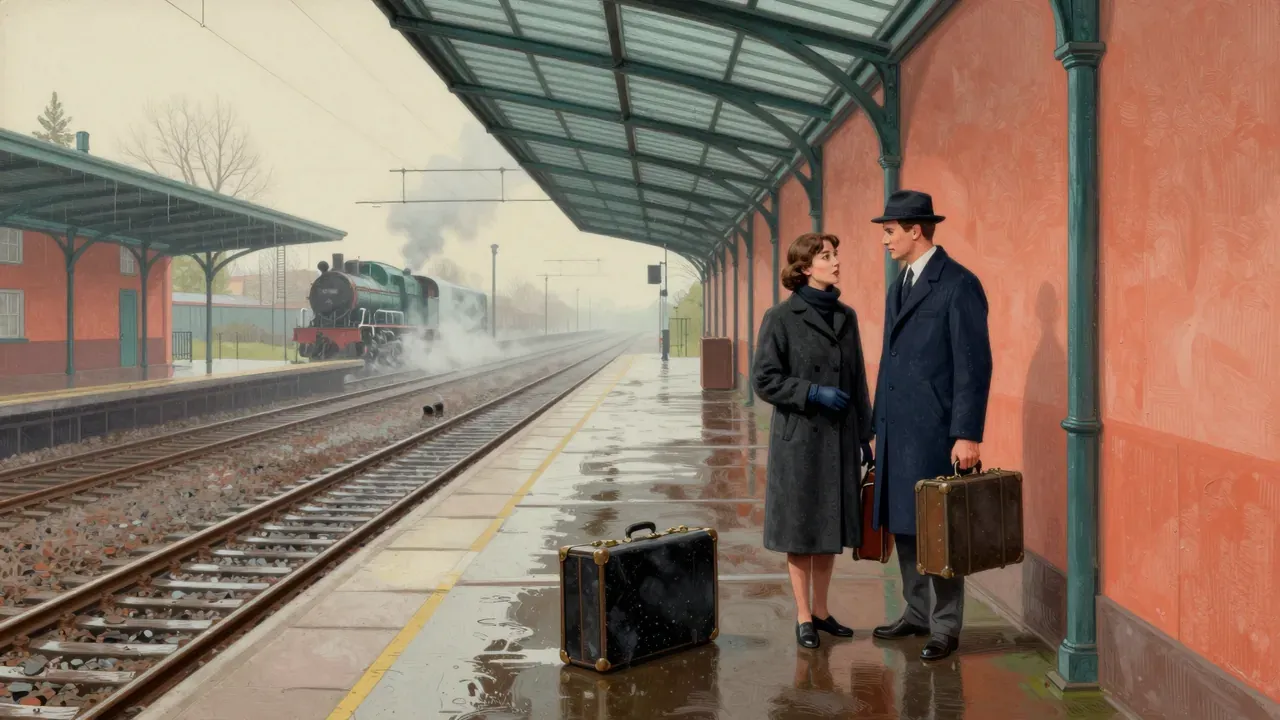
The walk through Paris
The story unfolds entirely in present tense, beginning inside Shakespeare & Company and moving through streets, cafés, a boat, a taxi, and finally an apartment—each location anchoring a shift in tone or revelation. Ethan Hawke and Julie Delpy perform with granular precision: their rhythms interlock, their pauses feel earned, their shifts from irony to vulnerability never theatrical. Lee Daniel’s cinematography uses Steadicam for fluid, unbroken takes—some lasting eleven minutes—keeping the camera close but never intrusive, letting light and weather shape mood without comment. Sandra Adair’s editing sustains continuity across locations while preserving the sense of real duration; there are no cuts that cheat time. Julie Delpy’s score is sparse, acoustic, woven into the background like passing street noise. The writing—by Linklater, Hawke, and Delpy—avoids monologue in favour of dialogue that doubles back, contradicts itself, and circles meaning like a bird testing air currents. There is no music cue to signal emotion, no lighting shift to underline a turning point: everything rests on what is said, unsaid, or half-meant. (159 words)
The rhythm between them
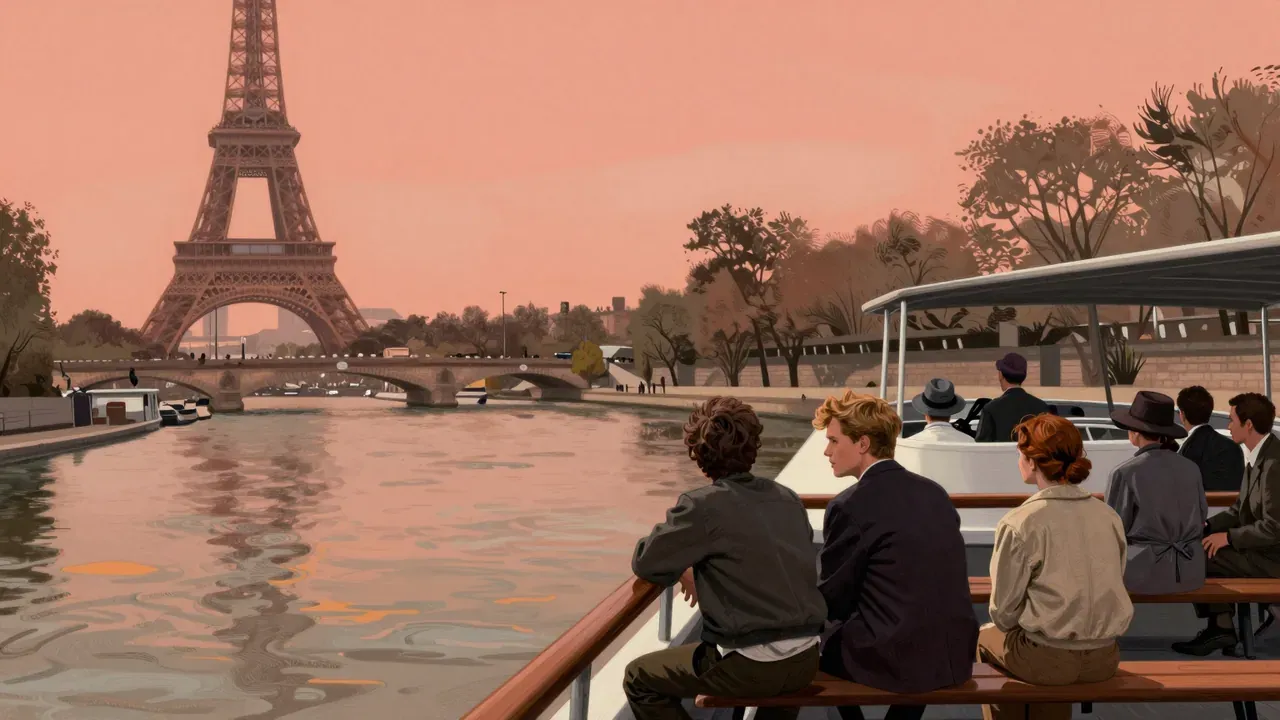
What lands is the cumulative effect of sustained attention—how a glance held a beat too long, a hand briefly resting on a shoulder, or the way Céline’s voice tightens when she describes her work, all register with quiet force. The film’s restraint makes its moments of openness land harder: Jesse admitting he wrote a book about their night in Vienna, Céline confessing she listened to his recorded voice on tape for years, the shared silence aboard the bateau mouche as dusk settles—all feel earned, not engineered. The Paris locations do not function as postcard backdrops but as active participants: the heat, the fading light, the uneven pavements, the hum of traffic outside a café window. Even minor characters—Vernon Dobtcheff’s bookseller, Rodolphe Pauly’s café patron—register as real presences, not devices. The film trusts its leads’ chemistry so completely that it never needs to underline it; their history lives in the ease with which they interrupt each other, the shorthand of shared reference, the way they finish sentences only to retract them. This is not acting as display, but as continuation—of a conversation begun nearly a decade earlier and never truly closed. (157 words)
The weight of what’s unsaid
What does not land is the occasional strain of the conceit: the real-time frame demands absolute consistency, and some exchanges verge on overwriting—lines that sound less like speech than polished essays on longing or regret. A few passages, particularly those touching on politics or art, risk sounding like seminar contributions rather than spontaneous thought. The film’s refusal to cut away also means it cannot escape moments where pacing slackens—not from lack of intent, but from the sheer difficulty of sustaining such density across seventy-seven minutes without variation in rhythm or perspective. Some viewers may find the apartment sequence, though emotionally pivotal, structurally abrupt: the shift from public to private space happens without transition, and the final scene’s ambiguity, while deliberate, leaves little room for interpretation beyond what is already implied. The film offers no counterpoint—no contrasting character voice, no visual metaphor, no narrative detour—to relieve its intense focus. That is its design, but it is also its limit: it asks for unwavering investment, and does not forgive distraction. (156 words)
The act of staying
The themes that matter are time as erosion and accumulation, language as both bridge and barrier, and the quiet heroism of choosing vulnerability after disappointment. Ageing is treated not as decline but as layering: Jesse’s guardedness, Céline’s idealism tempered by pragmatism, their mutual awareness of mortality—all emerge not through statement but through how they speak of the past. The film treats romance not as destiny but as negotiation: every admission is preceded by evasion, every confession weighed against consequence. Memory appears not as archive but as living tissue—unreliable, selective, emotionally charged. The Paris setting reinforces this: a city built on sediment, where medieval lanes sit beneath Haussmann boulevards, where light changes minute by minute, mirroring how perception shifts across a single afternoon. The film also engages with creative labour—not just as subject (Jesse’s novel, Céline’s environmental work) but as method: the script itself is a collaboration across years, echoing the characters’ own co-authorship of memory and meaning. There is no grand thesis here, only the persistent question: what remains, and what must be rebuilt, when two people meet again on their own terms? (159 words)
The apartment door
This film is for viewers who value listening over watching, who find tension in hesitation more compelling than action in motion, and who accept that emotional resolution may look like uncertainty given weight. It suits those accustomed to arthouse pacing, comfortable with long takes and minimal exposition, and willing to sit with unresolved feeling. It is not for viewers who require plot propulsion, clear cause-and-effect, or narrative closure—the film ends mid-breath, not mid-arc. Those who rely on visual spectacle, tonal variety, or external conflict will likely find it thin. People who dislike improvised-sounding dialogue or distrust performances that resist ‘big moments’ may mistake its restraint for emptiness. The film assumes patience as a condition of engagement, not a virtue to be rewarded. Its appeal is narrow but deep: it rewards attention not with payoff but with recognition—of how people actually speak, hesitate, misdirect, and sometimes, quietly, mean exactly what they say. Anyone expecting a conventional romance will leave dissatisfied; anyone open to romance as sustained attention will find it generous. (158 words)
The length of the evening
Yes, it is worth your evening—if you are prepared to give it your full attention for its entire duration, without checking your phone or anticipating what comes next. Its value lies not in what it delivers but in what it invites: a recalibration of how we listen, how we hold space for another person’s contradictions, how we tolerate ambiguity without rushing to resolve it. It works best viewed alone or with someone equally willing to sit in shared silence afterwards. It will not entertain in the usual sense, nor distract, nor flatter; it asks for reciprocity. Those who disagree tend to cite its slowness, its talkiness, its refusal to offer answers—valid objections, but objections to its premises, not its execution. Change the premise—introduce a third character, cut the runtime by twenty minutes, add a musical montage—and the film collapses. Its worth is inseparable from its form. If you have ninety minutes and the willingness to inhabit them fully, Before Sunset repays that time not with spectacle, but with resonance. (159 words)