A requiem, not a record
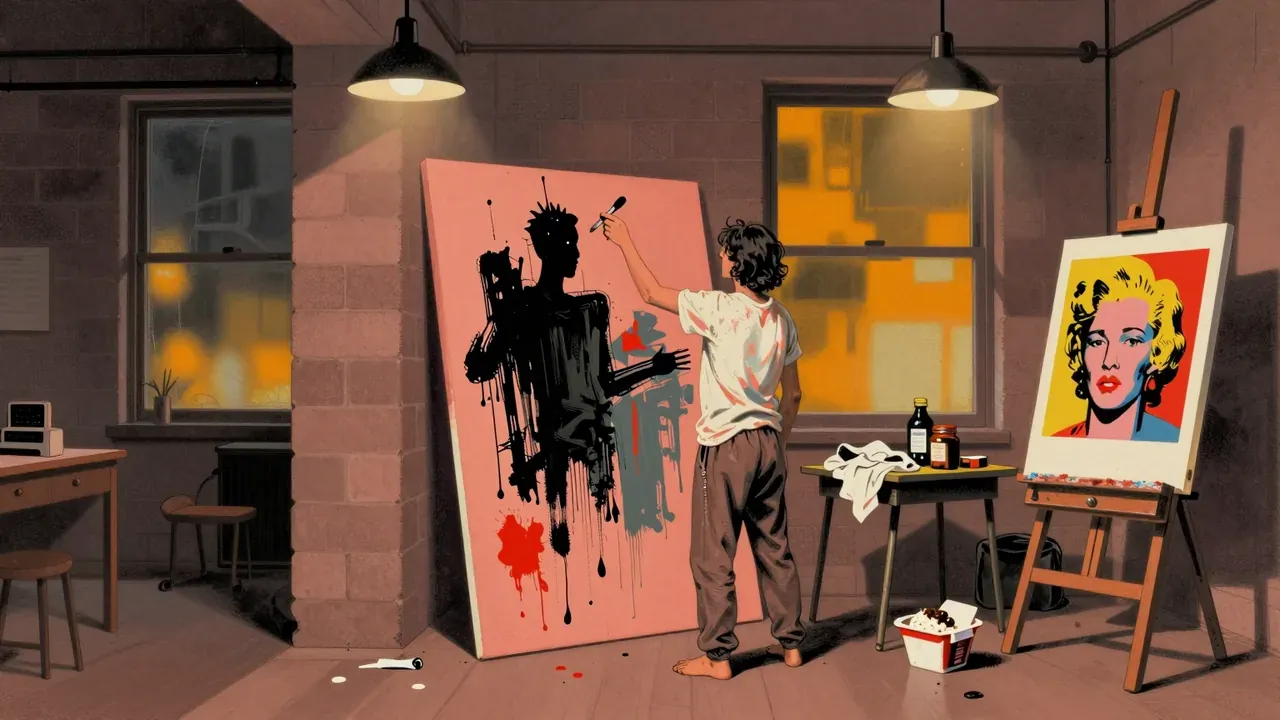
Basquiat is a biographical film about Jean-Michel Basquiat, made by painter Julian Schnabel in his directorial debut. It does not attempt documentary fidelity: Basquiat’s estate refused permission for use of his actual work, so Schnabel and studio assistant Greg Bogin painted approximations on set. The screenplay, co-written by Schnabel and Lech Majewski, treats Basquiat’s life as a loose scaffold — foregrounding his ascent from cardboard-box dweller in Tompkins Square Park to internationally exhibited artist, his bond with Andy Warhol, and his downward spiral into heroin addiction. Schnabel frames the film as a requiem for both Basquiat and Warhol, insisting on their mutual vulnerability against a hostile art world. He inserts himself into the narrative as Albert Milo, played by Gary Oldman — a fictionalised version who shares Schnabel’s Brooklyn roots, surfing habit, and even his parents’ cameo appearances. This self-reflexive structure signals that the film is less about Basquiat as historical subject than about Schnabel’s identification with him: two painters navigating fame, misrepresentation, and erasure.
The look of it
The story moves episodically, skipping exposition in favour of mood and gesture. Jeffrey Wright plays Basquiat with minimal dialogue and sustained physical stillness — a choice that invites interpretation but also risks flattening complexity. David Bowie’s Warhol is precise in posture and cadence, borrowing the real man’s wig, glasses and jacket; his performance anchors the film’s emotional gravity. Ron Fortunato’s cinematography favours shallow focus and tight framing, keeping faces half-obscured or lit from below, reinforcing isolation. John Cale’s score is sparse, often absent — ambient noise and silence carry more weight than melody. Michael Berenbaum’s editing avoids conventional rhythm: scenes bleed, repeat, or cut abruptly, mimicking the disorientation of addiction and fame. Supporting roles are largely functional — Benicio del Toro’s Benny, Claire Forlani’s Gina, Dennis Hopper’s Bruno Bischofberger — all serve narrative pivot points rather than psychological depth. The film’s craft is deliberate in its restraint, but that restraint sometimes reads as omission rather than economy.
What stays with you
What lands most securely is the texture of 1980s New York — not as backdrop but as pressure system. The diners, lofts, galleries and streets feel lived-in, not curated, thanks to production design that avoids period posturing. Wright’s physical embodiment of Basquiat remains compelling across the runtime: his gait, his pauses, his way of holding a marker or staring past a conversation all suggest interiority without exposition. Bowie’s Warhol lands with quiet authority — not as caricature but as a man performing detachment while quietly registering pain. The film’s strongest sequences are those with minimal dialogue: Basquiat painting alone at night, Warhol watching him paint, the two men eating takeout in silence. These moments avoid psychologising and instead trust image and duration. Schnabel’s insertion of himself as Milo does not distract — it clarifies. When Milo watches Basquiat from a doorway, or when Schnabel appears briefly as a waiter, the film acknowledges its own constructedness without breaking immersion. That self-awareness, grounded in concrete detail, gives the film its rarest quality: honesty about its limits.
What slips away
What does not land is the film’s treatment of Basquiat’s agency and danger. As Wright later observed, the portrayal leans heavily on passivity — Basquiat absorbs influence, endures betrayal, succumbs to addiction, but rarely initiates or resists with force. His graffiti origins, his verbal wit, his strategic self-mythologising, his confrontational intelligence — all are muted. The composite characters (Rene Ricard as Michael Wincott, Mary Boone as Parker Posey) flatten real figures into archetypes: the exploitative critic, the opportunistic dealer. Gina’s character lacks dimension beyond romantic foil; ‘Big Pink’ exists only as symbolic rupture. The film avoids Basquiat’s political consciousness — his engagement with race, colonialism, commodification — reducing his work to aesthetic rebellion rather than critique. Schnabel’s decision to omit Basquiat’s Haitian and Puerto Rican heritage further narrows the frame. The budgetary constraint shows in repetitive locations and thin supporting performances — not as flaws in themselves, but as choices that compound the film’s tendency to aestheticise suffering rather than interrogate its causes.
What it’s really about
The themes that matter are not those of rise-and-fall biography, but of artistic translation under duress: how a Black, working-class, bilingual New Yorker becomes legible — and profitable — to a white, moneyed, Eurocentric art world. The film circles the violence of representation: Basquiat’s name is misspelled on gallery walls, his interviews edited for coherence, his paintings reproduced without consent. Schnabel makes this literal — his Basquiat paintings are fakes, signed with false initials, hung beside real Warhols. The theme of containment recurs: Basquiat’s body is framed in doorways, trapped in elevators, dwarfed by gallery walls. Fame here is not liberation but enclosure. Another theme is the fragility of mentorship — Warhol’s care is genuine but insufficient, his death a catalyst for collapse rather than revelation. The film treats addiction not as moral failure but as systemic symptom: the speedball is less personal weakness than the logical endpoint of a world that consumes artists faster than it understands them. These ideas are implied, never stated — they gather weight through repetition of image and silence, not speech.
Who it’s for
This film is for viewers who value visual composition over exposition, who can sit with ambiguity, and who approach biographical fiction as interpretation rather than record. It rewards attention to gesture, costume, framing — to what is withheld as much as what is shown. It is not for those seeking narrative clarity, psychological explanation, or historical completeness. Viewers expecting a primer on Basquiat’s art, his politics, or his cultural impact will find the film frustratingly narrow. Those who object to the erasure of Basquiat’s Afro-Caribbean identity or the sanitisation of his anger will rightly see the film as an act of appropriation — as Wright did. A different verdict would follow if the film engaged directly with Basquiat’s notebooks, interviews, or writings, or if it acknowledged the critiques of scholars like Franklin Sirmans or curators at the Brooklyn Museum. Without that, the film remains a portrait filtered through one painter’s grief and ambition — powerful, partial, and unapologetically subjective.
Is it worth your evening
It is worth your evening if you watch it as a painter’s film — not a biographer’s, not a journalist’s, but a fellow artist’s reckoning with legacy, loss, and the ethics of looking. Its 102 minutes move deliberately, refusing easy catharsis or resolution. You will not leave with facts, but with impressions: the weight of a brushstroke, the hush before a gallery opening, the exhaustion in Bowie’s eyes as he watches Basquiat fade. It is not entertainment, nor instruction, but a sustained tone poem in celluloid. Those who demand narrative propulsion or thematic resolution will find it inert. But if you accept its terms — that biography is always translation, that memory is always selective, that homage is never neutral — then its quiet intensity lingers. Its value lies not in accuracy but in insistence: that Basquiat mattered, that Warhol mattered, that the space between them mattered — and that no single film, least of all this one, could hold all of it.