The origin of it
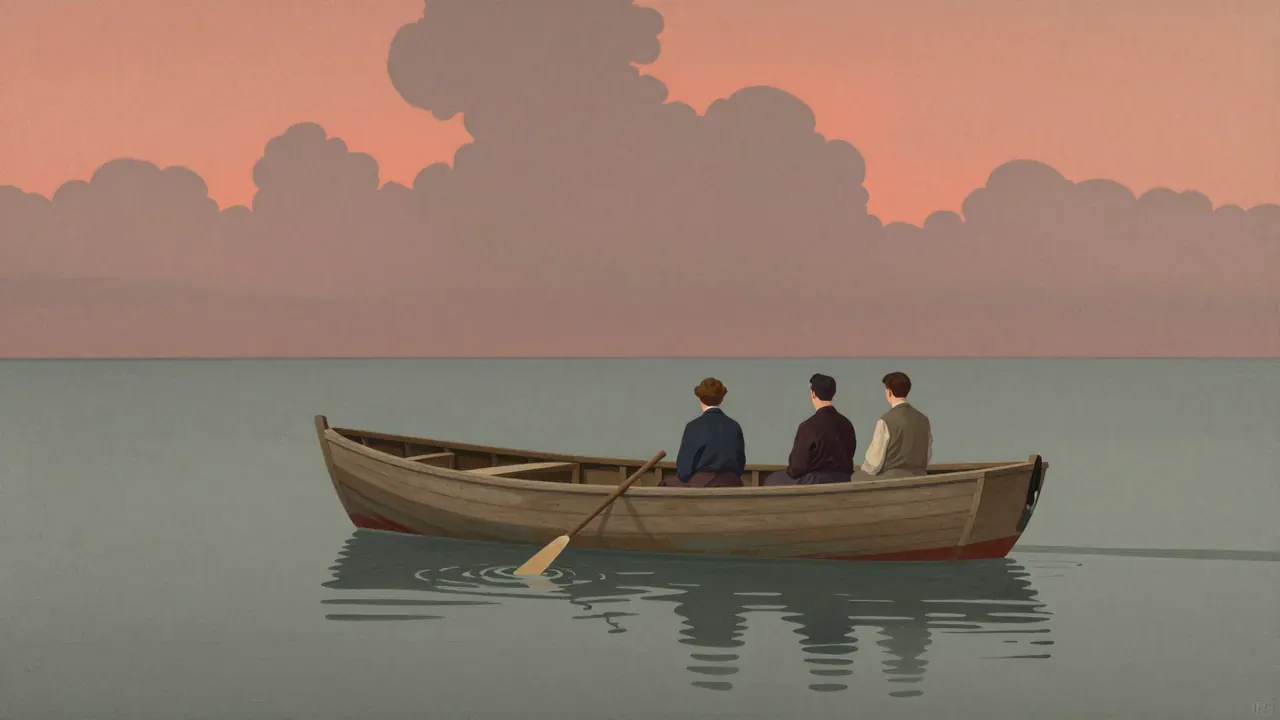
Limite is a silent, experimental feature film made in Brazil in 1930 and released in May 1931. It attempts to render psychological interiority through image, rhythm, and montage rather than narrative exposition or character psychology as conventionally understood. Mário Peixoto conceived it from a single photograph by André Kertész — two male hands around a woman’s neck — and built the film as a sequence of associative, emotionally charged tableaux. There are no named characters, no dialogue titles beyond minimal intertitles, and no linear cause-and-effect plot. Instead, the film holds three figures adrift in a rowboat while their pasts surface as fragmented, non-chronological flashbacks. Its ambition is structural and perceptual: to make time, memory, and emotional exhaustion visible through editing, composition, and light. It does not seek to tell a story so much as to induce a state — one of suspension, repetition, and diminishing volition. The film’s silence is not absence but density; its slowness is methodical, not inert. It asks the viewer to attend to texture, duration, and recurrence as carriers of meaning. Word count: 148
The look of it
The film works through juxtaposition and restraint. Three central figures — a man and two women — occupy a small boat on open water; their physical stillness becomes the frame for internal movement. Flashbacks unfold without exposition: a seamstress escapes prison, another woman leaves an alcoholic husband, the man learns his lover had leprosy. These are rendered in stark, high-contrast images shot by Edgar Brasil, whose cinematography draws on German expressionism and French surrealism — deep shadows, oblique angles, close-ups held just past comfort. Mário Peixoto edited the film himself, using rhythmic cutting that recalls Soviet montage but without its ideological urgency. Performances are muted, gestural, anti-theatrical: faces register fatigue more than grief, resignation more than despair. There are no dramatic climaxes, only accumulations — of waves, of glances, of repeated motifs like hands, water, graves, sewing machines. The music — added later for screenings — functions as temporal punctuation, marking shifts between present drift and remembered rupture. Word count: 152
The weight of it
What lands is the film’s atmosphere of irreversible stasis. The opening shots — waves breaking, oars dipping, light catching water — establish a tempo that never accelerates and rarely varies. This consistency makes the flashbacks feel less like revelations and more like returns: familiar shapes reappearing in altered light. The visual grammar sustains weight without melodrama — a hand gripping a rail, a woman’s back turned to camera, a grave marker half-submerged in mist. These images hold their charge across decades because they refuse interpretation; they simply persist. The restoration’s grain and occasional instability do not distract but deepen the sense of fragility — both material and existential. Even the missing scene, replaced by an intertitle, reinforces the film’s preoccupation with absence and erosion. Limite’s power lies in how little it offers and how insistently it holds that offering: a sustained, unblinking gaze at the edge of endurance. It does not persuade; it occupies. Word count: 150
The silence of it
What does not land is any clear through-line of motivation or consequence. The characters’ pasts remain deliberately opaque — names, dates, locations withheld; causes flattened into gestures. For viewers accustomed to psychological causality or even symbolic coherence, this can read as evasion rather than discipline. The film’s resistance to explanation extends to its structure: flashbacks do not clarify the present situation, nor does the present explain the past. Some repetitions — of hands, of water, of seated figures — begin to feel procedural rather than resonant. The pacing, though intentional, tests thresholds of attention without always renewing the terms of engagement. A viewer expecting development, resolution, or even thematic synthesis may find the film withholding to the point of austerity. Its refusal of context is absolute, and that rigour, while admirable, leaves little room for entry points other than patience and tolerance for ambiguity. Word count: 149
The edge of it
The themes that matter are limit, repetition, and erasure. Not as abstractions but as physical conditions: the limit of breath, of light, of narrative legibility, of archival survival. Repetition appears in waves, in editing rhythms, in recurring gestures — hands clasping, turning away, resting — suggesting memory as loop rather than line. Erasure operates on multiple levels: the woman fleeing her record, the man losing his lover to disease and stigma, the film itself nearly lost to nitrate decay and political seizure. Limite treats identity as something worn thin by time and circumstance, not forged by choice. There is no redemption arc, no moral pivot — only the slow dissolution of agency into drift. The sea is neither metaphor nor setting but presence: indifferent, cyclical, unchanging. The film’s enduring resonance comes from how precisely it renders exhaustion not as a moment but as a medium — the element in which these figures, and the film itself, continue to float. Word count: 147
The audience for it
This film is for viewers who value formal rigour over narrative clarity, and who find emotional weight in duration, texture, and restraint. It suits those already attentive to silent cinema, avant-garde practice, or Brazilian modernism — particularly those familiar with Epstein, Dulac, or early Murnau. It is not for viewers who require character motivation, causal logic, or tonal variation. Those seeking catharsis, irony, or even consistent mood will likely disengage. A student of film history may find it indispensable; a casual viewer, alienating. Its cult status rests partly on its difficulty — not as obscurity for its own sake, but as fidelity to a vision where meaning resides in what is withheld, not what is shown. To find it accessible would require surrendering expectations of conventional storytelling altogether. Word count: 149
The time it takes
Yes, it is worth your evening — but only if you approach it as a durational object, not a story to be followed. Its 120 minutes ask for attention calibrated to rhythm and recurrence, not plot or performance. You will not leave with new information about the characters, but you may carry the afterimage of a hand on water, or the weight of silence between cuts. Those who dismiss it as pretentious or inert have not misread it; they have simply engaged on different terms. Its value lies in its singularity: no other Brazilian film of the era attempted this fusion of poetic abstraction and psychological gravity. To skip it is to miss a foundational articulation of cinematic subjectivity in Latin America. Its restoration and Criterion release confirm its stature — not as entertainment, but as a benchmark of what film can sustain without speech, without names, without resolution. Word count: 149