The look of it
Drive My Car is a Japanese drama film directed by Ryusuke Hamaguchi, adapted from Haruki Murakami’s 2014 short story and expanded with material from two other stories in the same collection. It attempts to hold grief, language, performance, and silence in sustained equilibrium — not as metaphors but as lived conditions. The film follows Yūsuke Kafuku, a Tokyo-based theatre director whose wife dies suddenly after he discovers her infidelity; two years later, he accepts a residency in Hiroshima to direct a multilingual production of Uncle Vanya, required to be chauffeured in his red Saab 900 Turbo. The film’s ambition lies in its refusal to resolve loss through catharsis or narrative closure. Instead, it treats rehearsal, driving, translation, and listening as forms of ethical practice — spaces where meaning accrues slowly, unevenly, and often wordlessly. Its structure mirrors theatrical process: repetition, variation, miscommunication, and gradual alignment. It does not seek to explain grief but to inhabit its duration, its repetitions, its silences between people who speak different languages — literally and otherwise. Word count: 158
The shape of the story
The story unfolds across three interwoven registers: domestic rupture, professional labour, and quiet companionship. Hidetoshi Nishijima’s performance as Yūsuke is restrained, internalised, never explanatory — his face registers change only in increments, over hours. Tōko Miura as Misaki Watari matches him in stillness, her reserve never coded as mystery but as self-protective habit. The script, co-written by Hamaguchi and Takamasa Ōe, builds tension not through plot turns but through withheld information and delayed revelation — Oto’s death arrives off-screen, Kōji’s confession unfolds over drinks without score or cutaways. Hidetoshi Shinomiya’s cinematography avoids flourish: compositions are frontal, unobtrusive, favouring medium shots and shallow focus that keep faces and hands legible but never emphatic. The car interior becomes a stage within a stage — fixed, enclosed, lit by ambient light through glass. Sound design privileges diegetic texture: rain on metal, engine hum, tape hiss, overlapping dialogue in Japanese, Korean, Mandarin, Tagalog, and Korean Sign Language. There are no flashbacks, no voiceover, no music cues to signal feeling. Word count: 159
What sticks
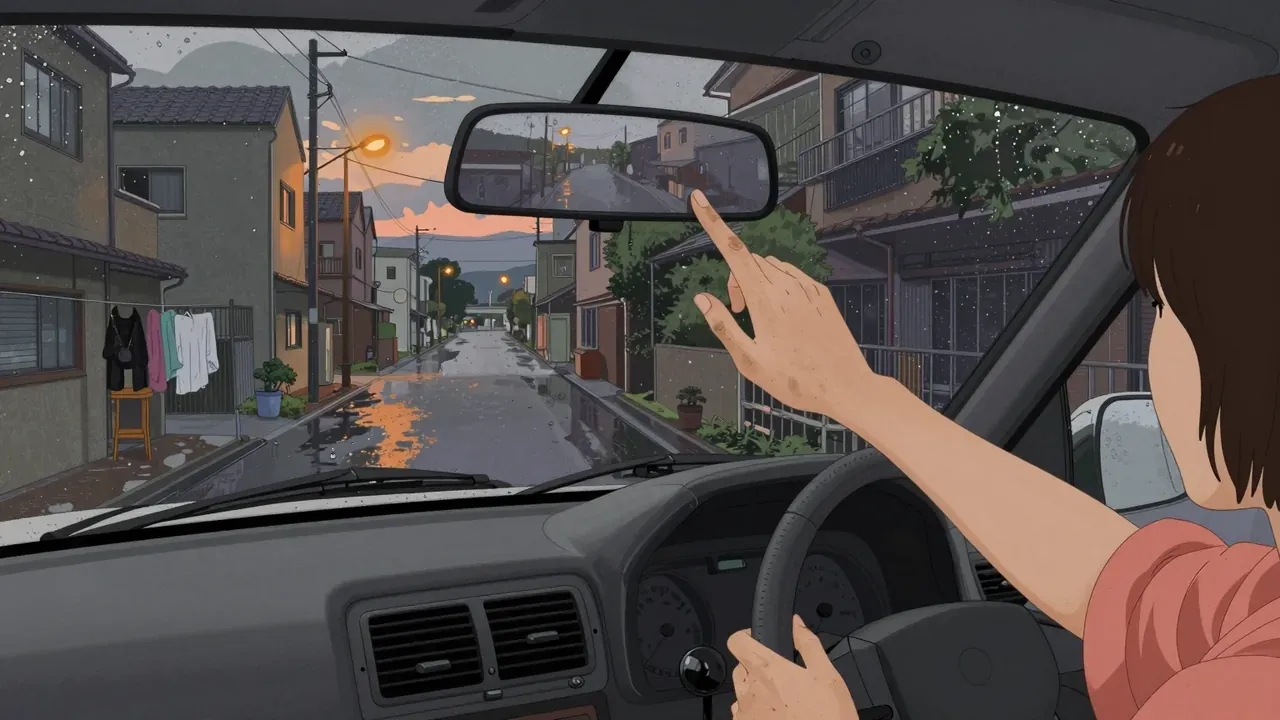
What lands is the accumulated weight of small, repeated gestures: Yūsuke listening to Oto’s voice on cassette while driving; Misaki adjusting the rear-view mirror before starting the engine; actors rehearsing lines they do not fully understand, trusting rhythm over meaning; the way smoke curls from cigarettes held through the sunroof. These are not symbolic moments but functional ones — habits that hold time steady when memory threatens to collapse it. The multilingual Uncle Vanya works not as spectacle but as structural necessity: each actor speaks their own language, yet the text binds them. This formal choice makes linguistic difference visible without exoticising it — no subtitles for sign language, no glossary for dialects, just presence. The film trusts the viewer to follow emotional logic before semantic clarity. Even the glaucoma diagnosis — a physical vulnerability introduced early — pays off not in medical drama but in how Yūsuke’s narrowing field of vision quietly reshapes his attention, making him more attuned to Misaki’s hands on the wheel than to the road ahead. The final rehearsal does not resolve grief but redistributes it — into shared labour, into listening, into the space between one line and the next. Word count: 157
Where it lets go
What does not land is the late-dinner sequence involving Gong Yoon-su’s wife, which introduces a new character and backstory without sufficient grounding or narrative return. It feels like an unassimilated fragment from Murakami’s source material — emotionally charged but structurally adrift. Similarly, the subplot around Kōji’s photo-scolding incident remains isolated: it signals vanity or shame but does not connect to the film’s central concerns with performance, authenticity, or repair. The film’s patience is its strength, but it also means some threads are left dangling not as ambiguity but as omission — moments that gesture toward psychological depth but lack the surrounding detail to make them resonate. A few scenes in the Hiroshima theatre offices feel procedural rather than revealing, their bureaucratic tone at odds with the film’s prevailing intimacy. These are not flaws in execution but limits of scope: the film chooses to deepen certain relationships — Yūsuke and Misaki, Yūsuke and Oto’s memory, Yūsuke and the text — at the expense of others. Those expecting narrative symmetry or psychological exposition may find these gaps frustrating rather than deliberate. Word count: 156
What it’s really about
The themes that matter are not abstraction but practice: how people rehearse themselves into being, how language both connects and isolates, how silence functions as consent, resistance, or care. Grief here is not a state but a set of habits — listening to tapes, driving the same route, repeating lines until they settle in the body. The film treats acting not as deception but as embodied truth-telling: Lee Yoo-na’s signing, Kōji’s vocal delivery, Yūsuke’s direction — all are forms of translation, of making inner life legible across barriers of language, culture, or trauma. Memory is not retrieved but re-enacted: Oto’s stories live in Yūsuke’s ear, then in the car’s speakers, then in the mouths of actors who have never met her. The red Saab is not a symbol of loss but a container — for sound, for speech, for time measured in kilometres and cassette minutes. The film’s most persistent idea is that healing is not arrival but continuation: showing up, speaking, listening, driving, rehearsing — even when you do not believe the words. Word count: 159
Who it’s for
This film is for viewers who accept that duration is part of meaning — those willing to sit with long takes, untranslated dialogue, and emotional shifts that arrive only after several minutes of stillness. It suits readers of literary fiction, theatre practitioners, language learners, and anyone who has ever grieved without knowing how to name it. It is not for those who require narrative propulsion, clear cause-and-effect, or emotional signposting. Some will find its pace inert rather than contemplative; others may mistake its restraint for detachment. Those who expect adaptation to prioritise plot over texture, or who rely on music or editing to cue response, will likely disengage before the first hour ends. The film assumes competence — in attention, in tolerance for ambiguity, in willingness to hold multiple languages in the same frame without translation. That assumption is not elitist but practical: it reflects how people actually live in multilingual, grieving, working worlds. Word count: 159
Is it worth your evening
Yes, it is worth your evening — if you have 179 minutes to give without expectation of payoff, only presence. It repays attention not with revelation but with recalibration: after watching, ordinary silences feel thicker, ordinary drives more charged, ordinary rehearsals more urgent. It asks nothing of the viewer but time and attention, and returns a subtle shift in how you listen — to voices, to engines, to pauses. Those who dislike it tend to cite its length or its refusal to explain itself, but neither is a flaw in context: the runtime matches the duration of real mourning, and the opacity mirrors how grief resists summary. A viewer who needs closure, catharsis, or moral resolution will leave unsatisfied — and rightly so, because the film is not offering those things. Its value lies in what it holds open, not what it fills. Word count: 159