The intention behind it
Medea is a 1969 Italian film directed by Pier Paolo Pasolini, adapting Euripides’ tragedy not as literary translation but as archaeological re-enactment of mythic consciousness. It treats the story not as psychology or moral drama but as ritual sequence — a series of sacred thresholds crossed, each marked by landscape, costume, and sound. Pasolini avoids classical Greek staging; instead, he locates Colchis in Cappadocian rock-cut churches, Corinth in Aleppo’s citadel, Iolcus in Pisa’s white marble squares — treating geography as ideology. The film seeks no fidelity to ancient theatre but to what pre-rational belief might look like when enacted: human sacrifice not as horror but as agrarian necessity, dismemberment as fertility rite, exile as ontological rupture. Its ambition is structural and anthropological: to strip the myth of Hellenistic rationalism and restore its archaic weight. This is not storytelling for comprehension but for immersion in a worldview where magic is physics and vengeance is liturgy. The film does not ask whether Medea is justified — it asks what world makes her action inevitable. Word count: 148.
The look of it
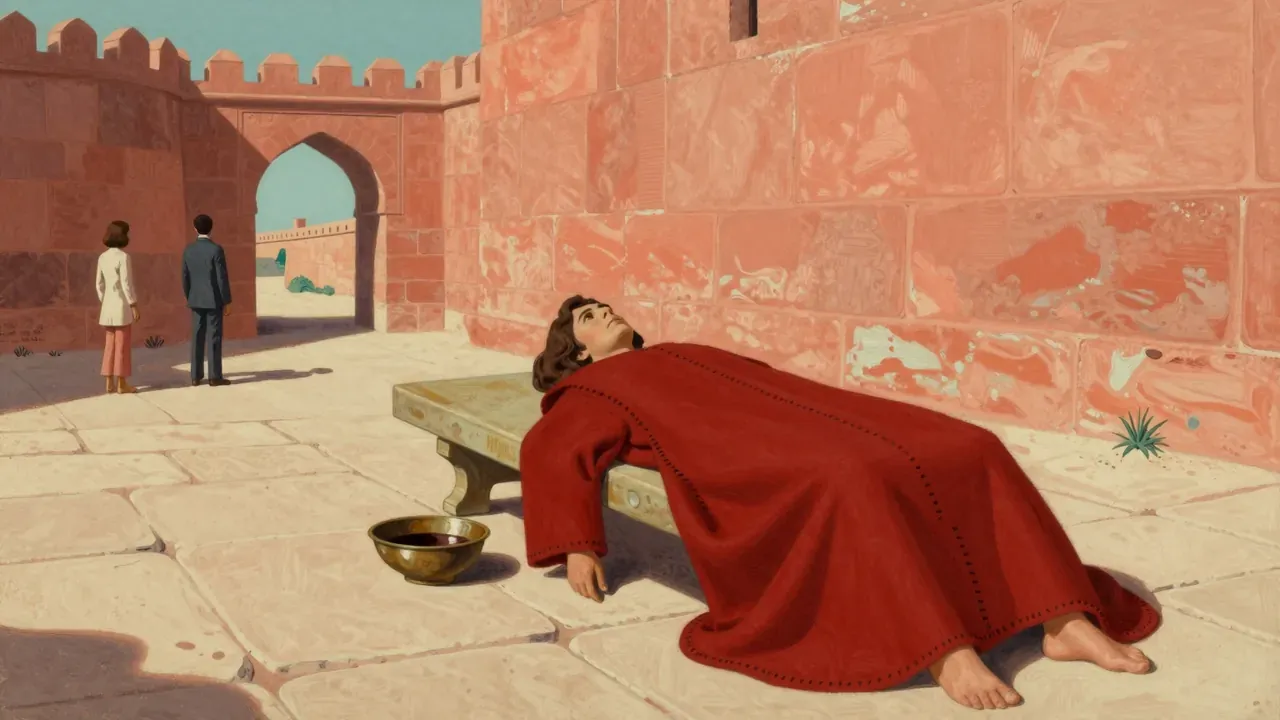
The narrative follows Euripides’ arc but compresses exposition into visual grammar: Ennio Guarnieri’s cinematography holds long takes on Callas’s face as if reading hieroglyphs, while Dante Ferretti’s production design isolates each civilisation by colour — Colchis in ochre and indigo, Iolcus in chalk-white austerity, Corinth in Pontormo-red intensity. Piero Tosi’s costumes reinforce this: Medea’s garments shift from layered earth-tones to stiff, pale Greek drapery, then to crimson ceremonial robes before the murders. Callas, in her only film role, performs with operatic stillness — voice rarely raised, gesture minimal, presence monumental. Her Medea speaks little Italian; her authority resides in gaze, posture, duration. Laurent Terzieff’s Chirone appears twice — first as centaur, then as man — a visual motif for Jason’s internal schism. The editing by Nino Baragli avoids continuity logic: cuts land on silence, not reaction; transitions follow ritual rhythm, not cause-and-effect. Music is sourced from Tibetan chant, Persian santur, Balkan female choirs — not diegetic but atmospheric archaeology. Word count: 152.
The weight of it
What lands is the film’s unblinking commitment to Medea as force of nature rather than character study. Her murder of the children is not psychologised but ritualised: the offscreen stabbings, the bloody knife held in frame, the separate beds laid out with funereal precision — all deny catharsis and demand witness. The landscapes do their work: Göreme’s volcanic caves make Colchis feel primordial; Aleppo’s fortress walls render Corinth implacably hierarchical; Pisa’s Piazza dei Miracoli becomes a stage for civic betrayal. Callas’s physicality — her broad shoulders, deep-set eyes, deliberate gait — embodies a dignity that precedes language. The soundtrack’s non-Western sources avoid exoticism by refusing integration: Tibetan chants do not ‘accompany’ scenes but occupy them as parallel realities. When Medea bathes her sons, the Balkan chorus swells not to heighten emotion but to mark the moment as liturgical. These choices cohere: the film’s power lies in its refusal to explain, its insistence on the myth as lived structure rather than symbolic allegory. Word count: 150.
The gap in it
What does not land is the film’s middle stretch — Jason’s drift from Colchis to Corinth — which feels narratively adrift rather than deliberately elliptical. Giuseppe Gentile’s Giasone lacks the gravitational pull needed to anchor Medea’s descent; his performance remains illustrative, never inhabited. The doubling of Chirone — centaur and man — is conceptually sharp but visually underdeveloped, its philosophical weight unearned by screen time. Some ritual sequences, particularly the sparagmos in Colchis, risk abstraction without sufficient grounding in bodily consequence: the blood on crops reads as tableau, not terror. The film’s resistance to psychological motivation occasionally tips into opacity — Medea’s spiritual crisis in Greece is signalled by her inability to touch soil, but the visual metaphor lacks tactile reinforcement. The score’s cultural sourcing, while intellectually rigorous, can flatten emotional texture: Persian santur music underscores political negotiation without distinguishing threat from ceremony. These are not failures of craft but of calibration — moments where Pasolini’s anthropological rigour outpaces dramatic legibility. Word count: 154.
The idea in it
The themes that matter are civilisational rupture, the violence of assimilation, and the erasure of embodied knowledge. Medea’s tragedy is not jealousy but displacement: her magic fails not because it is false but because it requires a world that believes in blood-as-fertiliser, dismemberment-as-harvest, exile-as-sacrifice. The film frames Greek rationality not as progress but as amputation — the severing of human life from cyclical, sacrificial time. Corinth’s red walls are not merely aesthetic but ideological: they enclose a society that has replaced ritual with law, blood with contract, prophecy with politics. Medea’s final act — killing her sons and burning the house — is neither madness nor revenge but a last assertion of sovereignty over meaning: if the new world denies her cosmology, she will erase its future within her own terms. The film treats motherhood, marriage, and kingship not as social roles but as sacred offices, each with its own liturgical grammar. This is not a film about gender but about epistemology: whose knowledge counts, and at what cost. Word count: 149.
The viewer for it
This film is for viewers who treat cinema as archaeology — those willing to sit with silence, absorb non-narrative rhythm, and accept that some emotions are expressed through costume colour or chant pitch rather than dialogue. It rewards patience with texture, not plot. It is not for those who require psychological continuity, clear motivation, or conventional pacing — viewers expecting a character-driven tragedy will find its architecture alienating. Those who dislike non-diegetic music that refuses to ‘support’ emotion, or who expect ancient myth to be rendered with classical restraint, will reject its visceral rawness. A viewer who values Maria Callas’s vocal authority but finds her physical stillness inert may leave unmoved. The film’s value shifts entirely depending on whether one accepts its premise: that myth is not story but system. Change that premise — insist on realism, psychology, or narrative propulsion — and the film collapses. Word count: 150.
The time for it
Yes, it is worth your evening — but only if you watch it as an artefact, not entertainment. Its 110 minutes unfold with the weight of liturgy, not momentum; its rewards are cumulative, sensory, architectural. You will not forget the image of Medea standing amid flames, refusing burial rites, or the way the camera lingers on cracked earth after the fleece is stolen. It is not ‘enjoyable’ in the usual sense, but it is unforgettable in its conviction. Those who prefer accessible adaptations — like the 1988 NBC version or Euripides on stage — may find it forbidding. But for anyone curious about how myth lives in the body, in landscape, in sound before it lives in words, it repays close attention. Its endurance lies not in accessibility but in integrity: every choice serves the same idea. That idea is demanding, but never dishonest. Word count: 150.