The shape of grief
Exotica is a tightly wound chamber drama set almost entirely within the fluorescent hush of a Toronto strip club and its adjacent spaces — a tax auditor’s office, a piano-lit apartment, a pet store humming with caged birds. Atom Egoyan wrote and directed it as a structural striptease: scenes are withheld, reordered, and returned to only when their emotional weight can be borne. It does not aim to titillate, nor to indict, but to map how grief hollows out routine and reshapes intimacy. The film treats the club not as spectacle but as ritual space — where touch is forbidden, where attention is bought and rationed, where people perform stability while carrying private catastrophes. Its ambition lies in restraint: to hold Francis Brown’s silence longer than feels comfortable, to let Christina’s schoolgirl costume sit unresolved until context reassembles it, to make the audience feel the weight of what is unsaid between characters who speak carefully, if at all. It is a film about the architecture of mourning, built from withheld information and repeated gestures — the turning of a key, the tuning of a piano, the counting of cash under red light.
The look of it
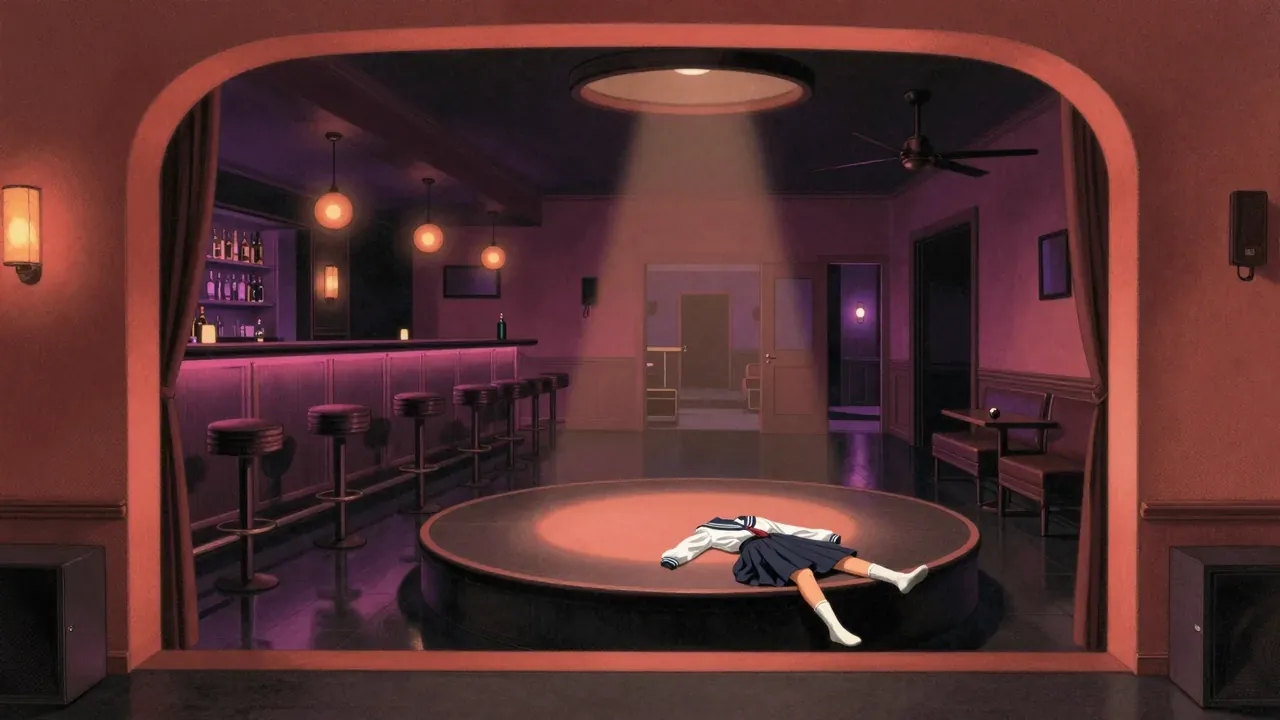
The story unfolds across three interlocking timelines — Francis’s present visits to Exotica, his past with his daughter Lisa, and Thomas’s smuggling operation — stitched together by Susan Shipton’s precise, unhurried editing. Paul Sarossy’s cinematography keeps the club interiors bathed in amber and violet, the camera often hovering just behind shoulders or framing characters through doorways and glass, as if observing from the perspective of someone absent. Mychael Danna’s score blends Indian classical instrumentation with minimalist repetition, underscoring emotional stasis rather than momentum. Performances avoid catharsis: Bruce Greenwood’s Francis is physically still, his face rarely betraying more than fatigue; Mia Kirshner’s Christina moves with quiet agency, never playing victim or seductress; Elias Koteas’s Eric carries resentment without melodrama. Arsinée Khanjian, pregnant during filming, grounds Zoe’s authority in weary pragmatism. There are no monologues that explain; everything is implied through duration, proximity, and what characters choose not to do — like Francis’s hand hovering inches from Christina’s back before pulling away.
What lands
What lands is the film’s refusal to simplify its characters’ motives. Francis’s fixation on Christina reads at first as pathological, then gradually resolves into something tender and shared — a pact between two people who witnessed the same unspeakable loss. The scene where Christina tells Thomas, over a lap dance, that Francis ‘doesn’t want anything from me except to remember her’ lands with quiet force because it arrives without exposition or music swell. The club’s rules — no touching, no names, fixed durations — become moral grammar: they define boundaries that protect, rather than suppress. The final confrontation outside Exotica works not because it delivers violence, but because it collapses distance: Eric’s revelation that he and Christina found Lisa’s body is delivered flatly, without score or close-up, making Francis’s embrace feel earned, not sentimental. The film’s emotional logic holds because every gesture, every cut, every silence serves the central idea — that trauma reshapes time, and memory is not recovered but re-entered, slowly, through shared ritual.
What does not
What does not land is the subplot involving Thomas Pinto’s illegal bird-smuggling operation. Though visually distinct — the humid, feather-strewn back room of his pet shop contrasts sharply with Exotica’s dry neon — it functions more as narrative scaffolding than thematic counterpart. Thomas himself remains underwritten: his motivations, his relationship to risk or guilt, are sketched but not deepened. His role as Francis’s reluctant accomplice feels structurally necessary but emotionally thin, especially beside the lived-in tensions between Francis, Eric and Zoe. The blackmail sequence lacks moral friction — Francis’s coercion of Thomas is presented as inevitable, not interrogated. Likewise, Harold’s presence as Francis’s estranged brother and former lover of his wife exists largely to supply exposition about the car crash, rather than to develop its own emotional current. These elements serve the plot’s mechanics, but they do not resonate with the same psychological density as the club scenes, where every glance and pause has been calibrated to carry history.
The weight of silence
The themes that matter are ritual as survival, silence as testimony, and the ethics of witnessing. Exotica treats the strip club not as a site of exploitation alone, but as a place where regulated performance allows unregulated grief to persist — where Christina’s uniform is both costume and shield, where Francis pays for time he spends remembering, not desiring. The film asks what it means to hold space for another person’s pain without fixing it: Zoe runs the club with maternal control; Eric channels his guilt into vigilance; Thomas, though peripheral, offers Francis a way back in — not through forgiveness, but through complicity. Grief here is not linear but recursive, returning in the rhythm of a DJ’s mix, the chirp of a macaw, the repetition of a piano phrase. The film also examines how institutions — Revenue Canada, the justice system, even the club’s own bylaws — impose order on chaos, while individuals quietly subvert them to preserve fragile connections. There is no healing, only endurance made visible through habit.
Who sits with it
It is for viewers who tolerate ambiguity, who find tension in stillness, and who trust that emotional weight accumulates in glances, silences and off-screen space. It suits those familiar with Canadian arthouse cinema of the 1990s — Egoyan’s contemporaries like David Cronenberg or Denys Arcand — or those drawn to films where plot serves character rather than vice versa. It is not for viewers who require narrative propulsion, clear moral positions, or resolution that feels earned through action rather than understanding. Those expecting an erotic thriller — as Miramax marketed it — will find little heat and no payoff in that register. Nor will those seeking social critique of strip clubs as institutions: the film declines to judge the club’s economics or ethics, focusing instead on its function as psychic infrastructure. A viewer who values exposition over implication, or catharsis over accumulation, would likely find it withholding to the point of opacity.
Is it worth your evening
Yes, it is worth your evening — not as diversion, but as immersion. Its 104 minutes pass with the quiet insistence of a metronome, each scene calibrated to deepen rather than advance. You leave not with answers, but with a recalibrated sense of how people hold sorrow without breaking. It rewards attention to texture: the grain of vinyl on the club’s sound system, the way light catches dust motes above the dance floor, the slight tremor in Francis’s hand as he counts change. Some will call it cold; others will recognise its warmth as the kind that only comes from refusing sentimentality. It is not for everyone — those who need closure, explanation or momentum may feel stranded. But for those willing to sit with discomfort, to accept that some wounds do not scar but settle, Exotica offers a rare kind of emotional fidelity. Its power lies not in what it says, but in how long and how carefully it lets you look.