The look of it
The Comfort of Strangers is a psychological drama adapted from Ian McEwan’s 1981 novel, with a screenplay by Harold Pinter and direction by Paul Schrader. It attempts to translate the novel’s quiet dread into cinematic form: not through plot mechanics or suspense tropes, but through sustained unease, architectural disorientation, and the slow erosion of social boundaries. The film treats Venice not as a postcard location but as a stage for ritualised encounter — a city where surfaces gleam, corridors narrow, and hospitality curdles without warning. Its ambition lies in sustaining ambiguity: Robert and Caroline are never psychologised, their motives left unanchored to motive or history beyond anecdote. This is not a thriller that asks ‘what happens next?’ but one that asks ‘why does this feel wrong before anything happens?’ It seeks to make the viewer share Mary’s dawning disorientation — not as a puzzle to solve, but as a physiological response to tone, pacing, and withheld information. The film’s project is austere, deliberate, and rooted in literary restraint rather than genre expectation. (158 words)
The weight of silence
The story unfolds in measured, repetitive loops: getting lost, being offered shelter, waking disoriented, returning to the same spaces under altered conditions. Natasha Richardson modulates Mary’s shift from curiosity to paralysis with minimal inflection; Christopher Walken holds Robert’s charm and menace in equilibrium, never tipping into caricature. Rupert Everett’s Colin carries a quiet, unexamined entitlement that makes his vulnerability credible. Dante Spinotti’s cinematography avoids Venice’s postcard angles: he frames interiors with shallow depth, keeps corridors tight, lets light pool narrowly on faces while leaving doorways and corners in near-black. Angelo Badalamenti’s score is sparse — low strings, isolated piano notes — never underscoring action but thickening silence. Bill Pankow’s editing sustains duration without slackness: scenes breathe, but never drift. There are no flash cuts, no subjective distortions — the horror arrives through accumulation, not rupture. The craft is unified in its refusal to explain, trusting the weight of gesture, pause, and spatial logic over exposition or climax. (159 words)
The photographs on the wall
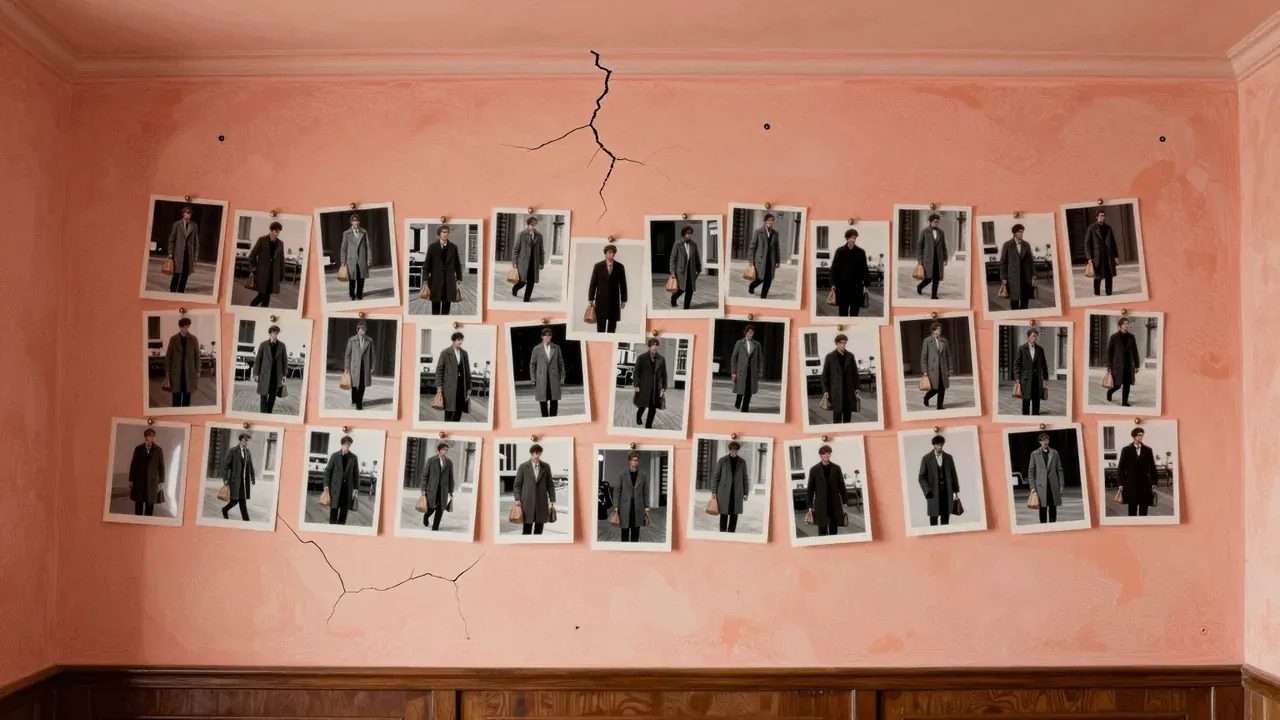
What lands is the film’s atmosphere of inescapable intimacy — the way Robert and Caroline’s apartment feels both opulent and claustrophobic, how their hospitality becomes indistinguishable from surveillance, how Mary’s vertigo reads less as symptom than as narrative pivot. The photographs of Colin, pinned to bedroom walls without comment, land with chilling precision: they are not evidence of obsession but of methodical attention, made more unsettling by their ordinariness. The final act’s violence is not shocking in its suddenness but in its banality — the razor drawn not in fury but as routine, the embrace that follows not triumphant but weary, almost domestic. The film’s refusal to moralise or diagnose its antagonists gives them weight; they are not monsters but people who have settled into a shared rhythm of control and submission. This coherence of tone — sustained across 104 minutes without concession to relief or explanation — is its strongest achievement. It trusts the viewer to sit with discomfort, and that trust is rarely broken. (157 words)
The couple who do not react
What does not land is the film’s structural passivity. Colin and Mary remain underwritten to the point of opacity: their relationship lacks texture beyond exposition, their decisions lack psychological scaffolding, and their passivity begins to read less as realism and more as narrative abdication. The film assumes the viewer will accept their inertia as plausible, but it offers little beyond habit or fatigue to justify it. Robert’s anecdotes about his father and sisters accumulate without resonance — they are not character revelations but decorative motifs, repeated without variation or consequence. The Venice setting, though visually controlled, never acquires symbolic weight beyond generic foreignness; its specificity feels aesthetic rather than functional. Some viewers will find the pacing inert rather than deliberate, mistaking restraint for emptiness. The ending’s circularity — Robert restarting his father story for the police — risks feeling like a tic rather than an insight, especially when the preceding two hours have offered no counterpoint to that pattern. The film’s austerity becomes, for some, austerity without purpose. (156 words)
The logic of the apartment
The themes that matter are the seduction of surrender, the architecture of consent, and the banality of violation. It examines how power operates not through force alone but through invitation, repetition, and the slow recalibration of what feels normal. Robert and Caroline do not coerce — they accommodate, observe, mirror, and wait. Their violence is preceded by weeks of curated proximity, making it feel less like rupture and more like culmination. The film also interrogates English reserve as complicity: Colin and Mary’s politeness, their reluctance to name discomfort, their deference to local custom — all become vectors for entrapment. There is no grand ideology at work, only the quiet, iterative logic of dominance rehearsed until it becomes invisible even to those enacting it. The film refuses to locate evil in aberration; instead, it shows how cruelty can be domesticated, how sadism can be mistaken for intimacy, how surveillance can masquerade as care. These are not abstract ideas but embodied behaviours, enacted in rooms, on streets, over tea. (158 words)
Who sits with it
This film is for viewers who value tonal precision over narrative payoff, who find unease more compelling than excitement, and who trust cinema to work through implication rather than explanation. It suits those familiar with Pinter’s pauses, Schrader’s ascetic framing, or McEwan’s clinical prose — readers and viewers accustomed to withholding as a mode of engagement. It is not for those who require clear motivation, emotional catharsis, or moral resolution. Anyone expecting a conventional thriller will find it inert; anyone needing psychological clarity from its characters will leave frustrated. Those who dislike long takes, static compositions, or dialogue that circles without landing may find it exhausting. A viewer who values character-driven momentum or thematic transparency would reasonably reject it — the verdict rests on whether one finds sustained ambiguity generative or evasive. Change the pacing or add interior monologue, and the film’s logic collapses; its success depends entirely on accepting its terms. (159 words)
The last ten minutes
Yes, it is worth your evening — but only if you approach it as a study in controlled unease, not as entertainment. Its 104 minutes ask for patience, not distraction; its rewards are cumulative, not immediate. You will not leave exhilarated, but you may leave unsettled in a way that lingers — not because of gore or jump scares, but because of how thoroughly it maps the grammar of discomfort. Those who dismiss it as ‘slow’ or ‘cold’ are not wrong, but they are measuring it against different criteria. Its value lies in its consistency: every frame, line, and silence serves the same proposition. To call it ‘unrewarding’ is to misunderstand its design. It is not indifferent to the viewer — it simply demands a different kind of attention. If you have sat with a Pinter play or watched a Tarkovsky sequence and felt time rearrange itself, this film will meet you there. Its worth is conditional, but the condition is clearly stated from the first shot. (159 words)