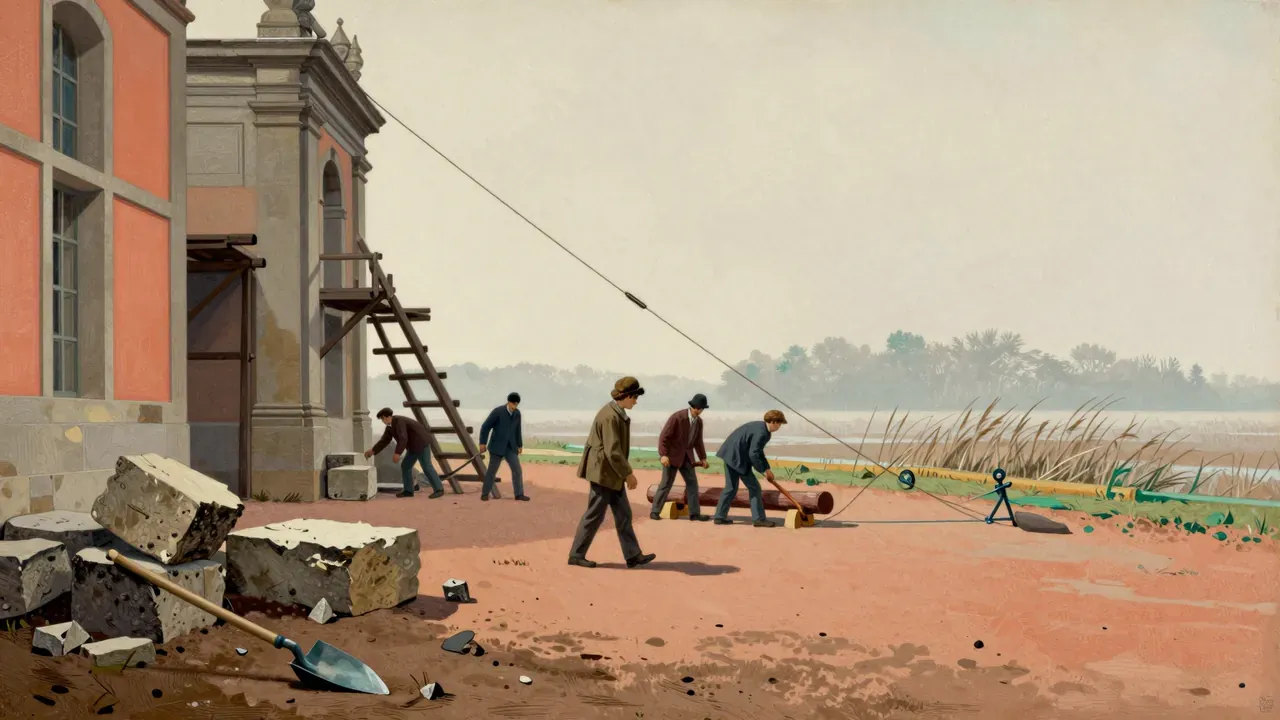
The shape of power
The Taking of Power by Louis XIV is a French television film made in 1966, directed by Roberto Rossellini as part of his late-career turn to historical subjects. It attempts neither spectacle nor psychological portraiture, but a methodical reconstruction of political process: how absolutism was not declared but assembled — through paperwork, ceremony, spatial control, and the quiet neutralisation of rivals. Its ambition is pedagogical, not dramatic: to show power not as charisma or force, but as administrative habit, ritual repetition, and the deliberate substitution of appearance for substance. Rossellini works from documented episodes — Mazarin’s deathbed manoeuvres, Fouquet’s arrest, the early Versailles court — and treats them as nodes in a system rather than climaxes in a narrative arc. The film assumes no prior knowledge of the Fronde or Colbert’s reforms, yet refuses exposition; it expects attention to gesture, scheduling, and silence. It is less about Louis XIV as man than Louis XIV as office — an institution being built in real time, with paper, pastry, and protocol. Word count: 148
The look of it
The story unfolds in strict chronological sequence, anchored by bureaucratic milestones: council meetings, tax decrees, building contracts, arrests. Raymond Jourdan plays Louis with minimal inflection, his delivery flat and uninflected, as if reading minutes aloud. This is not failure but design: Rossellini cast non-professionals deliberately, and Georges Leclerc’s cinematography keeps the lighting even, the framing static, the camera at medium distance. There are no close-ups on tears or clenched fists; instead, long takes follow platters through corridors or linger on hands signing documents. Dialogue is functional, often dry — negotiations over grain tariffs or seating arrangements carry the same weight as declarations of loyalty. Costume and set are accurate but unglamorous; the Palace of Versailles appears not as gilded fantasy but as scaffolding and damp stone. The editing avoids rhythm or emphasis, favouring duration over punctuation. Even Mazarin’s death scene is stripped of pathos: he applies powder, speaks plainly, and expires without music or cutaway. Word count: 152
The weight of procedure
What lands is the cumulative weight of procedure. The film makes visible how authority migrates not through speeches but through who signs what, who waits where, and who serves whom first. The final banquet sequence — a ten-minute tracking shot through kitchens, corridors, and throne room — lands with quiet force because it is the logical endpoint of every earlier decision: centralised supply chains, codified etiquette, and the conversion of nobles into ceremonial functionaries. The viewer grasps, without being told, that Louis’s power rests not on fear alone but on the exhaustion of alternatives: once you live at Versailles, your income, your marriage prospects, your very identity depend on proximity to the king. The film’s austerity becomes its strength when applied to bureaucracy — the dullness of tax reform, the tedium of dress codes, the monotony of daily audiences all cohere into a portrait of systemic control. It does not persuade emotionally, but it convinces structurally. Word count: 150
The cost of clarity
What does not land is any sense of interior life or moral reckoning. Louis remains opaque not as a mystery but as a void: there is no hesitation, no doubt, no private moment that complicates his public role. The film’s refusal to psychologise extends to its supporting figures — Colbert is efficient, Fouquet arrogant, Mazarin pragmatic — but none are granted contradiction or contradiction-in-action. The flat performances, while intentional, occasionally flatten consequence: when Fouquet is arrested, the lack of reaction from courtiers feels like omission rather than restraint. The pacing, calibrated for television broadcast in 1966, sits uneasily with contemporary viewing habits; scenes of document sorting or inventory lists test patience without clearly signalling their thematic purpose. Some viewers will read this as rigour; others as inertia. The film assumes a tolerance for stillness and repetition that not all will share. Word count: 152
The grammar of ceremony
The themes that matter are not monarchy or ambition but administration as aesthetics, and ritual as infrastructure. The film treats Versailles not as a palace but as a regulatory device: its layout controls movement, its ceremonies allocate status, its feasts absorb surplus capital. Taxation, costume, cuisine, and architecture are shown as interlocking instruments of statecraft. Power here is not seized but sedimented — laid down in layers of precedent, regulation, and display. The film also traces the displacement of personal loyalty by institutional dependency: nobles do not submit out of awe, but because their pensions, titles, and marriages now require royal approval. It suggests that modernity begins not with revolution but with routinisation — the replacement of feudal obligation with bureaucratic necessity. The closing image of Louis eating alone while dozens watch is not irony but arithmetic: absolute power is the point at which the ruler no longer needs witnesses, only accountants. Word count: 149
The audience it presumes
This film is for viewers who value precision over propulsion — those who find tension in a ledger entry or drama in a seating chart. It suits historians, political theorists, and students of state formation who want to see power as process, not personality. It is not for those who rely on character arcs, emotional escalation, or visual flourish to sustain engagement. A viewer expecting grandeur or intrigue will find it austere to the point of asceticism. Those who dislike long takes, uninflected dialogue, or films that withhold interpretation will feel alienated. The film’s value lies in its refusal to flatter attention; it asks for sustained observation, not identification. Anyone who finds meaning in repetition, detail, and structural logic will respond. Anyone who requires narrative momentum or psychological revelation will not. Word count: 149
The verdict it delivers
Yes, it is worth your evening — provided you approach it as a study, not a story. Its 100 minutes accumulate like evidence: each scene adds another brick to the edifice of absolutism. It rewards attention not with payoff but with pattern recognition — seeing how a tax decree echoes in a ballroom step, how a kitchen hierarchy mirrors a council chamber. Those who dismiss it as dry miss that its dryness is its argument: power, in this telling, is dry. It is not for casual viewing, but it repays focused attention more reliably than most historical dramas. Anyone who has watched Scorsese’s The Age of Innocence and wondered how such formality became expressive will find the answer here. The film’s reputation has grown because its method — patient, anti-sentimental, materially grounded — feels increasingly rare and necessary. Word count: 149