A grandmother’s devotion to an obsessive cyclist
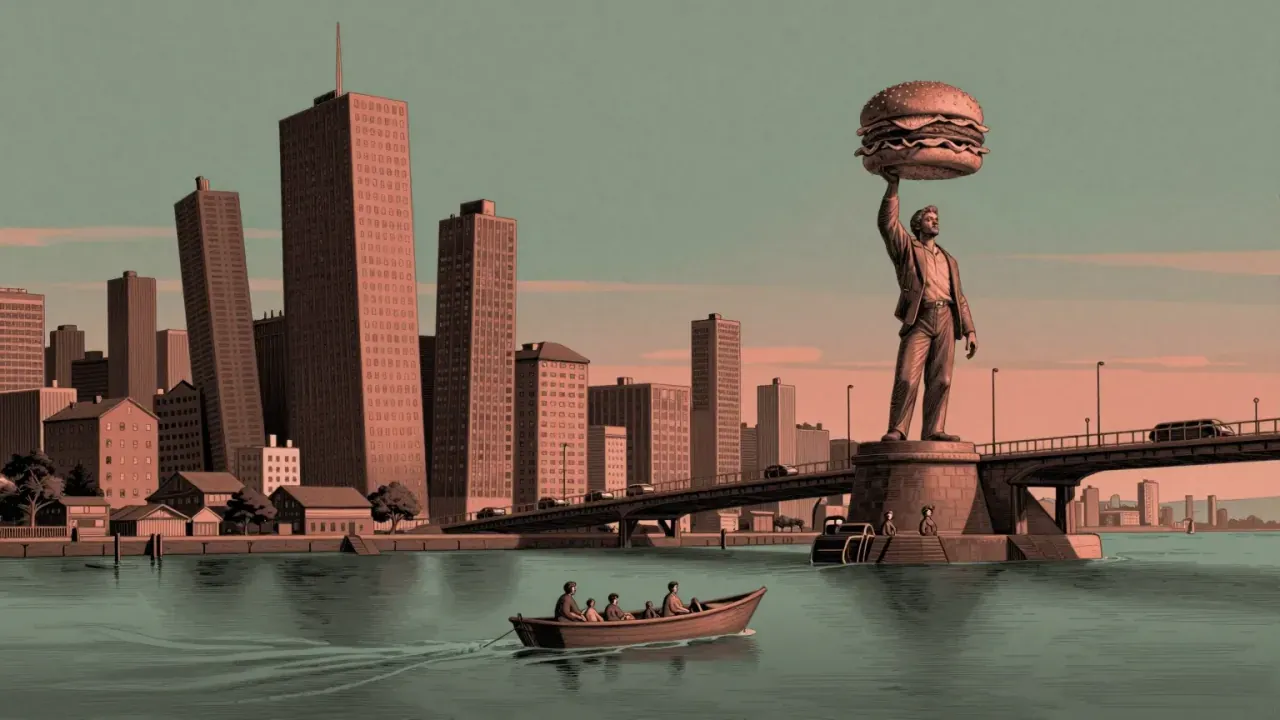
The Triplets of Belleville follows Madame Souza, an elderly Frenchwoman raising her grandson Champion, who becomes a competitive cyclist obsessed enough with the Tour de France that his grandmother reshapes her entire life around his training. When French gangsters kidnap Champion mid-race and ship him to the city of Belleville, an invented composite of New York, Montreal and Quebec City, Souza pursues him with only her wits and Champion’s overweight dog Bruno, eventually finding help from three elderly former music-hall stars, the Triplets, now scraping by on frog stew in a slum apartment. Sylvain Chomet directs his first feature, working with almost no spoken dialogue throughout.
Telling a plot almost entirely without dialogue
The decision to tell the story primarily through song, pantomime and exaggerated sound design rather than dialogue forces every character’s shape, walk and gesture to carry information a script would normally handle — Souza’s determination reads entirely through her posture and the tools she improvises along the way. Benoît Charest’s score, especially the Academy Award-nominated Belleville Rendez-vous, functions less as accompaniment than as the connective tissue holding sequences together where dialogue would usually bridge scenes. The animation style pushes bodies toward caricature well past naturalism — the Triplets’ spindly, ancient forms, Bruno’s rotund bulk, the impossibly narrow gangsters — without softening any of it for likability, a choice that helped make it the first PG-13-rated film nominated for the Best Animated Feature Oscar.
The scene where music replaces conversation
The Belleville sequence where Souza discovers she can make music by striking bicycle spokes, drawing the Triplets to her, plays as a complete scene without a word of explanation needed, and it does more to establish their friendship than any conversation could. The gambling-syndicate mechanism, chickens and bicycles rigged in-frame to power a betting operation, treats absurdity with total visual seriousness, which is what makes it funny rather than simply strange. Champion’s silent devotion to cycling, established almost entirely through the accumulation of objects — cutout photographs, a tricycle, an obsessive training regime — makes his grandmother’s sacrifice legible without a single line about what she’s given up.
Where the grotesque outpaces the clarity
The film’s commitment to visual grotesquerie occasionally outpaces its narrative clarity, and viewers unused to reading plot information through gesture and sound alone may find stretches of the Belleville-set middle section harder to follow than intended. The Triplets themselves, despite anchoring the film’s back half, remain relatively thin as individuals beyond their shared musical performance, more a unit than three distinct people. Bruno the dog, given real screen time early on for his singular fixation on barking at trains, is carried along for most of the journey mainly as company for Souza rather than as a character whose own arc develops any further once the chase begins.
Obsession without sentimentality
Obsession runs through every relationship in the film without much room for the sentimentality that usually accompanies it: Champion’s cycling consumes his entire personality, Souza’s devotion to him consumes hers, and the gangsters’ scheme to exploit cyclists for gambling profit is simply another version of the same monomania turned toward cruelty rather than love. The invented city of Belleville, stitched from three different North American cities, works as a specific joke about how European filmmakers have long flattened American cities into a single caricature of excess, obesity and organized crime, rather than as a generic fantastical setting. The nearly wordless storytelling itself becomes an argument that these obsessions don’t need to be explained, only shown.
Who the wordless storytelling suits
This suits viewers drawn to animation that pushes character design toward the genuinely grotesque rather than the cute, and anyone who enjoys a film willing to let visual storytelling and music do work usually assigned to a script. It also rewards audiences interested in how a low-budget, largely dialogue-free European animated film competed directly against Finding Nemo for an Oscar the same year. It’s a difficult recommendation for anyone who relies on dialogue to track plot mechanics, since several sequences ask you to infer relationships and motives purely from behavior.
Why 77 minutes of silence says enough
At 77 minutes, The Triplets of Belleville doesn’t ask for much of an evening, and a return well above its modest $8 million budget suggests a film built entirely outside mainstream animation conventions still found a real audience. Its César for Best Film Music and its Genie Award for Best Motion Picture point to a reception that took the film seriously as cinema rather than as a novelty. Worth the evening for the bicycle-spoke scene and the syndicate sequence alone, both of which demonstrate what’s possible once dialogue is taken off the table entirely.