The weight of the key
Ariel is a Finnish drama from 1988, the second in Aki Kaurismäki’s Proletariat Trilogy, and it sets out to trace the quiet collapse and stubborn reassembly of a working life after industrial abandonment. It follows Taisto Kasurinen — a miner displaced by closure in Lapland — as he moves south into Helsinki’s margins, not with ambition or rage but with a kind of dazed proceduralism. The film does not seek to diagnose systemic failure so much as register its texture: the hollow echo of a café after a suicide, the weight of a car key handed over like a last will, the silence between sentences when someone has nothing left to explain. Kaurismäki frames this not as tragedy but as drift — a slow-motion recalibration where dignity persists not through resistance, but through unembellished endurance. The film’s aim is neither satire nor uplift, but fidelity to a specific kind of defeat that still leaves room for cake, a saw, and a ship named Ariel. Word count: 132.
The look of it
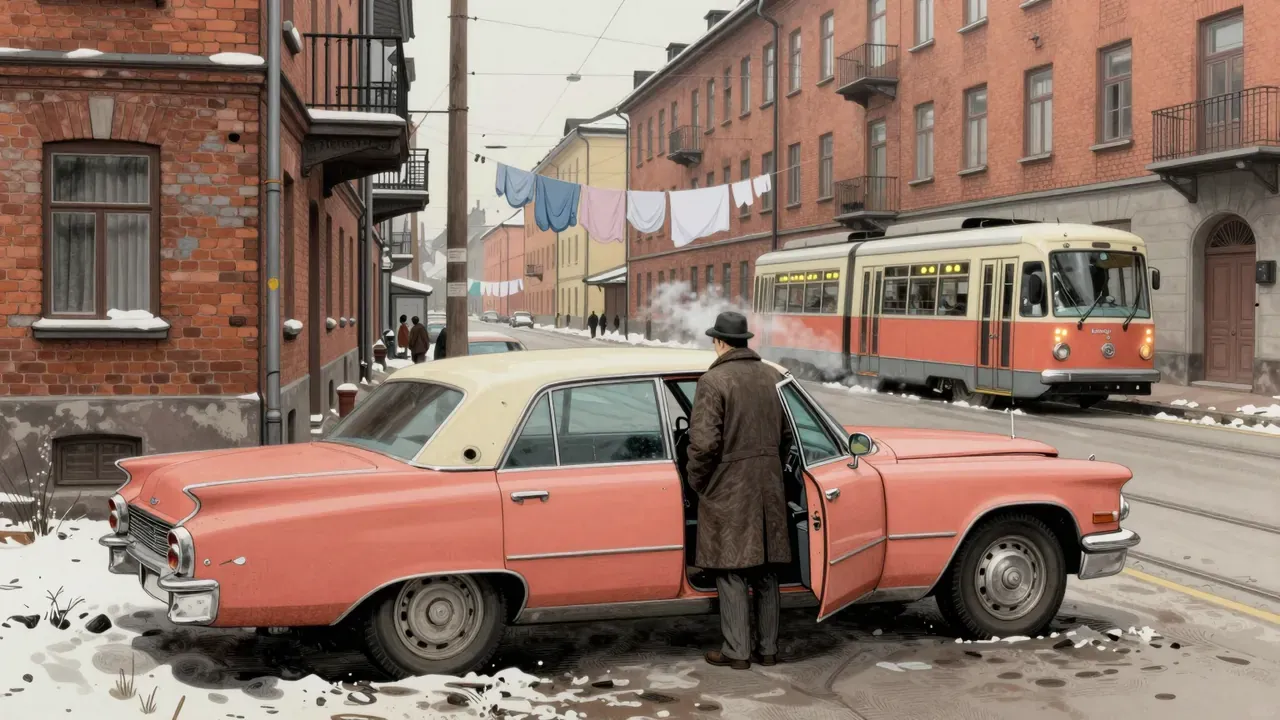
The story unfolds in flat, deliberate blocks: mine closure, suicide, road trip, mugging, labouring job, brief intimacy, eviction, arrest, prison, escape, bank robbery, murder, departure. Turo Pajala plays Kasurinen with minimal inflection — his face rarely opens, his voice rarely rises — and Matti Pellonpää’s Mikkonen matches him in stoic understatement. Timo Salminen’s cinematography holds interiors in low contrast, favouring muted greys and off-white walls; the 1962 Cadillac stands out not as glamour but as an anachronistic shell. William J. Casey’s score is sparse, mostly piano motifs that pause mid-phrase. Raija Talvio’s editing avoids transitions: scenes end on stillness, then begin again without explanation. There are no close-ups to cue emotion, no music swells to underline irony. The craft insists on withholding — not as austerity, but as method. Every choice serves the principle that what matters is not how a man feels, but what he does next. Word count: 147.
What lingers
What lands is the cumulative weight of small, unremarkable decisions made under eroded conditions: Kasurinen accepting Irmeli’s resignation from her job without comment; him sleeping in the Cadillac not out of romance but because he has nowhere else; the way he folds his coat before sitting in court. The film’s deadpan rhythm makes these moments legible as acts of agency, however diminished. The prison escape works not as thriller set-piece but as bureaucratic farce — the cake, the book, the saw — all delivered without fanfare. Even the final bank robbery feels less like crime than logistics: a means to an exit, not a statement. The ending — boarding the ship — lands because it arrives without catharsis or commentary, just three figures walking up a gangplank while the camera stays at dock-level. Nothing resolves, but something continues. That continuity, unadorned and unexplained, is the film’s strongest impression. Word count: 140.
Where the frame stays empty
What does not land is the attempted romantic pivot between Kasurinen and Irmeli. Their conversations lack reciprocity: she speaks of her ex-husband; he says only ‘I’m from the country’, and her reply — ‘that’s different’ — is left hanging, unexplored. Her sudden resignation, immediate bed-sharing, and swift acceptance of marriage feel narratively expedient rather than emotionally earned. The child with the gun is striking visually but remains a prop, not a character — his presence signals disruption but never develops into relationship. Likewise, the betrayal by the passport men arrives without prior setup; their motives and history are absent, making the violence abrupt rather than inevitable. These gaps do not break the film, but they leave certain emotional hinges loose — moments where the script assumes resonance that the performances and framing do not quite secure. Word count: 138.
The shape of the ground
The themes that matter are displacement without destination, work stripped of meaning, and solidarity as a series of small, reversible choices. Mining is not mythologised — it is simply gone, like a stopped clock. The city offers no promise, only lower rents and shorter shifts. Kasurinen’s journey is not upward or outward in any conventional sense; it is lateral, from one form of precarity to another. The film treats class not as identity but as condition: visible in the worn cuffs of Kasurinen’s coat, the institutional green of the hostel walls, the way food is portioned in the prison canteen. Even the Cadillac is less symbol than tool — unreliable, impractical, yet the only thing he owns that moves. The trilogy’s ‘proletariat’ label fits not because the characters articulate politics, but because their lives are shaped entirely by forces they did not choose and cannot name. Word count: 136.
Who it meets
This film is for viewers who tolerate long silences, distrust narrative payoff, and find emotional precision in withheld gesture — people familiar with Kaurismäki’s earlier work, or with Bresson, Ozu, or early Dardennes. It rewards attention to posture, duration, and negative space. It is not for those who require psychological exposition, causal clarity, or moral resolution. Someone expecting social realism may find the tone too detached; someone seeking dark comedy may miss the jokes altogether — there are none, strictly speaking. The verdict would shift if the film offered more texture in its secondary relationships, or if Irmeli’s character were given interiority beyond function. As it stands, its rigour is also its limit: it refuses to soften, explain, or enlarge itself for wider access. Word count: 139.
The gangplank
Yes, it is worth your evening — provided you arrive without expectation of momentum or revelation. Its seventy-three minutes pass without strain, anchored by Pajala’s stillness and Salminen’s steady light. You will not forget the image of Kasurinen smoking discarded cigarette butts, or the sound of the Cadillac’s engine cutting out on a Helsinki street. But it demands patience with repetition, comfort with ambiguity, and willingness to sit with outcomes that feel provisional rather than conclusive. Those who dislike films that treat suffering as atmosphere rather than plot will find it unrewarding. Its value lies not in what it says about Finland in 1988, but in how precisely it renders the mechanics of survival when all scaffolding has been removed. That specificity is rare, and worth the time. Word count: 142.