The logic of the pond
Demon Pond is a 1979 Japanese fantasy film adapting Izumi Kyōka’s 1913 stage play, directed by Masahiro Shinoda for Shochiku. It attempts a cinematic translation of kabuki’s stylised metaphysics into film language: not by literalising the supernatural, but by treating myth as structural logic — the pond’s dragon god, the bell’s daily toll, the princess’s dual embodiment — as binding narrative conditions. The film does not ask the viewer to believe in spirits, but to accept their presence as grammatical. Its ambition lies in sustaining that grammar across shifts between theatrical abstraction and cinematic naturalism, between rural realism and underwater surrealism, without collapsing either register into mere illustration. It works within the constraints of period Japanese studio production — optical composites, miniature floods, Moog-Debussy score — not as compromises, but as deliberate textures. This is not folklore rendered quaint or exotic; it is folklore treated as a system of cause and effect, where drought, suicide, and flood are not plot points but ritual consequences. The film’s project is formal and philosophical before it is narrative: to make belief operational, not illustrative. (158 words)
The body as text
The story follows a schoolteacher who arrives at a drought-stricken village bound by a bell-ringing pact with a dragon god, and becomes entangled in the fate of Yuri — a woman rumoured to be a sorceress, played by Kabuki onnagata Tamasaburo Bando in a dual role as both Yuri and the pond princess Shirayuki. Bando’s performance anchors the film: his Yuri is restrained, grounded, even hesitant; his Shirayuki is fluid, arch, physically expansive — a contrast achieved through posture, vocal timbre, and framing rather than costume or makeup. Cinematographer Masao Kosugi uses shallow focus and deliberate pacing, holding shots long enough for gesture to accrue meaning. Isao Tomita’s score separates land and water worlds via Debussy and Mussorgsky, filtered through Moog synthesis — not as mood-setting, but as sonic geography. Nobuo Yajima’s special effects rely on reversal, matte work, and miniatures, giving the flood an uncanny physicality: water rises because footage is reversed, not because it is digitally conjured. The five-act structure echoes kabuki, yet the kiss between husband and wife — absent from the stage version — asserts cinema’s different grammar of intimacy. (159 words)
The weight of water
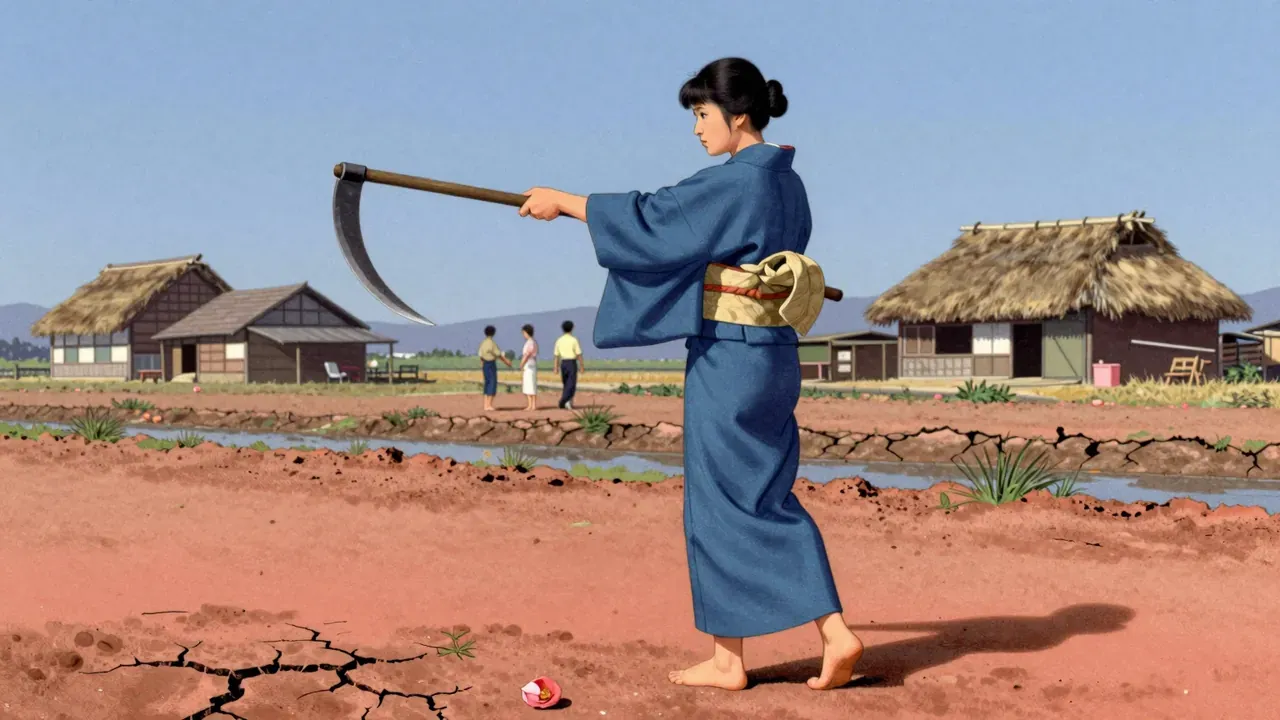
What lands is the film’s unwavering commitment to its own logic: the bell must ring, the pond must be appeased, the princess must wait — and when those conditions fracture, the collapse feels inevitable, not arbitrary. Bando’s duality works precisely because it refuses explanation: the two characters share no backstory, no mirror imagery, no voiceover linking them — yet their coexistence feels ontologically necessary. The flood sequence lands not through spectacle alone, but through its patient accumulation: first the cracked earth, then the priest’s hesitation, then the sickle’s glint, then the slow, reversed water column rising like breath drawn backward. Tomita’s score reinforces this: Debussy’s ‘La cathédrale engloutie’ appears not during the flood, but earlier, as a premonition in the teacher’s mind — a musical echo before the event. The villagers’ panic feels less like mob psychology than ritual failure made visible. Even the optical composites — blue-screened spirits against painted backdrops — gain weight from repetition and restraint: they are never hidden, never polished, and thus never pretend to be real. They are icons, not illusions. (157 words)
Where the bell does not ring
What does not land is the film’s occasional over-reliance on symbolic weight without sufficient dramatic friction. The Diet Member and village leaders remain types rather than individuals, their corruption gestured at but rarely dramatised — their authority asserted through title cards and stiff delivery rather than action or contradiction. The schoolteacher’s moral centrality is underwritten: he observes, intervenes once, survives, and departs — but his interiority remains opaque, his motivations unexamined beyond duty and friendship. Some transitions between acts feel abrupt, particularly the shift from dry-land realism to underwater fantasy, where the rules of movement and time loosen without clear narrative cue. The Moog synthesiser occasionally overwhelms the Debussy arrangements, flattening their harmonic nuance into texture rather than counterpoint. And while Bando’s gender performance was noted by Western reviewers as ‘unnoticeable’, that observation says more about their expectations than the film’s construction: the camera treats him as Yuri and Shirayuki with equal seriousness, but does not interrogate the social mechanics of that doubleness — it accepts it, rather than explores its implications. (156 words)
The depth of time
The themes that matter are covenant and consequence: the bell is not superstition but contract, the drought not misfortune but breach, the flood not punishment but restitution. The film treats myth not as metaphor but as infrastructure — a set of binding conditions governing human and non-human life alike. Gender is presented not as identity but as role: Bando’s dual casting makes embodiment provisional, not fixed — Yuri and Shirayuki are positions one occupies, not essences one possesses. Time is neither linear nor cyclical, but layered: the 1930s setting contains the 1913 play, which contains the Edo-era kabuki tradition, which contains older folk beliefs — all coexisting in the same frame. Water functions as memory, boundary, and medium: it remembers what the land forgets, separates worlds that should not touch, and carries voices across centuries. The film’s quietest theme is silence as agency: Yuri’s suicide is wordless, Akira’s decision not to ring the bell is silent, the princess’s ascent is soundless — each a refusal of expected utterance. There is no redemption arc, no lesson learned, no moral pivot. What matters is fidelity to form — to the shape of the story, the weight of the bell, the depth of the pond. (159 words)
The terms of entry
This film is for viewers who value formal rigour over exposition, who find tension in stillness and meaning in recurrence, and who approach myth not as allegory but as architecture. It rewards attention to gesture, to recurring motifs — the sickle, the bell rope, the camellia — and to the granular craft of optical printing and analogue synthesis. It is not for those who require psychological motivation, narrative propulsion, or visual continuity: the jump cuts between acts, the unmotivated close-ups, the abrupt tonal shifts will read as flaws, not choices. Viewers expecting coherent worldbuilding or character arcs will find the film withholding. Those who prefer digital clarity or seamless VFX may reject Yajima’s miniatures and matte lines as dated. But the verdict holds only if one accepts the film’s terms: it is not failing to explain itself — it is refusing to translate. A viewer who insists on realism, causality, or closure will leave frustrated. Change the premise — treat the pond as metaphor, not entity — and the film collapses. Its worth depends entirely on whether you meet it on its own ground. (159 words)
The measure of the bell
Yes, it is worth your evening — provided you watch it as a constructed object, not a story to be solved. Its 123 minutes unfold with unhurried gravity, each shot calibrated to sustain a single idea: that belief is a practice, not a proposition. The restoration clarifies Kosugi’s grain and Tomita’s stereo separation, making the underwater sequences newly immersive. It is not ‘entertaining’ in the conventional sense, but it is absorbing — a rare film that asks nothing of the viewer except patience and attention to pattern. Those who dislike ambiguity, who need resolution or emotional payoff, will find it arid. But for anyone attuned to the physicality of film craft — the weight of a reversed water shot, the hum of a Moog oscillator beneath a Debussy motif, the slight tremor in Bando’s wrist as he lifts the sickle — it offers sustained, unsentimental wonder. It does not argue for belief; it demonstrates how belief might be built, note by note, frame by frame, bell by bell. To dismiss it as ‘bizarre’ is to mistake its discipline for confusion. (159 words)