The shape of it
Polyester is John Waters’s deliberate pivot from underground shock cinema to a satirical mainstream parody, modelled on Douglas Sirk’s Technicolor melodramas but filtered through Baltimore trash aesthetics. It does not mimic Sirk’s emotional sincerity; instead, it hollows out the woman’s picture — its suburban despair, moral panic, and domestic collapse — and fills the shell with absurdity, malice, and calculated bad taste. The film targets the genre’s clichés: the long-suffering housewife, the philandering husband, the wayward children, the meddling mother — then exaggerates each until they become grotesque caricatures of middle-class anxiety. Its ambition is structural as much as tonal: to use the language of Hollywood respectability (R rating, polished lighting, narrative symmetry) while subverting every value that language implies. It is satire that refuses catharsis, preferring escalation over resolution — a comedy where every ‘happy ending’ is undercut by betrayal, violence, or farcical coincidence. Waters treats melodrama not as material to be humanised, but as a set whose props can be smashed without warning.
The look of it
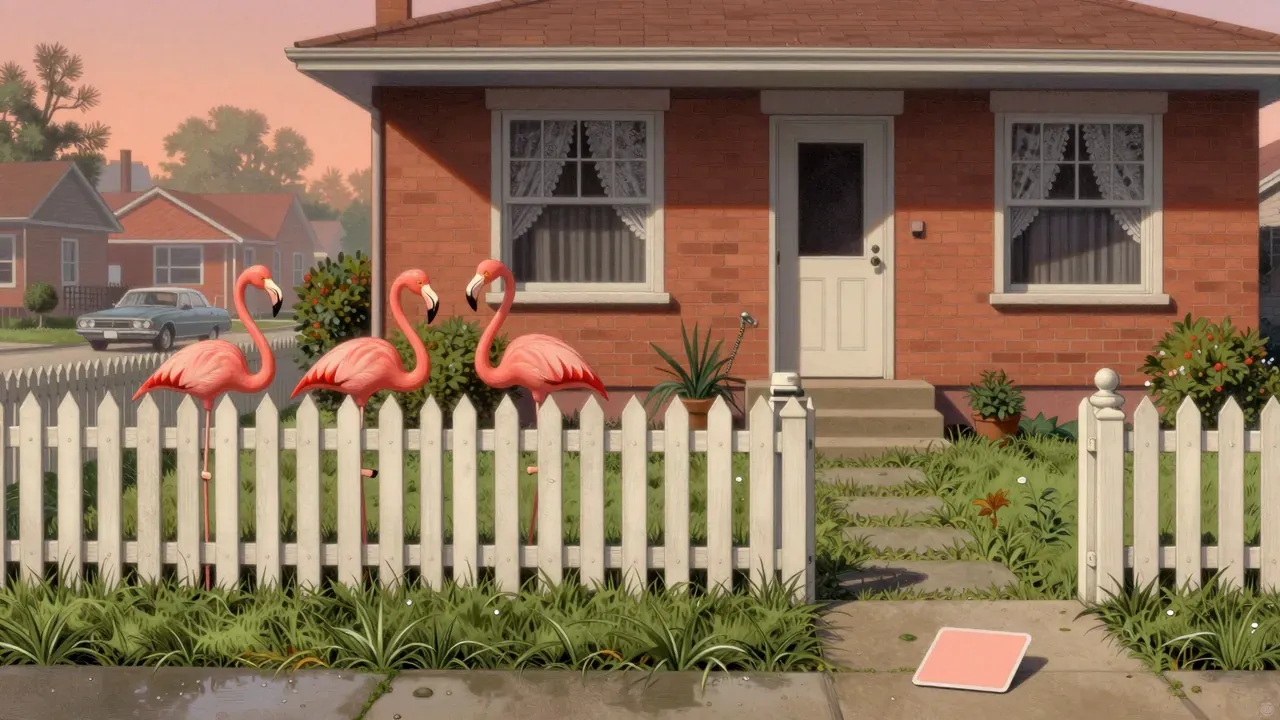
The story follows Francine Fishpaw’s disintegration and improbable reassembly across a tightly wound 85 minutes, structured like a soap opera stripped of pauses for breath. Divine’s performance anchors the film: her physicality, timing, and deadpan delivery turn Francine’s passivity into a kind of grim choreography. Tab Hunter plays against type as Elmer — blandly monstrous, never winking — while Edith Massey’s La Rue delivers class snobbery with surgical cruelty. David Insley’s cinematography replicates Sirk’s high-contrast, shallow-focus interiors and saturated colour palette, but with a flat, slightly cheap gloss that undercuts the illusion of glamour. The editing avoids rhythm, favouring abrupt cuts that punctuate jokes like slaps. Blondie’s music cues are deployed with ironic precision — a pop sheen over rot — and Michael Kamen’s score swells with mock-grandeur. Odorama is not decoration but narrative device: smells punctuate plot points (roses before humiliation, glue before foot-stomping), making audience participation part of the film’s logic of violation.
The rhythm of it
What lands most consistently is the film’s tonal control — its ability to sustain a single, unblinking stare at American banality without flinching or softening. The satire of suburban hypocrisy works because it is precise: the anti-porn picketers outside the Fishpaw home, the Catholic unwed mothers’ home that functions as a prison, the art-house drive-in run by a man named Todd Tomorrow — all land because they are rooted in real social contradictions, however absurdly amplified. The performances hold the frame: Divine’s stillness amid chaos, Massey’s brittle entitlement, Mink Stole’s shrill entitlement as Sandra — none overplay, and all commit to the script’s internal grammar. The Odorama gimmick succeeds not as novelty but as extension: when viewers scratch ‘flatulence’ during a marital argument, the joke isn’t the smell itself but the shared complicity in discomfort. Even the film’s visual polish — the polyester fabrics gleaming under studio lights, the manicured lawns hiding rot — reinforces its thesis: surfaces matter because they lie so convincingly.
The break in it
What does not land is the final act’s reliance on cartoonish violence as narrative reset. The deaths of Elmer, Sandra, La Rue and Todd arrive not as consequences but as punchlines delivered with diminishing returns — the dog’s apparent suicide, the gun-toting grandmother, the macramé strangulation — all strain credibility even within the film’s own logic. The shift from psychological collapse to bloodshed feels less like escalation and more like exhaustion: Waters runs out of ways to twist the screw, so he breaks the screwdriver. Some character arcs collapse under their own weight — Dexter’s transformation from glue-sniffing foot stomper to foot-painting artist lacks grounding, and Lu-Lu’s arc from abortion seeker to flower-child feels tacked on rather than earned. The satire of religious conservatism remains broad where earlier targets were sharp; the anti-abortion picketers are faceless, not fleshed-out, and their presence serves plot convenience more than critique. The film’s R rating — its bid for accessibility — occasionally blunts its edge, smoothing over the very textures of transgression that made Waters’s earlier work vital.
The weight of it
The themes that matter are not the listed subjects — abortion, alcoholism, foot fetishism — but how Polyester treats them as symptoms of a deeper sickness: the commodification of feeling. Every character performs an identity — Francine the martyr, Elmer the patriarch, La Rue the social climber — and every performance is mediated by consumption: polyester clothing, Smell-O-Vision cards, drive-in movies, macramé kits. The film interrogates how emotion is packaged, sold, and discarded in post-industrial America, where even rebellion becomes branded (Todd Tomorrow’s name, Cuddles’s inheritance). Class is not backdrop but mechanism: La Rue’s contempt for Francine’s obesity is inseparable from her contempt for her daughter’s lack of capital; Elmer’s adult theatre is both business and moral alibi. Race appears only as absence — no Black characters in this Baltimore suburb — a silence that speaks to the film’s narrow, white-trash gaze. Religion is spectacle, not belief: crucifixes hang beside popcorn machines, prayers compete with car horns. Polyester’s real subject is the infrastructure of delusion — the systems that let people believe they are living meaningfully while surrounded by decay.
The audience for it
This film is for viewers who recognise satire as a form of diagnosis, not dismissal — those who can sit with discomfort without demanding redemption. It rewards attention to craft: Insley’s lighting, Waters’s framing, the way a close-up on a pizza slice precedes a marital breakdown. It is not for those who require moral clarity, emotional payoff, or characters to ‘grow’. Anyone expecting empathy will find only mirror-gazing; anyone needing narrative coherence may balk at the third-act body count. Fans of Sirk or Fassbinder may appreciate the formal homage but reject its nihilism. Viewers put off by Waters’s earlier films will likely find Polyester too restrained; fans of Pink Flamingos may find it too polite. Its R rating misleads: this is not ‘accessible’ Waters, but Waters wearing a suit two sizes too small — the seams show, and that is the point. Without tolerance for sustained irony, the film collapses into noise.
The time for it
Yes, it is worth your evening — if you treat it as a period artefact with teeth, not a nostalgic lark. Its 85 minutes move briskly, its jokes land with surgical timing, and its design remains startlingly coherent: every costume, colour, and scratch-and-sniff cue serves the central joke — that middle-class life is a series of purchased illusions. It repays rewatching for its density of detail: the wallpaper patterns, the brand names on cereal boxes, the way Francine’s hairdo stays perfect even as her world implodes. Those who dismiss it as camp miss its rigour; those who praise it only as provocation ignore its craftsmanship. It is not for casual viewing — it demands active participation, including literal scratching — but that demand is part of its integrity. To skip it is to miss one of the few American films that treats suburban despair as both farce and tragedy, without choosing between them.