The length of it
Before Sunrise is a film built on a single premise: two strangers, one American man and one French woman, meet on a train and spend twelve hours walking Vienna before parting at dawn. It does not try to mimic life’s density or pace; instead, it isolates a narrow band of time and treats it as a laboratory for intimacy. The film aims to test whether sustained conversation—unmediated by shared history, social obligation, or future consequence—can generate real emotional resonance. It rejects plot mechanics in favour of duration and attention: the camera stays with Jesse and Céline not because they are doing much, but because they are saying things that matter to them, and the film trusts that those things will matter to us if we stay long enough. There is no antagonist, no ticking clock beyond the flight schedule, no external stakes—only the quiet pressure of time passing and the risk of misreading another person. Its ambition is modest in scale but precise in intent: to make talk feel consequential again.
The talk of it
The story unfolds as a sequence of encounters—train carriage, café, Ferris wheel, cemetery, park, tram, street corner—each location serving less as setting than as a slight shift in register for the dialogue. Ethan Hawke and Julie Delpy perform without affectation or flourish; their line readings are unpolished, sometimes hesitant, often overlapping, as though they are thinking aloud rather than delivering lines. Lee Daniel’s cinematography avoids stylisation: he keeps the frame loose, the focus shallow but never showy, the lighting naturalistic even at night—streetlamps, café bulbs, moonlight through trees. Sandra Adair edits with patience, holding shots longer than most films dare, letting silences breathe and pauses settle. Fred Frith’s score is sparse, mostly ambient textures and prepared-piano fragments that recede behind speech. There is no montage, no voiceover, no cutaways to reaction shots—the film’s rhythm comes entirely from the actors’ timing and the weight they give to individual words. Nothing is underscored; nothing is explained. The craft serves one purpose only: to keep the audience in the same room as the conversation, not watching it from outside.
The weight of it
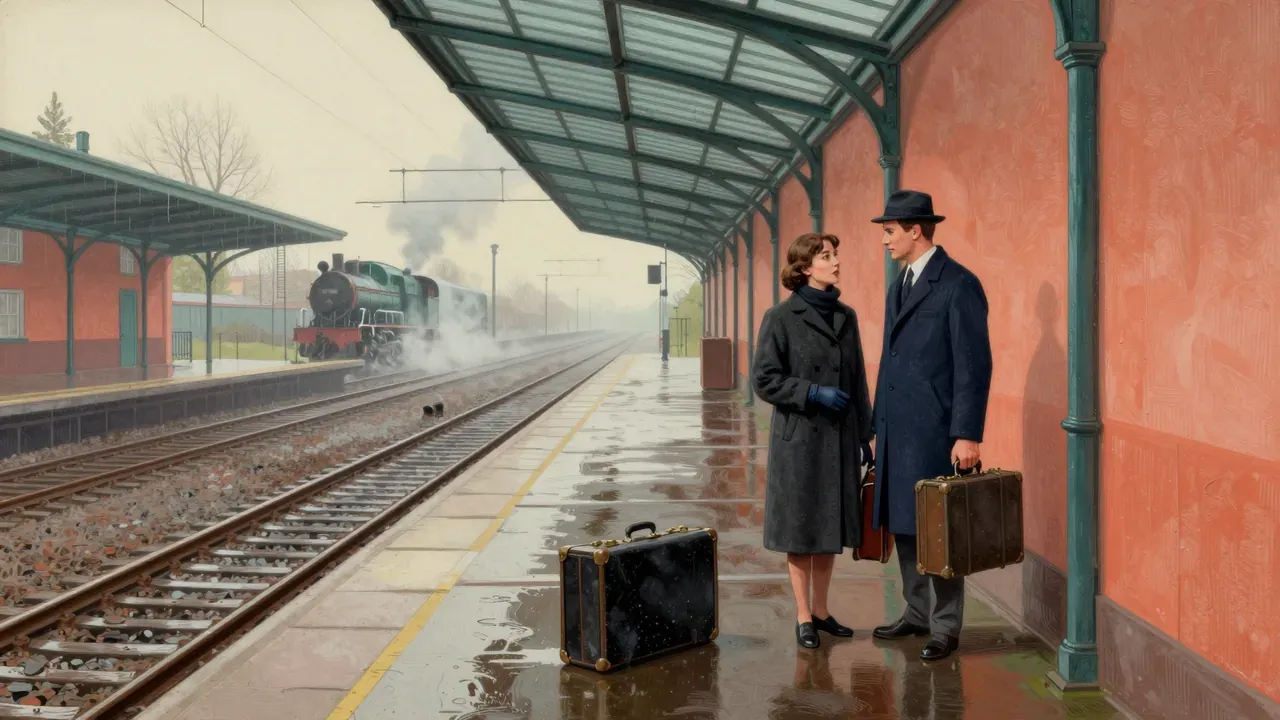
What lands is the cumulative effect of sustained attention. The film earns its emotional payoffs not through revelation but through accumulation: a detail about Céline’s grandmother, a half-joke about milkshakes, a pause before Jesse says he’d marry her—all land because the film has spent ninety minutes making us believe in the reality of their attention to each other. The Wiener Riesenrad kiss works not as spectacle but as relief, the first physical punctuation in a long stretch of verbal calibration. The cemetery scene lands because it follows directly from earlier talk about mortality, and because the actors do not treat it as symbolic—they walk, look, speak plainly. Even the final train-station decision feels earned: not because it is romantic, but because it is consistent with how the characters have behaved all night—choosing honesty over convenience, uncertainty over false certainty. The film’s restraint becomes its authority. It never tells us what to feel, yet the ending leaves a quiet ache—not for what happens next, but for the sheer rarity of being heard so completely, even briefly.
The shape of it
What does not land is the assumption that all viewers will find this kind of talk inherently compelling. Some will find the pacing inert, the dialogue self-conscious, the characters too articulate to be believable. The film offers no counterpoint: no contrasting voices, no irony from outside the couple, no visual or tonal variation to relieve the intensity of the dyad. When Jesse and Céline stage fake phone calls in the café, the device feels thin—not because it is poorly performed, but because the film has no mechanism to signal when it is nudging at artifice versus sincerity. The poem ‘Delusion Angel’ lands awkwardly: its inclusion feels like a thematic marker rather than an organic moment, and its cynicism sits uneasily beside the film’s otherwise sincere tone. There is also a structural flatness in the second half—the park wine scene and the implied sex lack the textural variety of earlier scenes, becoming more abstract and less grounded. These are not flaws in execution, but limits of design: the film commits so fully to its central conceit that it cannot afford deviation, and some viewers will find that commitment exhausting rather than immersive.
The time of it
The themes that matter are not love as destiny or romance as escape, but love as temporary suspension—a deliberate stepping out of ordinary time and identity. The film treats self-discovery not as solitary introspection but as co-creation: Céline and Jesse invent versions of themselves in response to each other, testing ideas aloud, retracting them, revising. Mortality surfaces not as dread but as context: the Cemetery of the Nameless gives the film its quietest moral weight—not because death is near, but because anonymity in life is avoidable, and connection is a choice. Time is both constraint and medium: the twelve-hour limit forces honesty, but also makes every minute feel provisional, every admission reversible. Postmodern romance here means rejecting grand narratives—no marriage proposals, no declarations of forever—but still treating the encounter as meaningful precisely because it is finite. The film’s deepest theme is epistemic humility: the understanding that you can know someone deeply without knowing them fully, and that such partial knowledge may be the only kind worth having.
The patience of it
This film is for viewers who value listening over watching, who find pleasure in the texture of speech and the weight of hesitation, who do not require narrative propulsion to stay engaged. It suits those accustomed to arthouse pacing, comfortable with ambiguity, and willing to sit with characters whose appeal lies in their ordinariness. It is not for viewers who rely on plot turns, visual spectacle, or clear character arcs to sustain interest—those who expect escalation, conflict resolution, or catharsis will find it thin. Anyone allergic to extended dialogue, or who finds intellectualised romance emotionally distant, will leave unmoved. A viewer who prefers irony over sincerity, or who needs external stakes to care about internal ones, will struggle. The film assumes patience as a condition of entry; it does not earn that patience gradually—it demands it from the first shot. Those who reject that demand outright will not be persuaded by any argument made later in the film, because the film itself makes no concessions.
The price of it
Yes, it is worth your evening—if you are prepared to give it your full, undivided attention for ninety-seven minutes. It repays that attention not with spectacle or surprise, but with a rare fidelity to how people actually talk when they are trying to be known. Its value lies in its refusal to compress experience: no summary, no shorthand, no editorialising. It asks you to sit with two people who are learning how to listen, and in doing so, invites you to remember what it feels like to be truly heard—even if only for one night. Those who find this proposition dull or indulgent will not be converted by repetition or emphasis; their objection is structural, not circumstantial. A different edit, a faster pace, or added subplots would not improve the film—they would dissolve its purpose. Its worth is inseparable from its method. To watch it distracted, or while waiting for something else to happen, is to miss it entirely. It is not a film to consume, but one to inhabit—for as long as you’re willing to stay.