What it is trying to do
Two or Three Things I Know About Her is an essay-film in the form of a day in the life of Juliette Jeanson, a Parisian housewife who sells sex to supplement her husband’s income. It does not aim to tell a story but to stage a series of inquiries — into how language, architecture, advertising and war shape consciousness; into whether observation can be neutral when the observer is complicit; into what it means to speak of ‘her’ when ‘she’ is at once a woman, a city, a system, a commodity, a wound. Godard builds the film as a self-conscious apparatus: he whispers commentary over images, interrupts scenes with direct address, inserts documentary footage of tower-block construction, and treats dialogue as provisional — feeding lines live via earpiece. The title’s ambiguity is structural, not rhetorical: each ‘her’ named on the poster is treated as equally real, equally unstable, equally subject to definition by power. This is not a film about prostitution alone, but about the conditions under which all labour, all speech, all intimacy becomes transactional.
How it works
The film has no conventional plot arc, no character development, no resolution — only recurrence, interruption, and juxtaposition. Marina Vlady performs Juliette with studied reserve, her face often held in tight close-up while Godard’s voiceover dissects her gestures, her silence, her choices. Raoul Coutard’s cinematography favours shallow focus and flat, frontal compositions; interiors are lit with the evenness of a shop window, exteriors with the bleached clarity of midday sun on concrete. Françoise Collin’s editing avoids continuity logic: a shot of coffee being poured cuts to a crane lifting steel girders; a beauty salon mirror reflects not the client but a news bulletin about Vietnam. Beethoven’s String Quartet Op. 135 appears twice, briefly, as punctuation rather than accompaniment. Godard himself appears on screen as a man reading a newspaper, then as the voice whispering over Juliette’s shoulder — never as author, always as participant-observer. Performance is calibrated to expose artifice: actors look into the lens, pause mid-sentence, repeat phrases, correct themselves.
What lands
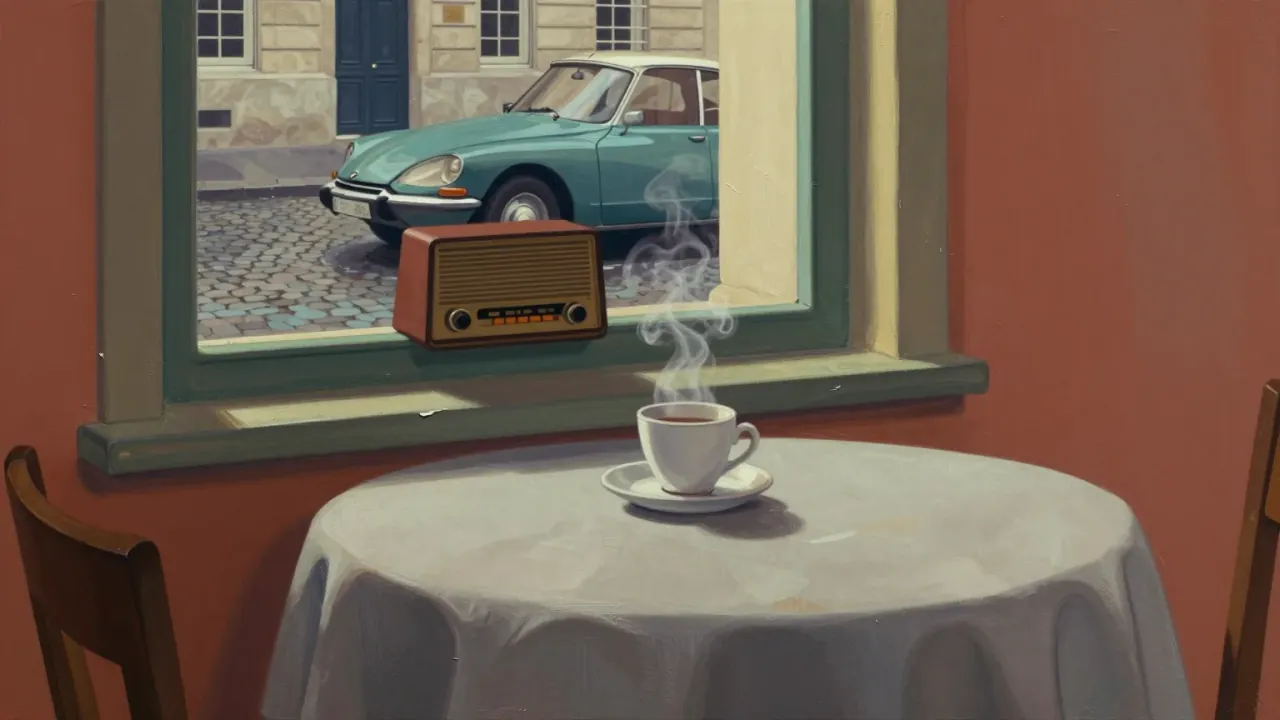
What lands is the film’s sustained intellectual pressure — its refusal to let any image stand for itself. A cup of coffee holds for over a minute, not as metaphor but as test: can you watch it without assigning meaning? The banlieue towers appear not as backdrop but as active agents — their geometry dictating movement, their scale dwarfing bodies, their repetition eroding individuality. Godard’s whispered narration works because it never explains; it names contradictions and leaves them hanging: ‘She sells her body. She buys a dress. She pays for the war.’ The film’s rhythm — slow, repetitive, digressive — forces attention onto syntax, cadence, silence. Even the humour lands precisely: the absurdity of Bogus’s airline-bag headwear is not satirical but diagnostic, revealing how branding colonises the body before the mind. These moments do not persuade so much as recalibrate perception — they make the familiar feel estranged, the trivial feel charged, the everyday feel like evidence.
What does not
What does not land is any expectation of emotional identification or narrative immersion. Juliette remains deliberately opaque: her motives are stated but not dramatised, her feelings described but not embodied. The film offers no psychological access, no backstory, no moral framing — only analysis. Some viewers will find the whispered narration intrusive or pedantic, particularly when it overtakes dialogue or lingers over static shots. The structural repetitions — the return to the high-rise, the recurring café table, the looping motifs of coffee, lipstick, and radio static — may read as monotony rather than method. The political references assume familiarity with 1960s French media, Vietnam War coverage, and debates around consumerism; without that context, passages risk sounding abstract or declamatory. And while the film critiques advertising, its own visual style — crisp, composed, highly aestheticised — sits uneasily beside that critique, offering beauty where it promises exposure.
The themes that matter
The themes that matter are those Godard ties to material conditions: the banlieue as both housing project and ideological machine; advertising as a form of coercion indistinguishable from pimping; the Vietnam War not as distant conflict but as economic and psychic export, funded by the same consumer economy that supplies Juliette’s dress and her daughter’s milk. He treats language as infrastructure: words like ‘freedom’, ‘love’, ‘modern’ are shown to circulate without referents, hollowed out by repetition and commercial use. The film insists that consciousness is shaped less by inner life than by the surfaces it encounters — billboards, bathroom tiles, car wash rollers, television screens. Even the title’s plural ‘her’ is thematic: identity is not singular but layered, contested, assigned. Godard does not argue these points; he demonstrates them through juxtaposition — placing a shot of a woman applying mascara beside a newsreel of napalm falling, not to equate them but to ask what kind of world makes such proximity unremarkable.
Who should watch it
This film is for viewers who treat cinema as a tool for thinking, not just feeling — those willing to sit with unresolved questions, to rewatch a scene three times to catch a shift in tone or a change in framing, to accept that a film can be rigorous without being explanatory. It suits readers of Barthes or Debord, listeners of late Beethoven, students of urban planning or semiotics. It is not for those who require narrative momentum, emotional payoff, or clear authorial guidance. A viewer expecting character-driven drama or social realism will find it alienating; someone seeking satire or polemic will find it too elusive. Its value depends on tolerance for opacity — not as evasion, but as principle. Those who reject its methods often do so on grounds of elitism or obscurity, but the film’s difficulty lies not in vocabulary but in its refusal to simplify cause and effect. Change the verdict? Only if you believe inquiry must always yield answers — and this film insists it need not.
Is it worth your evening
Yes, it is worth your evening — provided you approach it as you would a difficult poem or a philosophical text: slowly, repeatedly, with pen in hand. Its ninety minutes accumulate density rather than pace; its rewards are cumulative, not immediate. You will not leave with a clearer view of Juliette, but with a sharper sense of how light falls on concrete, how silence functions in a crowded room, how a single word — ‘her’ — can hold contradiction without collapsing. It repays attention not because it reveals secrets, but because it trains attention itself. Some will find that effort unrewarding — especially if they expect entertainment, catharsis or closure. But for those who accept that films can be laboratories for perception, this remains one of the most exacting and illuminating ever made. Its endurance lies not in nostalgia for the sixties, but in its diagnosis of structures — consumerism, surveillance, linguistic erosion — that have only intensified since 1967.