The look of it
This Sporting Life is Lindsay Anderson’s first feature film, adapted by David Storey from his 1960 novel, and set in the rugby league world of early-1960s Wakefield. It is not a sports film in the conventional sense — there are no triumphant climaxes, no underdog victories, no crowd-pleasing choreography of victory. Instead, it uses rugby as pressure-test machinery for a man’s interior life: Frank Machin’s physical aggression on the field maps directly onto his emotional incapacity off it. The film attempts something precise and unyielding: to render the texture of working-class masculinity as it fractures under economic precarity, sexual frustration, and grief. It refuses uplift, avoids exposition, and declines to soften its characters’ contradictions. Storey’s script treats sport not as metaphor but as environment — the mud, the bruises, the contractual haggling, the way a loose forward’s body becomes both weapon and liability. Anderson does not seek to explain Frank; he places him in rooms, on buses, in riverside fields, and watches what happens when feeling has no vocabulary beyond force. Word count: 142
The shape of time
The story unfolds in two temporal layers: anaesthetised flashbacks during a dental procedure, then linear recovery after. Peter Taylor’s editing sustains this structure with abrupt, unsmoothing cuts — no dissolves, no music cues to ease transitions — making memory feel like impact rather than recollection. Denys Coop’s cinematography keeps interiors dim and grainy, favouring natural light through grimy windows or the flat glare of floodlit pitches. Richard Harris’s performance as Frank is physically total: shoulders locked, jaw clenched, eyes rarely meeting others’ gaze head-on. Rachel Roberts matches him in stillness — her Margaret speaks less in dialogue than in posture, in the way she folds her arms or turns her back mid-sentence. Alan Badel, as Gerald Weaver, embodies managerial condescension without caricature; William Hartnell’s brief role as a club official carries quiet, unspoken weight. Roberto Gerhard’s score avoids orchestral sweep, using dissonant brass and fragmented percussion that never resolves. Word count: 153
What stays unsaid
What lands most firmly is the film’s refusal to flatter its protagonist or its audience. Frank’s violence is neither romanticised nor excused; it is shown as habitual, clumsy, and ultimately self-defeating. The rugby sequences feel authentically brutal — not choreographed spectacle but collisions of bodies moving at speed, filmed low and close, with mud caking jerseys and breath fogging cold air. The domestic scenes land because they avoid psychology-as-explanation: Margaret’s withdrawal is not diagnosed, only witnessed — in her silence over tea, her hesitation before touching Frank’s hand, the way she stares past him while he talks. The film’s moral gravity comes from restraint: no voiceover interprets Frank’s rage, no cutaway confirms Margaret’s despair. Even the final hospital scene works because it denies catharsis — Frank’s grief is silent, his anger misdirected at a spider, his exit wordless. The film trusts its images to hold meaning without translation. Word count: 147
Where the frame holds firm
What does not land is the structural conceit of the dental-frame flashback. Introduced with clinical precision, it promises psychological excavation but delivers little insight into Frank’s past beyond what the present already shows: his isolation, his lack of language for tenderness, his identification of love with possession. The device feels more functional than expressive — a narrative hinge rather than a thematic lens. Some supporting performances drift into type: Arthur Lowe’s cameo as a club secretary is technically exact but tonally thin, and Leonard Rossiter’s brief appearance lacks the specificity of his later work. The film’s commitment to austerity occasionally tips into opacity: Frank’s motivations shift without clear cause, and Margaret’s emotional thresholds remain deliberately vague — admirable in intent, but at times alienating in effect. The rugby league setting, though authentic, may distance viewers unfamiliar with its codes, not because it is obscure, but because the film assumes immersion rather than offering orientation. Word count: 152
The air around the characters
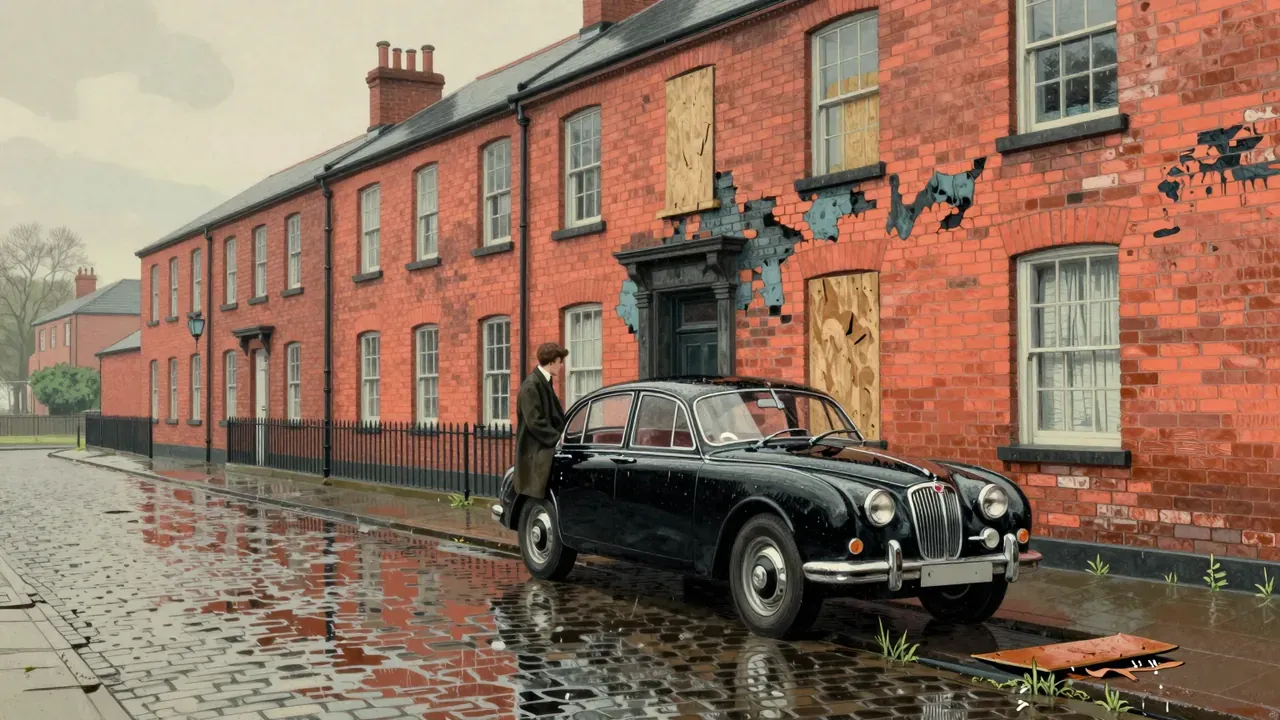
The themes that matter are not sport or romance but containment — of bodies, of feeling, of class mobility. Frank’s new Jaguar sits incongruously outside a bombed-out boarding house, a symbol not of success but of displacement: he has money but no social grammar to use it. Margaret’s widowhood is not mourned privately but policed publicly — her neighbours’ judgement, her children’s silence, her own fear of attachment all enforce emotional quarantine. The film treats masculinity as a set of enforced postures: Frank punches because he cannot ask; he buys a fur coat because he cannot name what Margaret needs. Class operates not through dialogue about wages but through spatial logic — the difference between Weaver’s office and Frank’s rented room, between Bolton Priory’s riverbank and Servia Terrace’s terraced rows. Grief is rendered as physiological: blood in the mouth, swelling in the jaw, the weight of a hand held too long. These are not ideas dressed up as drama; they are dramatised as lived conditions. Word count: 149
Who walks with it
This film is for viewers who value psychological realism over narrative convenience, who tolerate ambiguity as a condition of truth, and who accept that some characters will remain unresolved because real people do. It suits those familiar with British New Wave conventions — the muted palette, the location shooting, the resistance to closure — but also those new to them, provided they approach it without expectation of explanation. It is not for viewers who require moral clarity, character arcs, or emotional payoff. Those who find prolonged discomfort unrewarding, or who expect sport to function as allegory for redemption, will leave frustrated. A viewer who values Richard Harris’s physical acting but dislikes his emotional withholding may resist Frank entirely. Someone who prefers structured chronology over fractured memory will struggle with the opening act. The film’s endurance depends on patience with silence, stillness, and unspoken tension — qualities that demand attention but offer no guarantee of comfort. Word count: 148
The weight of the hours
Yes, it is worth your evening — not as entertainment but as an encounter. Its 134 minutes accumulate weight precisely because they refuse to rush, to summarise, or to soothe. You will not leave energised, but you may leave unsettled in a way that lingers: the image of Frank holding Margaret’s hand while staring at a spider, the sound of boots on wet pitch, the way light falls across a kitchen table at dawn. It rewards attention to detail — Denys Coop’s framing of doorways, Peter Taylor’s cut from a rugby tackle to a teacup being set down, Rachel Roberts’s slight flinch before speaking. Those who dismiss it as ‘dour’ or ‘unrelenting’ are not wrong, but they mistake tone for thesis: the film’s bleakness is its method, not its message. It is worth your evening if you accept that some truths are held in the body before they reach the tongue. Word count: 149