The look of it
From the Life of the Marionettes is a German-language television film made by Ingmar Bergman during his self-imposed exile in West Germany after the 1976 tax investigation in Sweden. It is not a continuation but a reimagining: Peter and Katarina Egermann, briefly glimpsed as brittle antagonists in Scenes from a Marriage, are here transplanted to Munich and given full, forensic attention. Bergman stated he used them to externalise his own anguish — not as autobiography but as vessel. The film’s formal design supports that aim: black-and-white cinematography dominates, punctuated by two brief colour sequences — a red-tinted prologue and epilogue — imposed at ZDF’s insistence. Its structure is procedural and clinical: a murder opens the film, then retreats twenty days to trace the slow collapse of a marriage through dialogue, confession, and interrogation. It does not seek suspense or moral resolution, but psychological exposure — less ‘why did he do it?’ than ‘how did he become someone who could?’. It is a case study in psychic erosion, written and directed with surgical precision, not dramatic flourish. (158 words)
How it speaks
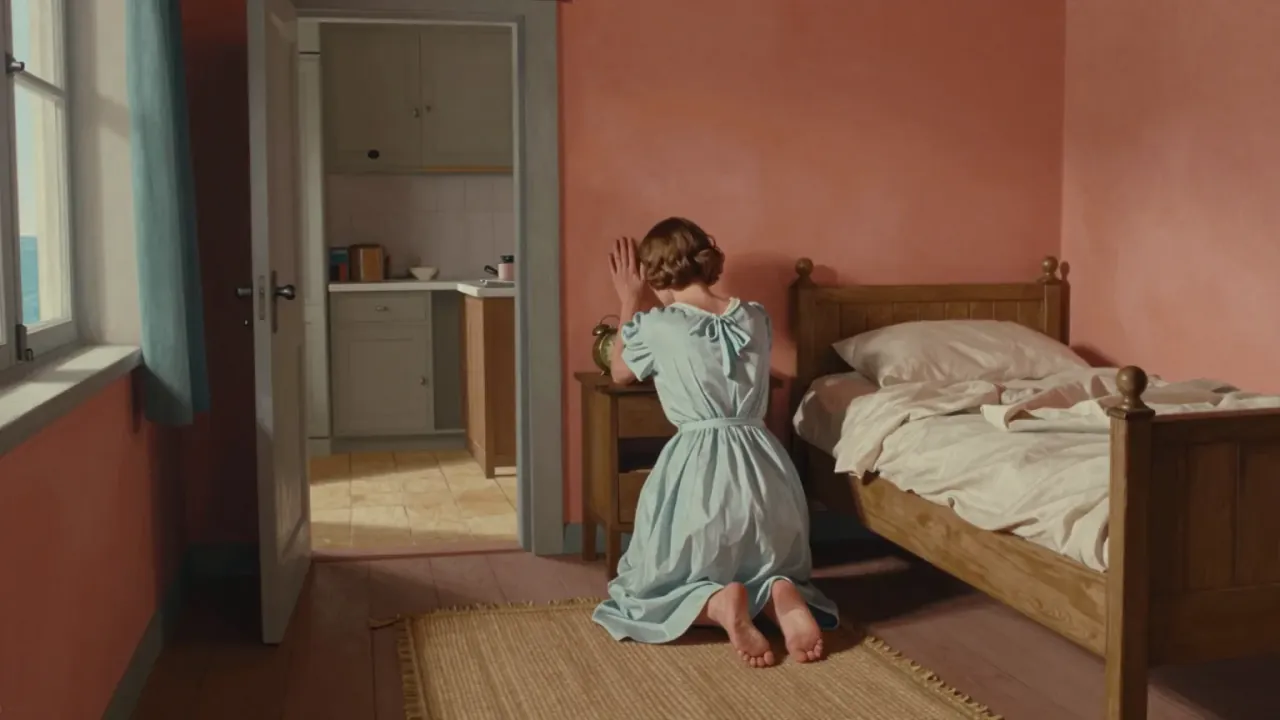
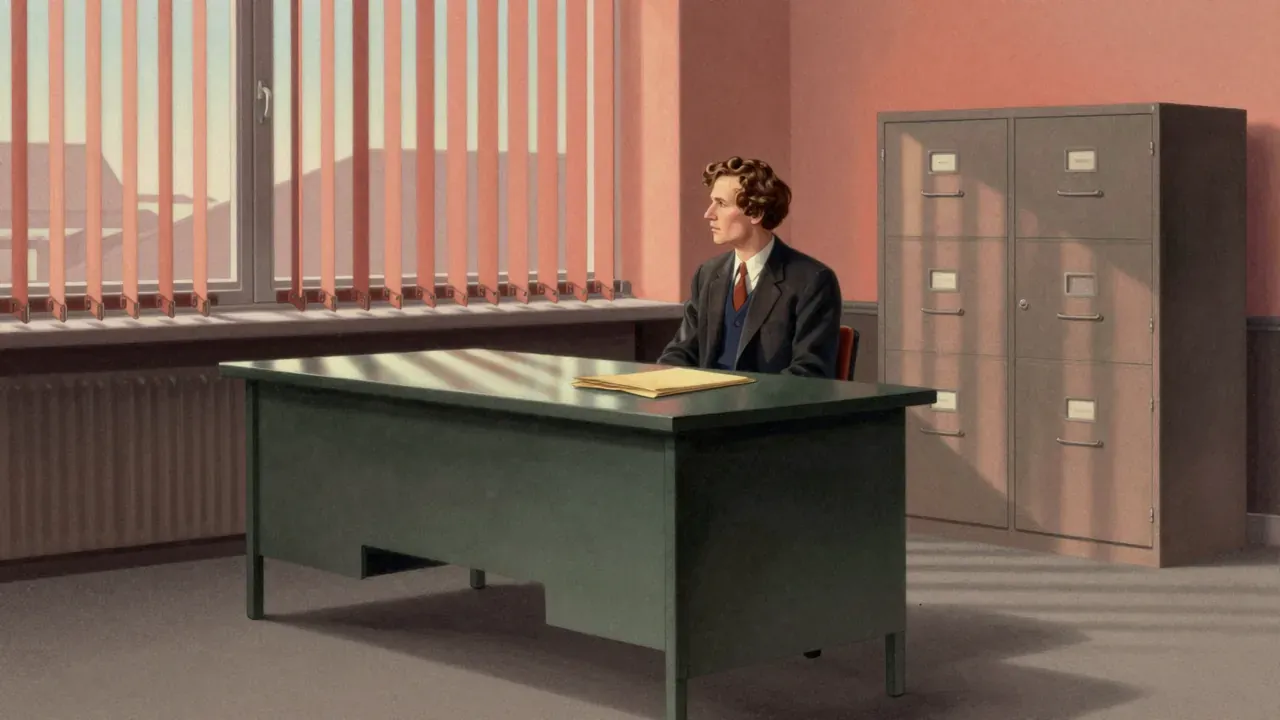
The story unfolds through overlapping testimonies and flashbacks, anchored by Robert Atzorn’s tightly coiled performance as Peter and Christine Buchegger’s controlled, weary Katarina. Sven Nykvist’s cinematography avoids expressionist distortion; instead, he uses shallow focus, static frames, and long takes to enforce emotional distance — even in intimacy, characters remain physically and psychologically separated. The lighting is flat, functional, rarely flattering: interiors are lit like offices or waiting rooms, not homes. Rolf Alexander Wilhelm’s score deploys timpani and glass harmonica for dissonant, uncanny texture, but never swells to underscore emotion. Dialogue is delivered with deliberate flatness — no actor raises their voice unnecessarily, no line is underlined. Even the coroner’s interviews feel like clinical intake forms. The film resists theatricality: Tim’s confession about his desire for Peter lands not through delivery but through its hesitant pacing and the silence that follows. There are no dream sequences beyond what the script specifies; Nykvist’s shots in those moments are precise, not impressionistic. The craft serves containment, not release. (159 words)
The shape of collapse
What lands is the cumulative weight of small betrayals — Katarina skipping her mother-in-law’s meal, Peter dictating business deals while sleepless, Tim handing over a scarf meant for Peter. These details accrue without commentary, making the murder feel less like a rupture and more like an endpoint already implied in the rhythm of daily life. Buchegger’s performance holds the film’s centre: her Katarina is neither villain nor victim, but a woman whose competence masks exhaustion and whose detachment becomes contagious. Atzorn’s Peter is equally persuasive in his quiet unraveling — his near-suicide on the balcony reads not as melodrama but as the logical extension of a man who has stopped feeling his own body. The film’s refusal to offer psychological comfort lands precisely because it refuses to flinch: when Peter cradles a teddy bear in the asylum, it is not pathetic but inevitable, the last gesture of a self reduced to infancy. The colour bookends — stark, artificial, red — work as visual punctuation: not symbolism, but framing devices that mark the film as constructed, observed, and deliberately bounded. (157 words)
Where it explains too much
What does not land is the explanatory framework imposed in the final act. Mogens Jensen’s psychiatric summation — that Peter’s aggression stems from an aggressive mother and latent homosexuality triggered by Ka’s name — arrives as diagnosis rather than discovery, flattening ambiguity into cause. The film’s earlier restraint makes this conclusion feel abrupt, almost bureaucratic, as if Bergman stepped out of character to file a report. Tim’s guilt-ridden monologue about introducing Peter to Ka also strains credulity: his self-accusation is too neatly aligned with the film’s stated theme of manipulation, lacking the contradictory messiness of real remorse. Some performances falter under the script’s demands for affectless delivery — Martin Benrath’s coroner occasionally slips into procedural monotony rather than quiet authority. The black-and-white aesthetic, while consistent, occasionally blurs spatial relationships in interior scenes, making geography hard to parse. And though the film avoids sensationalism, its clinical tone risks alienating viewers seeking emotional entry points: there is no warmth, no humour, no incidental humanity to soften the scrutiny. That is a choice, not a flaw — but it is a choice that narrows the film’s reach. (159 words)
Who pulls the strings
The themes that matter are control and its illusion. Bergman’s title is literal: the Egermanns move through life as marionettes, not because they are evil or weak, but because their choices are shaped by forces they cannot name — professional pressure, unspoken sexual tension, inherited patterns of aggression, the quiet violence of routine. The film treats sexuality not as identity but as symptom: Katarina fakes orgasms, Peter fixates on Ka’s name, Tim conflates desire with sabotage — all gestures toward something unspeakable that circulates beneath language. Class is present but muted: Peter works in business, Katarina in management, Tim in partnership — their world is white-collar, stable, and therefore more unsettling in its capacity for implosion. The film also interrogates narrative itself: the coroner’s interviews expose how memory fractures under pressure, how testimony reshapes reality, how even confession can be a form of evasion. There is no transcendent truth here, only layered accounts — each partial, each revealing something about the speaker as much as the subject. The film’s bleakness is not nihilistic; it is diagnostic. (158 words)
Who sits with it
This film is for viewers who value psychological precision over emotional payoff, who find tension in silence and revelation in repetition. It suits those familiar with Bergman’s late style — particularly the austerity of Autumn Sonata or the structural rigour of Persona — and those interested in the ethics of representation in mental-health narratives. It is not for viewers who require narrative momentum, moral clarity, or empathetic anchoring: there is no character here to ‘root for’, no arc to follow, no catharsis to earn. Those expecting the domestic intensity of Scenes from a Marriage will find this colder, more abstract. Viewers who rely on music, editing, or visual metaphor to guide interpretation may feel adrift: Nykvist’s camera observes, never interprets. A viewer who values ambiguity as substance, not obstacle, will find it rich; one who sees ambiguity as evasion will find it withholding. It rewards patience, but not passive watching — it asks you to hold contradictions without resolving them. (159 words)
What remains after
Yes, it is worth your evening — but only if you accept its terms. It is not entertainment, nor therapy, nor argument; it is a sustained act of attention, calibrated to expose how ordinary lives fracture under unexamined pressure. Its 103 minutes pass without hurry, yet never drag: every scene is weighted, every pause considered. Those who dismiss it as ‘cold’ or ‘over-explained’ — like David Denby, who wished Bergman had dramatised more — mistake its method for its aim. Its power lies in its refusal to soothe. To watch it is to sit alongside the coroner, listening, weighing, resisting the urge to conclude. It gains little from repeated viewings — its logic is linear, not cyclical — but its precision lingers. It is not a film to love, but one to reckon with. Anyone willing to meet it on its own ground will find it exacting, unsparing, and ultimately clarifying — not about Peter and Katarina, but about the quiet systems that govern us all. (159 words)