The premise
Not on Your Life — though the fact sheet misnames it, the film is The Executioner (El verdugo), a 1963 Spanish black-and-white satire directed by Luis García Berlanga. It sets out to dissect the moral inertia of bureaucracy under Francoist Spain, not through polemic but through the grotesque logic of a civil service job: execution as routine employment. The film treats capital punishment not as political spectacle but as administrative friction — a housing allocation hinges on it, a marriage depends on concealing it, a man’s conscience buckles under its paperwork. Berlanga and writers Ennio Flaiano and Rafael Azcona anchor the absurdity in lived detail: the funeral parlour’s quiet dignity, the executioner’s cramped flat, the way pension rules override human consequence. Its aim is not to condemn execution per se, but to expose how institutions absorb horror into procedure — making complicity banal, not monstrous. It does so without voiceover, without editorialising, and with no music underscoring moral gravity. Tonino Delli Colli’s cinematography keeps faces half in shadow, not for mood, but because Madrid’s light does that indoors. Word count: 158.
The rhythm of it
The story follows José Luis, an undertaker who marries Carmen, daughter of Amadeo the state executioner; their union collapses under the weight of a housing bribe — he must accept the executioner’s post to keep their flat. Nino Manfredi plays José Luis with restrained physicality: shoulders hunched, hands rarely still, eyes darting away from mirrors. José Isbert as Amadeo delivers bureaucratic calm — not cruelty, but exhaustion worn like a uniform. Emma Penella’s Carmen is neither naive nor cynical, but pragmatically affectionate, her warmth sharpened by resignation. Berlanga stages key scenes in tight, unbroken takes: the flat’s narrow corridor, the prison office’s cluttered desk, the Mallorca execution chamber’s bare walls. Alfonso Santacana’s editing avoids reaction shots, trusting performance and framing instead. Miquel Asins Arbó’s score is sparse — a few piano phrases, then silence — refusing to cue emotion. The film’s craft works by subtraction: no flashbacks, no exposition, no establishing shots of Madrid beyond what the characters pass on foot. It trusts the audience to infer hierarchy from who opens doors, who waits, who signs forms. Word count: 159.
The weight of it
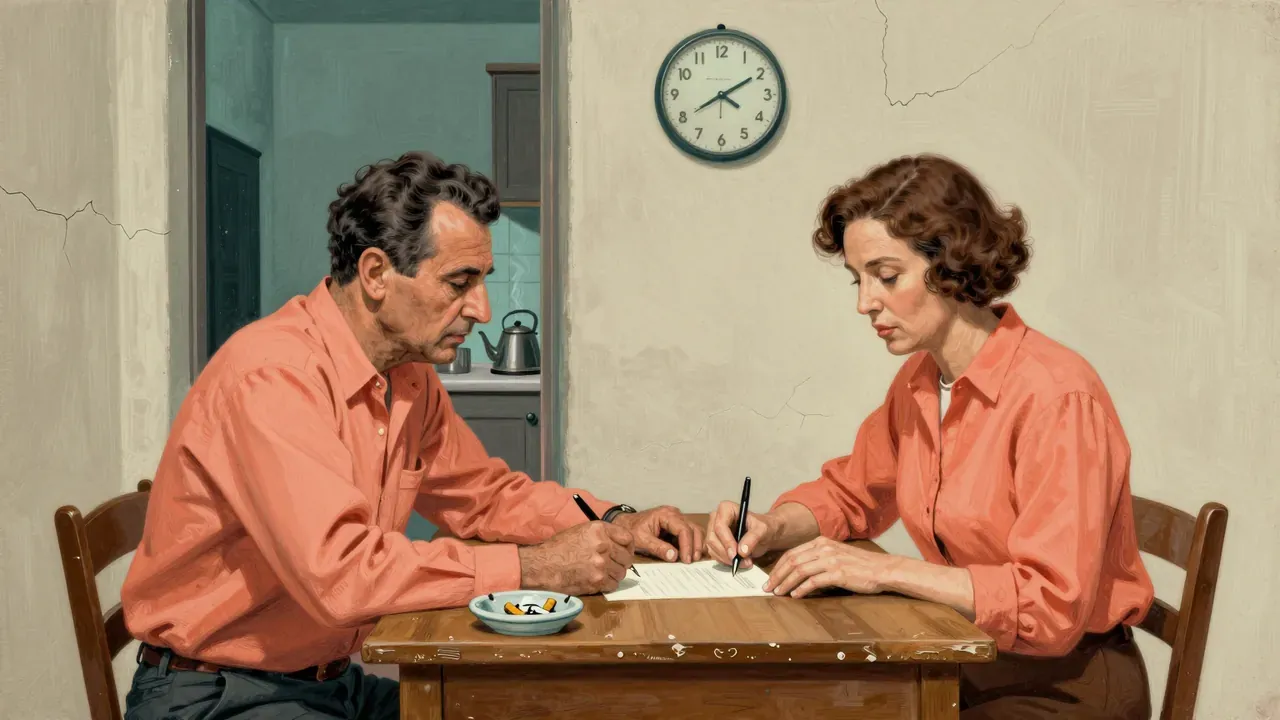
What lands is the cumulative weight of small betrayals — not grand lies, but polite evasions, deferred truths, and shared silences that harden into complicity. The scene where José Luis signs the executioner’s contract while holding Carmen’s hand lands because it is shot at eye level, with no cutaways: two people agreeing to a fiction they both know will unravel. The Mallorca sequence lands not for its tension but for its anti-climax — the prisoner is already ill, the guards are bored, the priest recites mechanically. Even the final walk to the chamber feels less like tragedy than transport logistics. The film’s dark comedy rests in proportion: the stakes are life and death, but the dialogue concerns rent receipts and pension eligibility. The casting reinforces this — Guido Alberti’s prison director speaks in the tone of a municipal clerk; Ángel Álvarez’s fellow undertaker offers condolences like a neighbour commenting on the weather. The film’s moral force comes not from outrage but from the sheer, unblinking normality of its world. Word count: 157.
The gap in it
What does not land is the attempt to frame José Luis’s final capitulation as existential crisis. His despair is real, but the script gives him no interior language for it — no monologue, no gesture beyond trembling hands — and the film refuses to linger on his face in the moments before the chamber door closes. This restraint becomes omission: we see his dread, but not its shape or source beyond fear of exposure. Similarly, the satire weakens when it leans on caricature — José Luis López Vázquez’s brother Antonio appears only to deliver a single, broad joke about funeral parlour odours, adding nothing to theme or character. The film’s refusal to name Franco or cite specific laws leaves its politics legible but diffuse; international audiences in 1963 grasped the allegory, but without context, some sequences read as generic farce rather than precise indictment. The pacing sags slightly in the middle third, where bureaucratic delays — waiting for paperwork, for a medical report — risk mirroring the very inertia they critique. Word count: 159.
The logic of it
The themes that matter are institutional absorption, moral deferral, and the domestication of violence. The film treats execution not as an act of state terror but as a civil service role with pension rights, sick leave, and housing entitlements — a system that makes conscience optional. It shows how families manage stigma not through resistance but through rebranding: Carmen hides her father’s profession; José Luis obscures his own. Class is structural, not aspirational — the flat is not luxury, but shelter; the job is not power, but tenure. The film also explores generational accommodation: Amadeo accepts his role as duty; Carmen accepts it as inheritance; José Luis accepts it as transaction. Religion appears not as faith but as ritual infrastructure — priests, confessionals, and church bells functioning like municipal services. Absurdism here is not philosophical but administrative: the logic is flawless, the outcome horrifying, and the gap between them is where the film lives. Word count: 158.
The audience for it
This film is for viewers who tolerate slow-burn irony, who find moral unease in silence more than speech, and who value precision over explanation. It rewards attention to posture, to off-screen sound, to the weight of a pause before signing a document. It is not for those who require narrative propulsion, emotional signposting, or clear ideological positioning — the film never names Franco, never shows a protest, never lets a character articulate dissent aloud. Some British or American viewers may mistake its restraint for ambiguity, or its dryness for detachment; others, particularly those familiar with mid-century Spanish history or Berlanga’s earlier work, will recognise its calibrated fury. A viewer expecting satire like Dr. Strangelove will find it too quiet; one seeking neorealist grit may find it too mannered. What would change the verdict? A stronger central performance — Manfredi is excellent, but the role demands more vocal texture — or tighter editing in the second act. Word count: 159.
The use of it
Yes, it is worth your evening — not as entertainment, but as calibration. Ninety-five minutes spent with The Executioner recalibrates how you read bureaucracy, how you hear euphemism, how you watch people negotiate moral thresholds without naming them. It is not ‘enjoyable’ in the conventional sense, but it lingers: the image of José Luis walking down that corridor stays because it is ordinary, not theatrical. Those who dislike films that withhold catharsis or refuse to name villains may feel short-changed — the film’s power lies in its refusal to offer either. It is not for viewers who need resolution, or who equate seriousness with solemnity. But if you’ve ever signed something you didn’t fully read, or stayed silent when speaking up felt professionally risky, the film will land with uncomfortable familiarity. Its worth lies not in what it says, but in how accurately it maps the quiet compromises we make daily. Word count: 159.