The shape of decline
The Magnificent Ambersons is a period drama adapting Booth Tarkington’s 1918 novel about the slow dissolution of an aristocratic Midwestern family amid industrial modernity, particularly the rise of the automobile. It sets out to trace decline not as sudden collapse but as quiet erosion: of wealth, influence, social standing, and moral certainty. The film frames this through George Minafer, the spoiled heir whose arrogance accelerates his family’s fall, and through Isabel Amberson, whose quiet idealism softens into resignation. Orson Welles intended it as a companion piece to Citizen Kane — less about the construction of myth than its unmaking. Where Kane charts ascent and self-invention, Ambersons charts descent and unmooring, with time itself as antagonist. Its ambition is structural and tonal: to sustain an elegiac rhythm across narrative beats that resist catharsis, to make loss feel atmospheric rather than event-driven. It treats history not as backdrop but as pressure — cumulative, inescapable, indifferent. The film’s central gesture is restraint: no villains, few speeches, little exposition. Its subject is how privilege dissolves when it stops being useful — and how hard it is to notice while it happens. (159 words)
The look of it
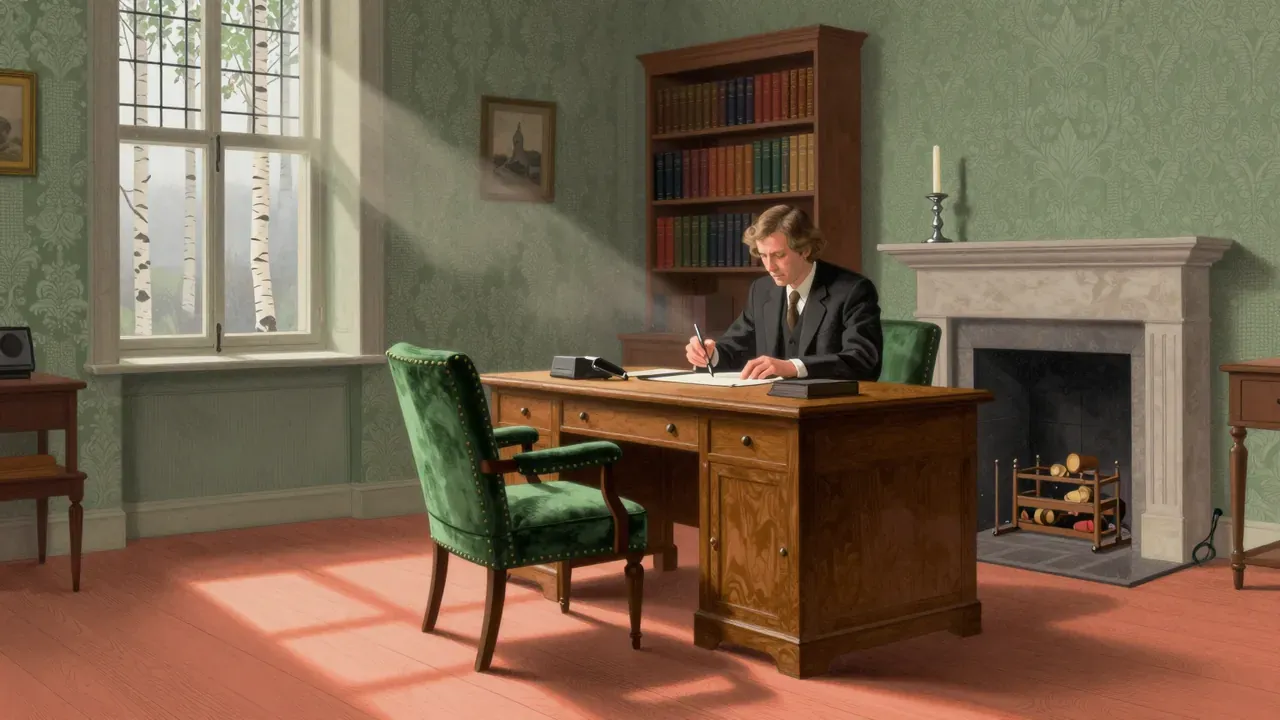
The story unfolds across three decades, anchored by Joseph Cotten’s measured, sorrowful Eugene Morgan and Agnes Moorehead’s Isabel — her performance calibrated to diminishing returns, each scene quieter than the last. Stanley Cortez’s cinematography uses deep focus and low-key interiors to compress space and time; corridors narrow, staircases recede, rooms grow colder as the Amberson mansion decays. Robert Wise’s editing — though later overruled — preserves long takes and rhythmic pauses, letting silence accumulate weight. Bernard Herrmann’s score, even in its truncated form, leans on strings and muted brass to evoke both grandeur and vacancy. Welles’s narration is dry, unsentimental, occasionally ironic — a counterpoint to the characters’ self-deception. Anne Baxter and Tim Holt convey youthful entitlement without caricature; Ray Collins and Erskine Sanford embody institutional memory fading into irrelevance. The production design — a functional, reconfigurable house set — allows camera movement that feels like observation rather than intervention. Every craft choice serves the film’s thesis: that decline is not dramatic, but procedural — a series of small concessions, missed opportunities, and unspoken withdrawals. (158 words)
What stays with you
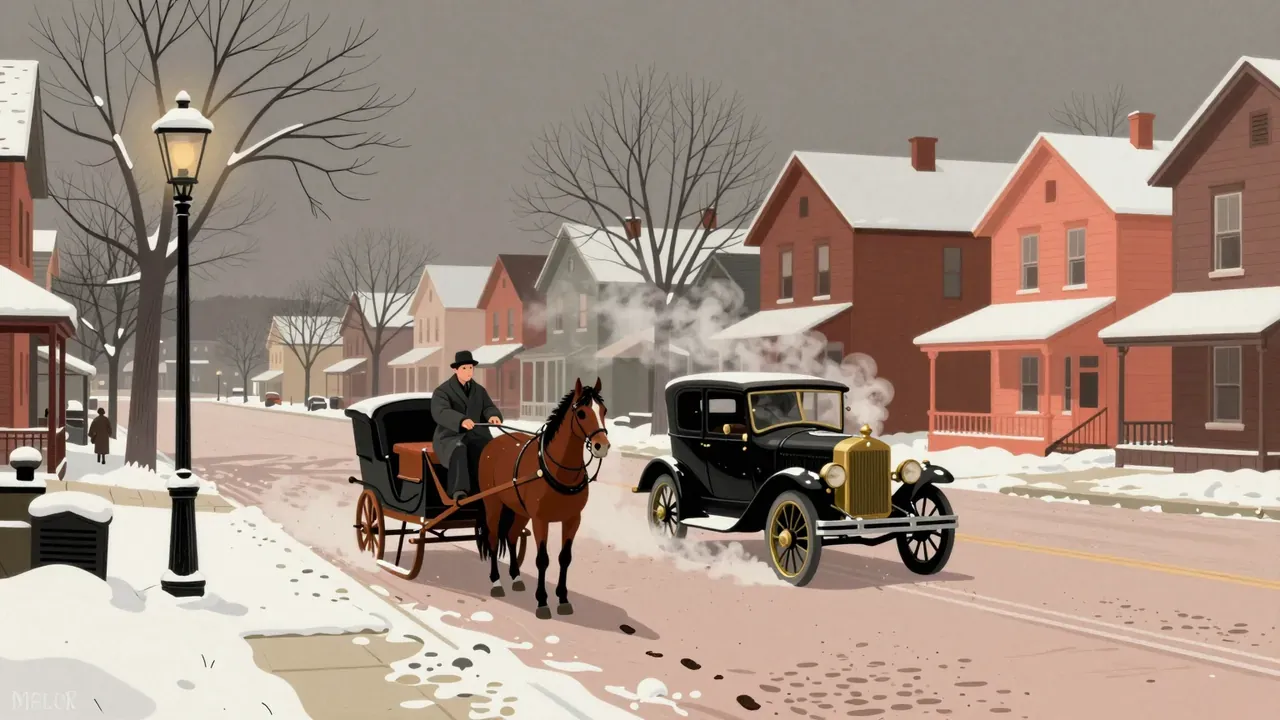
What lands is the film’s emotional architecture: the way grief settles not in tears but in posture, in the length of a pause, in the refusal to look someone in the eye. Moorehead’s breakdown against the boiler — filmed in one unbroken take, lit from below — remains devastating because it refuses theatricality; her collapse is physical, uncoordinated, humiliating. The snow scenes, shot in an ice house, feel genuinely inhospitable — breath plumes, stiffened shoulders, the crunch of footsteps swallowed by silence. Welles’s narration works precisely because it never explains; it names what the image shows, then undercuts it, creating dissonance that lingers. The recurring motif of the automobile — first a novelty, then a nuisance, then a necessity — lands with documentary precision: we see its impact on street life, on social ritual, on class mobility. Even the excised footage’s absence is felt: the surviving film’s abrupt transitions and tonal shifts register as wounds, not flaws — evidence of something vital missing. The film’s power lies in its refusal to flatter the audience’s desire for resolution or redemption. It trusts the viewer to sit with discomfort, and that trust is repaid in accumulated gravity. (157 words)
Where it breaks
What does not land is the studio-imposed ending. Its forced reconciliation — George’s repentance, Eugene’s forgiveness, Isabel’s posthumous vindication — contradicts everything the preceding eighty minutes have built. The shift from melancholy inevitability to moral neatness is jarring, tonally incoherent, and structurally dishonest. Without Welles’s original final sequence — George’s solitary walk to the boardinghouse, stripped of status and illusion — the film loses its spine. The reshoots lack Cortez’s texture and Herrmann’s underscoring; they play like a different film grafted onto the same body. Some supporting performances suffer from the cuts: Dolores Costello’s Fanny has less room to pivot from nervous spinster to weary witness; Richard Bennett’s Major Amberson becomes more caricature than cautionary figure. The pacing also suffers in places — a few transitional scenes now feel elliptical not by design but by deletion. These are not failures of execution but of authorship: the film as released is a palimpsest, its surface legible but its subtext scraped away. Those who know the rough cut’s structure will sense the gaps; those who do not may still feel the disjunction, a faint unease beneath the polish. (156 words)
What it’s really about
The themes that matter are inheritance and obsolescence — not just of wealth or property, but of manners, language, belief systems. The Ambersons do not lose money first; they lose relevance, then comprehension, then dignity. The film treats class not as static hierarchy but as a set of habits — how one holds a teacup, addresses a servant, reads a newspaper — that become unintelligible as the world changes. Technology here is not neutral: the automobile does not merely replace the horse-drawn carriage; it reorders social space, dissolves neighbourhoods, and makes privacy impossible. Time is another theme — not chronological but experiential. Characters age, but the film’s rhythm slows as it progresses, mirroring their withdrawal from consequence. Memory is unreliable, filtered through Welles’s narration and the characters’ own self-mythologising. There is no nostalgia in the film’s gaze — only diagnosis. It asks what survives when institutions crumble: not institutions themselves, but the quiet compromises people make to keep living inside them. The answer is ambiguous, unromantic, and entirely unsentimental: some survive by forgetting; others by refusing to notice they’ve already left. (159 words)
Who it’s for
This film is for viewers who tolerate ambiguity, who find emotional resonance in restraint, and who value tone over plot mechanics. It suits those accustomed to mid-century American literature or European art cinema — readers of Chekhov or viewers of Ozu — where meaning accrues in glances and silences. It is not for those who require narrative propulsion, clear moral stakes, or character arcs that resolve. Anyone expecting the formal innovation of Citizen Kane will be disappointed: Ambersons is quieter, slower, more resigned. Those put off by monochrome, period diction, or unrelenting melancholy should pass. A viewer who dislikes the film is likely reacting to its refusal to comfort — not its technical failings. That verdict would change only if RKO’s excised footage were recovered and restored, or if a credible reconstruction emerged that reinstated Welles’s ending and pacing. Until then, its power remains real but partial — a masterpiece seen through cracked glass. (158 words)
Why it matters now
Yes, it is worth your evening — but only if you watch it as a historical document and an aesthetic object, not as a self-contained story. Its ninety minutes deliver sustained visual intelligence, compositional rigour, and performances that deepen with attention. It repays slow viewing, repeated viewing, and viewing alongside the novel or Welles’s radio adaptation. Those who approach it expecting conventional drama will leave frustrated; those who accept its terms will find it haunting, precise, and unusually honest about loss. Its value lies less in what it achieves whole than in what it suggests was possible — a vision of American decline rendered with Shakespearean economy and modernist austerity. The fact that it exists at all, in any form, is remarkable. That it endures despite mutilation speaks to the strength of its conception. It is not entertainment. It is reckoning. And reckoning, however incomplete, demands time. To skip it is to miss one of cinema’s most disciplined meditations on time, class, and quiet failure. (159 words)