The shape of it
Dreams is an anthology film of eight self-contained vignettes, each drawn from recurring dreams Akira Kurosawa claimed to have had over decades. It is not a narrative feature but a sequence of visual parables — stylised, symbolic, and deliberately unmoored from linear cause and effect. The film attempts neither psychological realism nor dream-logic coherence; instead, it treats each episode as a painted scroll or Noh tableau, where composition, colour, and gesture carry meaning more than dialogue or plot. Kurosawa’s authorship is total: he wrote the screenplay alone for the first time since 1945, edited the final cut himself, and oversaw every frame with the precision of a painter laying down glazes. The ambition is not to explain dreams but to reconstitute their affective weight — awe, dread, reverence, sorrow — through controlled artifice. This is not cinema as mirror or window, but as shrine: each segment a devotional object, placed before the viewer without translation. The film’s structure rejects synthesis; there is no cumulative argument, only accumulation — of image, motif, seasonal shift, and moral tone. Its project is essentially anti-naturalist, and its fidelity is to memory’s emotional residue, not to the chronology or causality of lived experience. (158 words)
The look of it
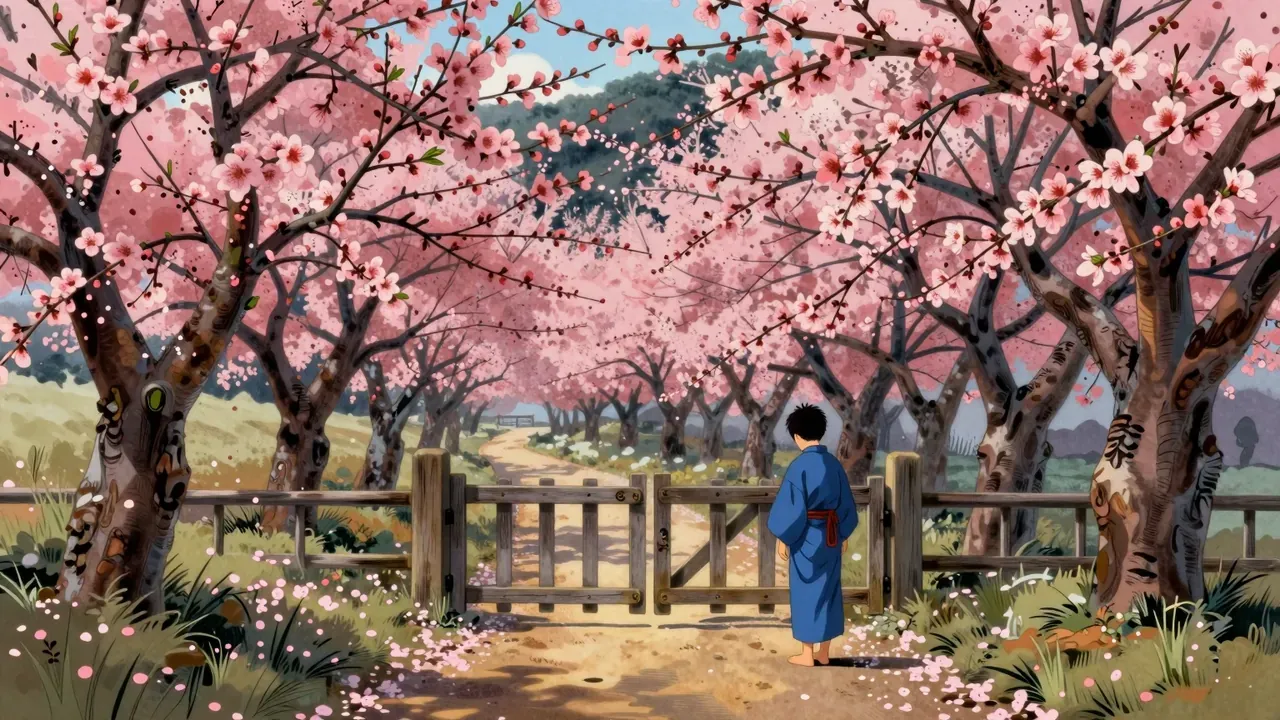
The film works through disciplined formalism: Takao Saito and Shōji Ueda’s cinematography favours deep focus, symmetrical framing, and saturated, almost theatrical colour — peach blossoms rendered in luminous pink, blizzards in monochrome blue-grey, crows against a yellow wheatfield like brushstrokes on canvas. Performances are stylised rather than psychological: Akira Terao plays the silent, wide-eyed protagonist across all segments, reacting with minimal inflection; Chishū Ryū delivers his monologue in ‘The Village of the Water Mills’ in one unbroken take, voice steady, posture rooted, as if reciting liturgy. Martin Scorsese’s Van Gogh is less a character than a kinetic cipher — all flailing arms and urgent speech, filmed in tight close-up against painted backdrops. Editing is sparse and deliberate: the 16-minute single-take march in ‘The Tunnel’ uses camera movement and light shifts to mark time, not cuts. Shinichirō Ikebe’s score avoids leitmotif in favour of discrete, evocative cues — Chopin for van Gogh, Caucasian folk motifs for the village finale. Even the special effects, handled by ILM, are restrained: rainbows added digitally, crows released manually, petals scattered by hand. Nothing feels inserted; everything feels assembled. (159 words)
The making of it
What lands is the film’s unwavering tonal consistency and its tactile sense of craft. Each segment sustains its own emotional register — the child’s trembling fear in ‘Sunshine Through the Rain’, the eerie stillness of the foxes’ ritual, the oppressive claustrophobia of the tunnel, the hallucinatory grandeur of the blizzard — without slipping into sentimentality or spectacle. The peach orchard sequence achieves a rare equilibrium between nostalgia and unease, its beauty undercut by the boy’s quiet shame; the water mill village closes the film with a gentle, unforced affirmation of continuity and quiet labour. These moments succeed because they rely on physical detail — the texture of handmade masks, the weight of snow-laden coats, the precise rhythm of footsteps on gravel — rather than exposition or metaphor made explicit. The film’s strongest passages are those where Kurosawa trusts the image to hold meaning without explanation: the stone bearing flowers, the foxes bowing in unison, the van Gogh painting dissolving into wheat. There is no irony, no distance, no wink at the audience. What lands is sincerity rendered visible — not as naivety, but as discipline. The film’s conviction in its own grammar makes even its most archaic gestures feel necessary, not quaint. (157 words)
The rhythm of it
What does not land is the structural looseness between segments and the unevenness of their conceptual weight. ‘The Tunnel’, though technically audacious, feels emotionally inert next to the visceral immediacy of ‘The Blizzard’ or the spiritual gravity of ‘The Village of the Water Mills’. Its central conceit — a soldier returning from war to find his platoon dead — relies on pathos that the film refuses to develop, leaving it stranded between allegory and anecdote. Similarly, ‘Crows’ hinges on Scorsese’s presence as a kind of cinematic talisman, but the segment’s English-language dialogue and abrupt shifts between painted studio sets and real fields disrupt the film’s otherwise unified Japanese-language, location-rooted aesthetic. The van Gogh sequence also suffers from literalism: the painter’s rapturous monologue about colour and suffering reads like a lecture, not a dream. Where other episodes trust silence or gesture, this one explains. The film’s refusal to edit out weaker material — or to tighten transitions between segments — means some episodes feel like sketches left on the easel rather than finished panels. A viewer expecting cohesion may find the anthology format arbitrary rather than organic. That said, the failure is not of execution but of selection: the film contains no badly made scenes, only some that do not resonate with the same frequency as the others. (159 words)
The weight of it
The themes that matter are not abstract ideas but embodied conditions: the fragility of childhood perception, the weight of inherited guilt, the quiet persistence of ritual, the violence of industrial progress against natural cycles, and the moral cost of human dominion over land and life. ‘The Peach Orchard’ treats memory as both sanctuary and sentence; ‘The Weeping Demon’ frames ecological collapse as spiritual desecration, not policy failure. Death appears not as event but as atmosphere — in the frozen breath of climbers, the hollow eyes of soldiers, the slow decay of a nuclear wasteland. Spirituality here is non-doctrinal: it lives in the act of laying flowers on a stone, in the shared silence after a funeral procession, in the way light falls across a river at dawn. Kurosawa does not argue for Buddhism or Shinto, but for attention — to season, to gesture, to consequence. The film’s deepest concern is with what endures when systems fail: not institutions or ideologies, but the human impulse to mark time, honour loss, and tend small things. Its critique of nuclear power or deforestation is not polemical but phenomenological — shown through poisoned rivers, mutated foxes, ash-choked skies. These are not themes stated, but states enacted. (156 words)
The watching of it
This film is for viewers who value compositional rigour over narrative propulsion, who find resonance in restraint, and who accept that a film may ask to be contemplated rather than followed. It suits those familiar with Kurosawa’s late style — the stately pacing of Ran, the painterly density of Dersu Uzala — or with Japanese theatrical forms where stillness carries weight. It is not for viewers who require psychological motivation, causal logic, or tonal consistency across a feature-length work. Those who expect fantasy to offer escapism will find Dreams too grounded in moral gravity; those who seek genre thrills will find its pacing antithetical to suspense. Some critics have argued its symbolism is too transparent, its messages too earnest — a charge that misses the point: this is not allegory as puzzle but as incantation. A viewer who values ambiguity over clarity, or who finds beauty in repetition rather than variation, may find it revelatory. But anyone needing narrative momentum, character arc, or ironic distance will leave impatient. That is not a flaw in the film, but a mismatch of expectation. (159 words)
The keeping of it
Yes, it is worth your evening — provided you watch it as Kurosawa intended: not as story but as succession, not as entertainment but as observance. Its 119 minutes unfold with the gravity of a seasonal ceremony, each segment a distinct phase of light, temperature, and feeling. It repays attention not with revelation but with recalibration: after watching, the world outside seems momentarily sharper, quieter, more thickly layered with meaning. That effect is not guaranteed — it depends on willingness to surrender narrative habit and meet the film on its own formal terms. Those who dismiss it as ‘slow’ or ‘old-fashioned’ are not wrong about its pace, but mistaken about its purpose. It is not trying to move you through time, but to hold you inside it. A viewer who watches while checking their phone, or who expects payoff in the final frame, will likely feel short-changed. But for anyone open to cinema as sustained visual thought — as painting in motion, as poetry in structure — Dreams remains singular. Its value lies not in what it says, but in how insistently, beautifully, it insists on being seen. (158 words)