The opening frame
Death by Hanging is a 1968 Japanese drama film directed, written and produced by Nagisa Ōshima for Art Theatre Guild. It uses the failed execution of an ethnic Korean man — referred to only as R — as a scaffold to interrogate legal legitimacy, racial subjugation, and the construction of guilt. The film does not seek to reconstruct a crime or plead mitigation; it dismantles the apparatus that declares certain violence lawful and other violence criminal. Its method is conceptual rather than procedural: it treats the death chamber not as a site of finality but as a stage for iterative, failing re-enactments of memory, identity and justice. Ōshima builds from the real case of Ri Chin’u — a Korean-Japanese man executed in 1958 — but replaces biography with abstraction, naming the protagonist R and stripping him of documentary specificity so that his body becomes a contested terrain between state authority and minority subjectivity. The film’s ambition is structural and political: to expose how law, psychiatry, nationalism and theatre all converge in the act of assigning meaning to suffering.
The recreations
The story unfolds in three overlapping registers: documentary framing, theatrical reconstruction, and psychoanalytic farce. A voiceover announces facts while images contradict them; intertitles punctuate scenes like stage directions. Kei Satō, Fumio Watanabe and Masao Adachi play officials whose escalating desperation reveals more about their own complicity than R’s culpability. Yung-Do Yoon’s R remains physically present but psychically opaque — a void around which others perform. Hikaru Hayashi’s score is sparse, often absent, letting dialogue and silence carry weight. Ōshima’s direction avoids naturalism: sets are deliberately artificial, lighting flat and frontal, camera movements minimal. The ‘sister’ sequence introduces a shift in tone and logic, not resolution — her arguments for nationalist justification are neither endorsed nor refuted, but absorbed into the film’s refusal of closure. Editing is rhythmic rather than narrative, favouring repetition and interruption over exposition. Every recreation — of rape, childhood, schoolyard murder — is staged with clinical detachment and grotesque precision, underlining how ideology rehearses itself through violence.
The sister’s entrance
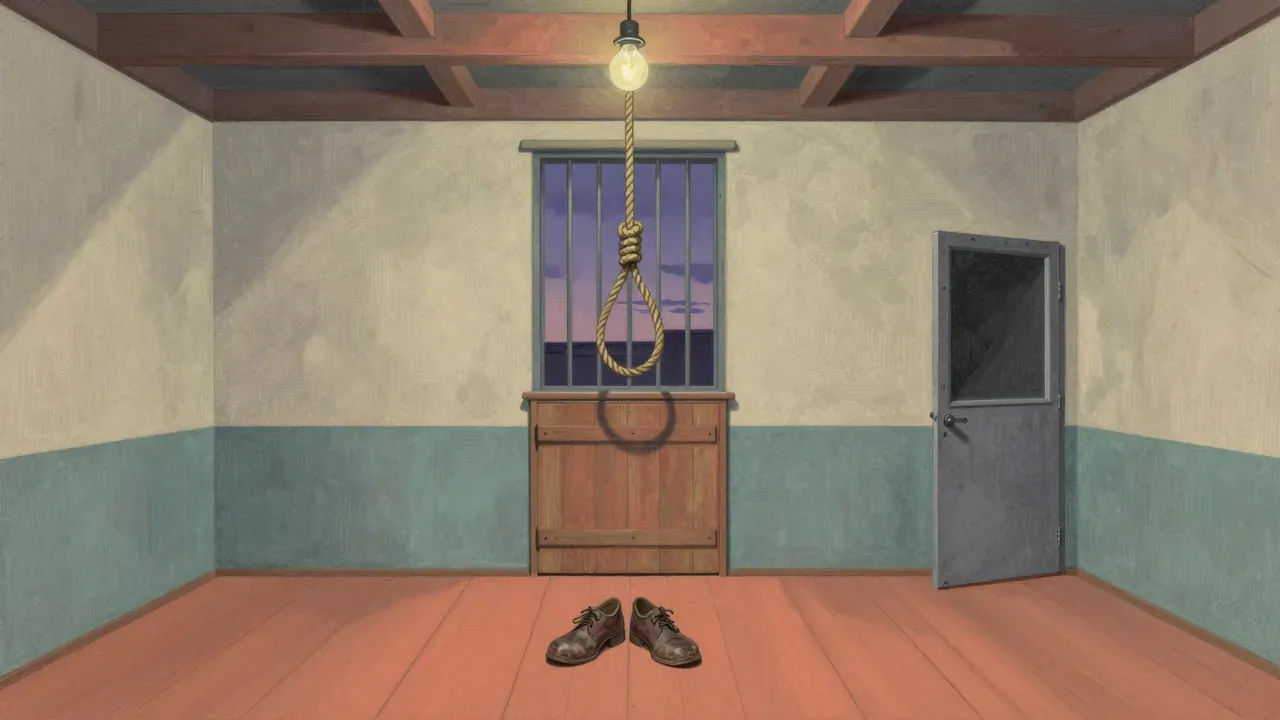
What lands is the film’s unrelenting pressure on contradiction. The officials’ insistence that R must remember his crimes in order to be killed exposes the absurdity of a justice system that requires self-recognition as a precondition for state murder. Their attempts to manufacture memory — first through coercion, then caricature, then confession — become increasingly transparent as acts of projection. The scene where an official kills a girl during a re-enactment lands with shocking banality, not shock value: it confirms that the line between sanctioned and unsanctioned violence is administrative, not moral. The sister’s appearance works because it introduces a counter-narrative without resolving the central tension — her hanging is neither triumph nor tragedy, but another layer of institutional failure. The final image — an empty noose — lands precisely because it refuses metaphorical comfort: it is literal, unresolved, and materially stubborn. The film’s Brechtian devices do not distance the viewer from emotion, but recalibrate attention toward structure, repetition and power.
The drinking party
What does not land is the film’s late drift into rhetorical overload. After the sister’s hanging, the drinking-party sequence — where officials confess wartime atrocities while ignoring R and the sister lying at their feet — strains under its own density. The dialogue grows faster, denser, less anchored in character or situation, and the satire begins to blur into abstraction without sufficient grounding. The prosecutor’s offer of freedom feels narratively unmotivated, and R’s final proclamation of innocence lacks the visceral weight of earlier moments because it arrives after the film has exhausted its primary dramatic engine: the struggle over memory. Some sequences — particularly the crude racial pantomimes of R’s childhood — risk flattening the very discrimination they critique, relying on shock rather than insight. The film’s resistance to catharsis is deliberate, but in its final third, that resistance begins to feel less like rigour and more like evasion: the contradictions multiply without deepening, and the absence of resolution starts to read as exhaustion rather than principle.
The second hanging
The themes that matter are not capital punishment in isolation, but the relationship between law and ethnic erasure, and between consciousness and coercion. The film treats guilt not as a psychological fact but as a social technology — one that requires shared language, history and legitimacy to function. R’s amnesia is therefore political: if he cannot recall his crime, he cannot internalise the state’s definition of it, and thus cannot be integrated into its moral economy. His Korean identity is not incidental background but constitutive — the Japanese state’s denial of full personhood to Koreans makes R’s non-recognition of guilt structurally inevitable. The officials’ inability to reconstruct his psyche reflects the state’s broader failure to recognise Korean subjectivity at all. Nationalism, whether Japanese or Korean, appears here not as liberation but as another script imposed on R’s body. The film’s enduring force lies in how it ties the death penalty to colonial continuity: the gallows are not an endpoint but an extension of occupation-era hierarchies, now administered by bureaucrats who mistake procedure for justice.
The empty noose
This film is for viewers who approach cinema as argument, not illustration — those willing to sit with discomfort, ambiguity and sustained intellectual provocation. It rewards attention to form, repetition and tonal shifts, not plot resolution. It is not for viewers who require emotional anchoring in character arcs or who expect satire to clarify rather than complicate. Those put off by theatrical artifice, deadpan delivery or extended philosophical dialogue will find little purchase. People who value historical fidelity over conceptual rigour may reject its liberties with Ri Chin’u’s story — Park Soo-nam did, and her objection remains valid. The film would change its appeal if it offered even one moment of earned empathy — not for R, but for any figure caught in the machinery — but it refuses that gesture. That refusal is its strength and its limit. Without it, the film would be less radical; with it, it remains inaccessible to many who might otherwise engage its politics.
The final frame
Yes, it is worth your evening — but only if you accept that its value lies in friction, not fluency. At 117 minutes, it demands patience with digression, tolerance for unresolved paradox and willingness to treat every scene as hypothesis rather than statement. It is not entertainment in any conventional sense, nor is it a primer on Korean-Japanese relations — it assumes prior knowledge of both the Ri Chin’u case and Japan’s postwar treatment of zainichi Koreans. Viewers expecting clarity or catharsis will leave frustrated; those who see cinema as a space for structural questioning will find few 1960s films so rigorously committed to that task. Its endurance is not due to accessibility but to its refusal to simplify. A version with tighter editing in the final third, or a stronger through-line for the sister’s role, would improve its impact — but such changes would also dilute its central provocation: that justice, like memory, cannot be rehearsed into being.