The premise is a vow, not a plot
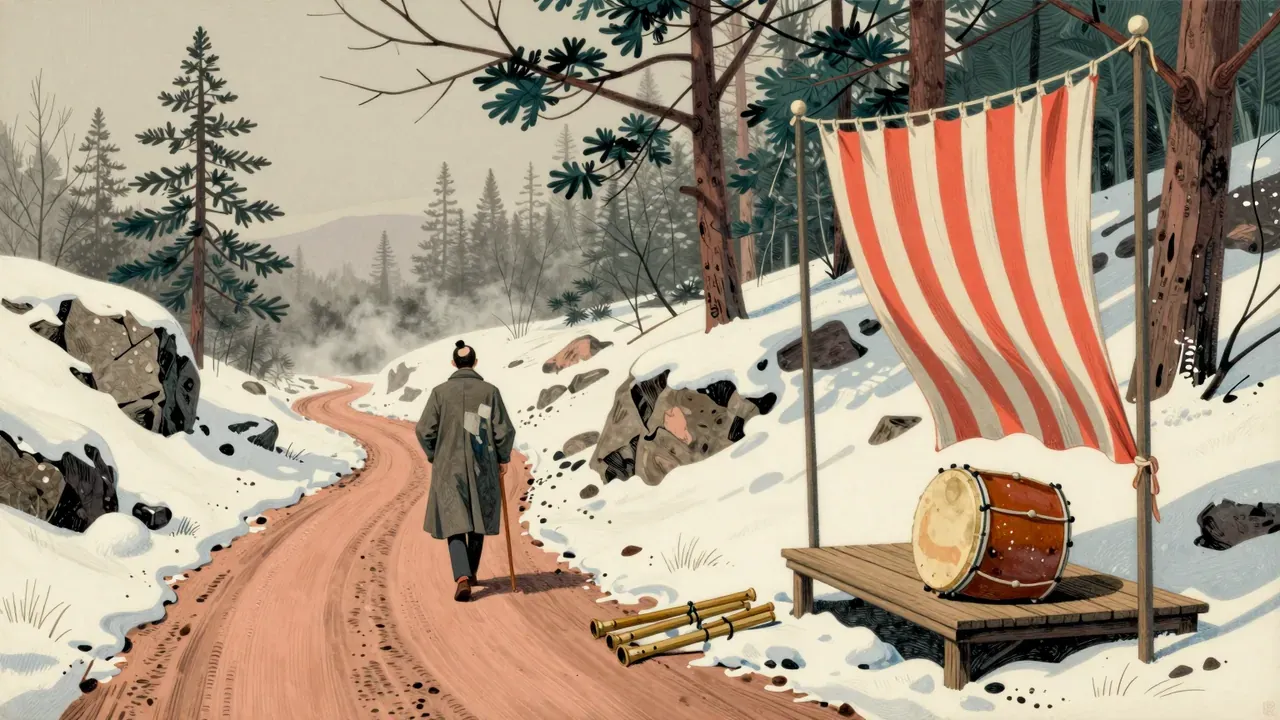
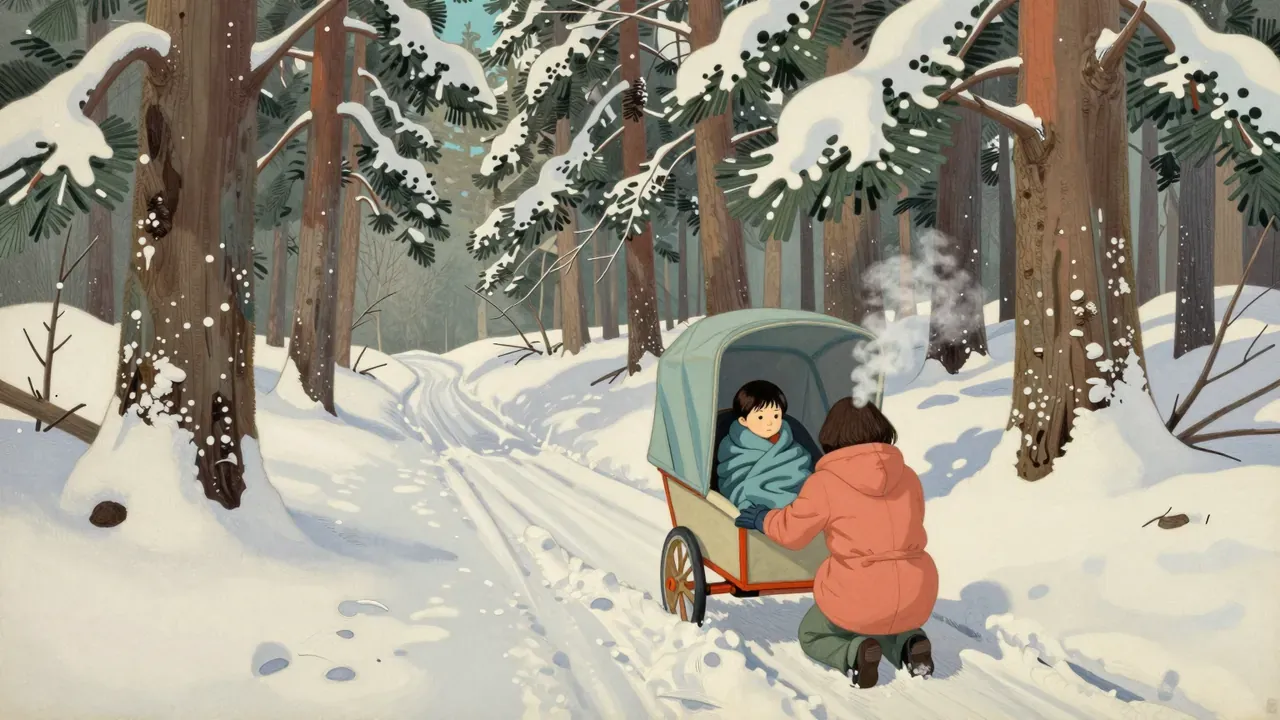
Lone Wolf and Cub: Sword of Vengeance is the first film in a six-part Japanese samurai series adapted from Kazuo Koike and Goseki Kojima’s manga. It sets out to establish Ogami Ittō — a disgraced shōgun’s executioner turned wandering assassin — not as a hero but as a figure stripped of rank, family, and moral certainty, moving through Edo-period Japan with his three-year-old son Daigoro in a baby cart. The film does not aim for historical realism or psychological exposition; instead, it uses ritualised violence, stark visual framing, and recurring symbolic gestures — the sword, the ball, the sashimono banner — to articulate a worldview where honour has been hollowed out and replaced by a vow of vengeance pursued with absolute, almost mechanical discipline. Its ambition is structural and tonal: to build a mythic grammar for the rōnin-as-avenger, one where every action, however brutal, follows from a single irrevocable choice made two years earlier. It treats genre conventions — the lone swordsman, the child sidekick, the corrupt clan — not as tropes to subvert but as vessels for a sustained meditation on duty, filiality, and damnation. (158 words)
The look of it
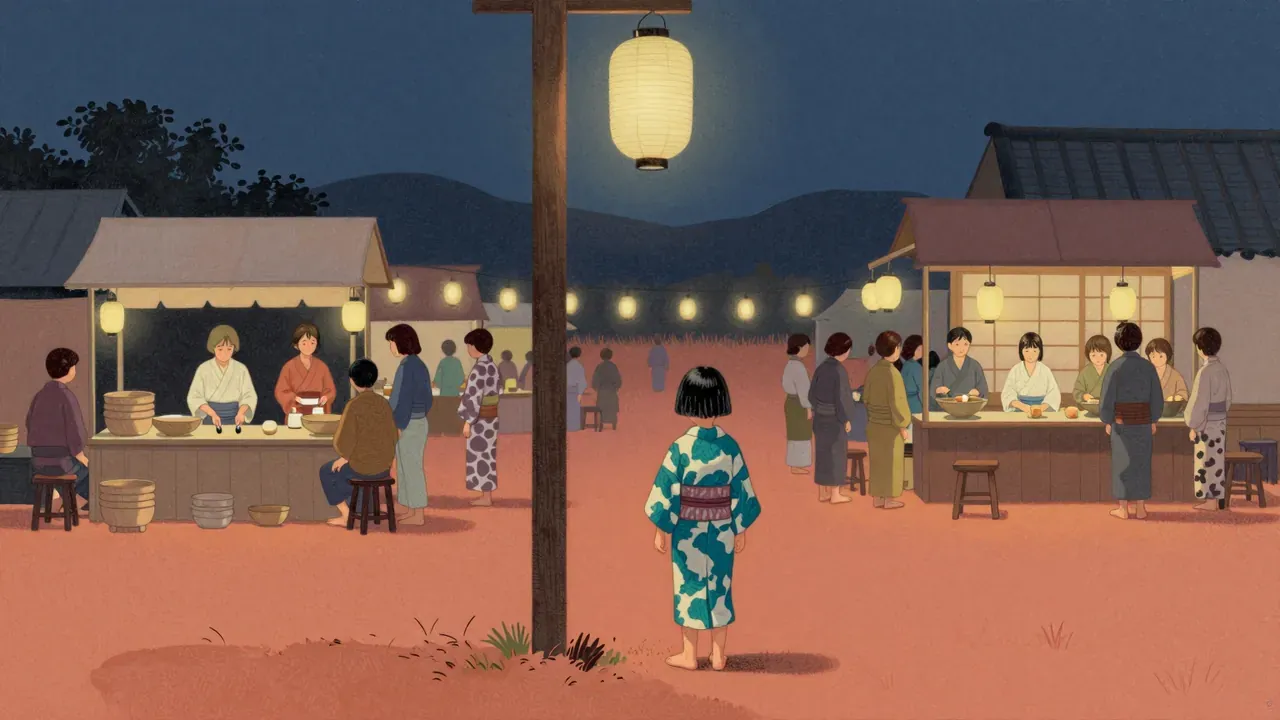
The story moves in deliberate, episodic strokes: flashbacks intercut with present-tense missions, each anchored by Tomisaburō Wakayama’s stillness — he blinks infrequently, speaks rarely, and never raises his voice. His performance rests on posture, timing, and the weight of silence; Daigoro’s presence is registered through observation, not dialogue. Kenji Misumi directs with a controlled austerity: compositions are often symmetrical, interiors lit with low contrast, exteriors shot in rain-slicked greys and muted ochres. The editing avoids reaction shots after violence; cuts land on aftermath, not impact. Action sequences are choreographed for clarity over speed — the duel with the mirror, the hot-spring massacre — relying on precise camera placement and minimal coverage. Fumio Watanabe and Shigeru Tsuyuguchi give restrained, bureaucratic menace as Yagyū functionaries; Tomoko Mayama’s prostitute registers as the only character whose empathy breaches Ittō’s carapace, though even that is cut short by a gesture, not a line. The score — sparse, percussive, dominated by taiko and shamisen — underscores rhythm rather than emotion. There are no establishing shots of towns, no exposition about clan politics; context arrives obliquely, through banners, surnames, and the way men bow. (159 words)
What lands
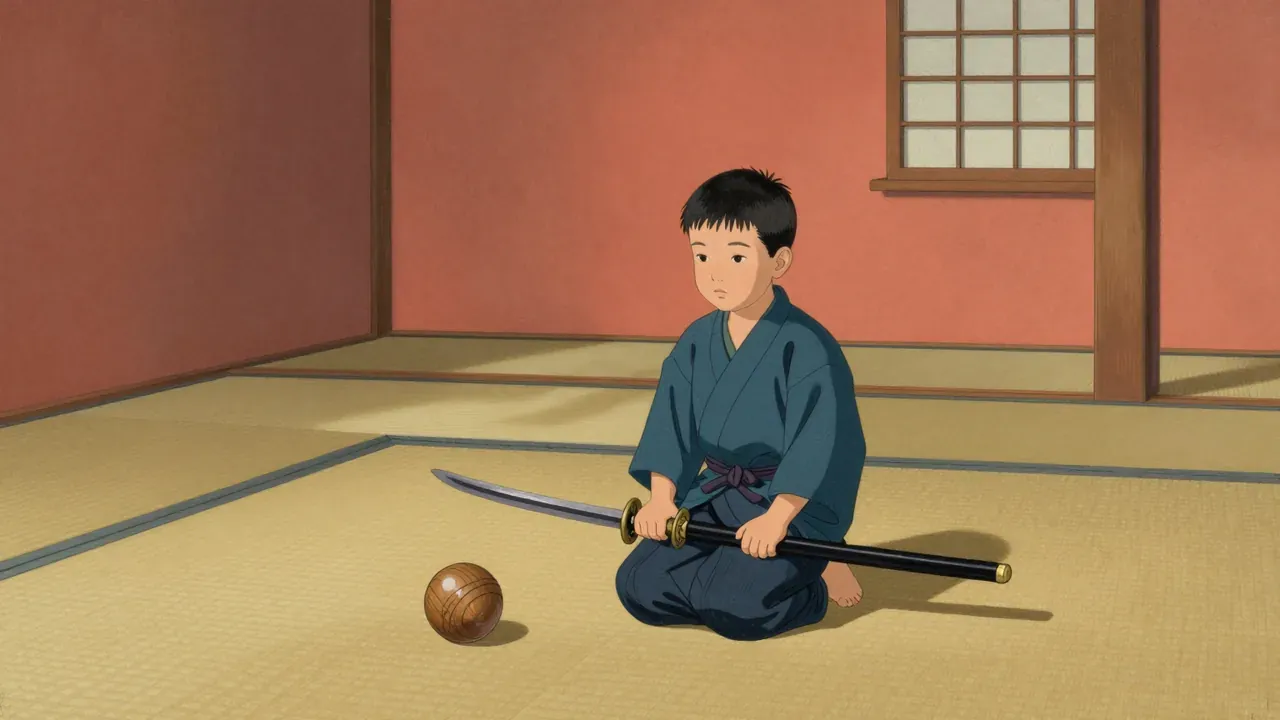
What lands is the film’s unwavering commitment to its own logic: the baby cart as both cradle and armoured chassis, the son’s silent participation in his father’s path, the refusal to sentimentalise either violence or parenthood. The scene where Daigoro suckles the madwoman works because it is presented without commentary — a physiological fact met with stoic pragmatism, not shock or irony. The flashback to the sword-or-ball choice lands with quiet force: it is not a test of courage but of ontological alignment — the boy’s reach is not volition but recognition of the only world left open to him. The final confrontation in the hot-spring village lands because its brutality is procedural, not cathartic; Ittō does not roar or hesitate, and the camera does not linger on wounds. The film’s restraint makes its few deviations — the prostitute’s gaze, the brief shot of Daigoro watching dogs nurse puppies — resonate precisely because they are rare. These moments do not soften the film; they confirm its rigour by showing what has been excluded. The pacing, at 83 minutes, sustains this without dilution: every scene occupies its full duration, no more, no less. (157 words)
What does not
What does not land is the attempt to frame the Yagyū conspiracy as politically intricate. The motivations remain vague — treason is named, but the stakes of succession, the mechanics of the Shadow Yagyū’s influence, or the chamberlain’s own reliability are left unexamined. Characters like Yagyū Bizen-no-kami and Kurando speak in proverbs but never clarify their position within the clan hierarchy or their personal stake in Ittō’s elimination. The hot-spring ronin are functionally interchangeable: their cruelty is generic, their dialogue expository filler rather than character revelation. The film assumes familiarity with Edo-period power structures it never explains, leaving non-Japanese viewers to infer hierarchy from titles alone. Worse, the sexual coercion scene — where Ittō submits to public humiliation — risks reading as punitive rather than existential without clearer grounding in his stated abandonment of ‘Meifumado’ values. It is filmed with detachment, but the narrative does not earn that detachment: we see the act, but not the internal calculus that makes it inevitable. The film’s refusal to explain also means its symbolism — the mirror, the banner, the cart — can feel ornamental rather than integrated when viewed outside the manga’s broader arc. (159 words)
The themes that matter
The themes that matter are filial obligation as complicity, vengeance as a system rather than an emotion, and the erosion of selfhood under absolute duty. Ittō does not grieve; he enacts. His relationship with Daigoro is not tender but contractual — the child is witness, accomplice, and living proof of the vow. The film treats parenthood not as nurture but as transmission: Daigoro learns not by instruction but by proximity to consequence. The repeated motif of nursing — the madwoman, the dog, the prostitute’s implied care — contrasts with Ittō’s refusal to feed anything but his purpose. The ‘crossroads to hell’ is not metaphorical geography but daily practice: every job, every mile, every rain-soaked pause confirms his status as already damned. Stoicism here is not virtue but symptom — the absence of alternatives. The Yagyū represent institutional rot disguised as order; Ittō’s path is chaos weaponised into form. There is no redemption arc, no moral ambiguity about ends justifying means — only the grinding consistency of cause and effect. The film’s rigour lies in refusing to let its protagonist feel anything other than resolve, making his humanity visible only in the spaces between actions: the way he adjusts the cart’s handle, the glance he gives Daigoro before drawing steel. (158 words)
Who should watch it, and who should not
This film is for viewers who value formal discipline over exposition, who find meaning in repetition and restraint, and who accept genre not as escapism but as philosophical architecture. It rewards attention to composition, timing, and the weight of silence — not just what characters do, but how long they hold a pose before acting. It is not for those who require psychological motivation, narrative closure, or moral resolution; the Yagyū plot remains opaque, the ending offers no release, and Ittō’s interiority is inaccessible by design. Anyone expecting character development, thematic elaboration, or even consistent world-building will find it withholding. A viewer who values strong emotional arcs or clear political stakes — say, someone drawn to Kurosawa’s humanism or Miike’s volatility — may find it cold. But that coldness is intentional: the film’s power depends on its refusal to warm up. To call it ‘unapproachable’ mistakes its method for its message — it is approachable on its own terms, which demand patience, not sympathy. (158 words)
Is it worth your evening
Yes, it is worth your evening — provided you watch it as a singular, self-contained object, not as an entry point to a franchise or a primer on samurai ethics. Its 83 minutes pass with the inevitability of its protagonist’s blade: no digression, no padding, no false notes. It repays rewatching not for hidden clues but for the precision of its craft — how Misumi holds a medium shot just long enough to register exhaustion, how Wakayama’s hands move before his eyes do, how the cart’s wheels sound different on stone versus mud. Those who dismiss it as ‘just action’ miss its structural intelligence; those who demand deeper backstory misunderstand its economy. It is not for casual viewing, nor for those seeking comfort — but for anyone willing to sit with austerity as expression, it delivers a rare kind of coherence. Its verdict does not hinge on likability or uplift, but on whether a film can be morally severe and formally exacting without becoming inert. On that count, it succeeds. (159 words)