The look of it
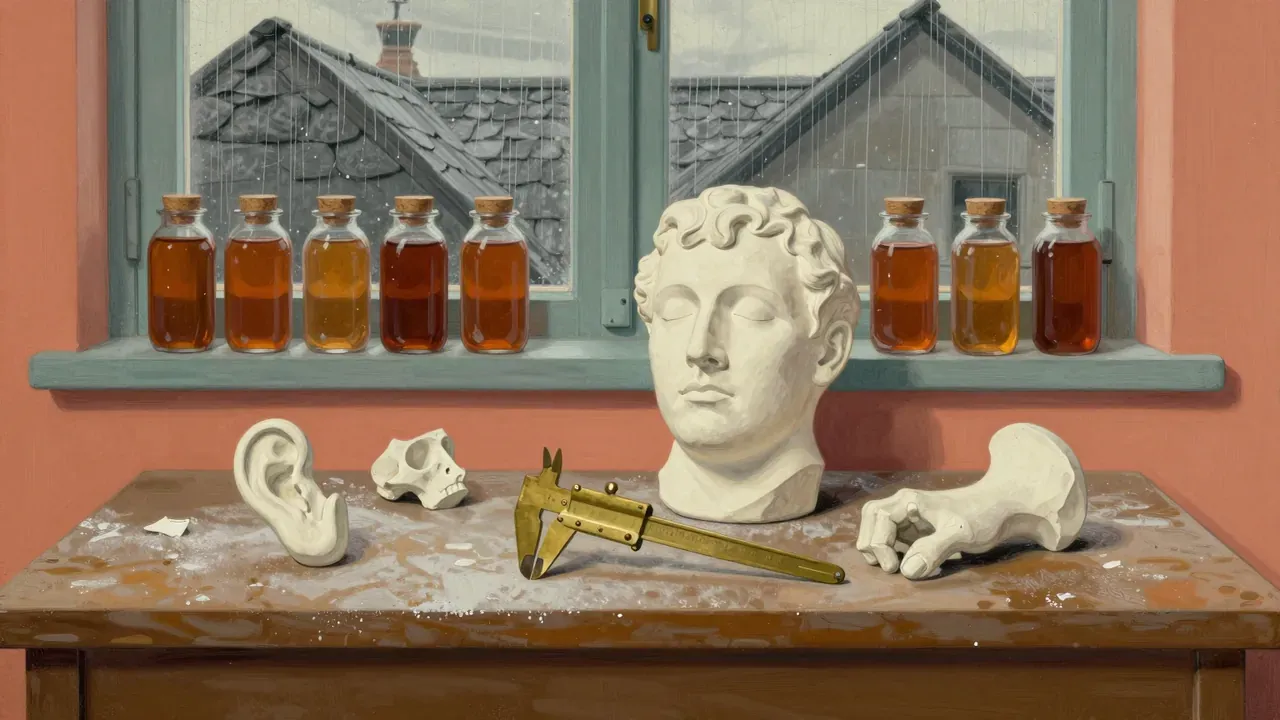
Eyes Without a Face is a French horror film from 1960 that attempts to transpose surgical obsession and paternal grief into a mode of quiet, ritualistic dread — not shock, not gore, not even conventional suspense. It does not seek to startle with violence but to unsettle through stillness: the slow tracking shot down a corridor, the unmoving face behind a mask, the silence between a father’s instruction and his daughter’s compliance. Georges Franju, directing his second fiction feature after a documentary background, treats the material not as pulp but as fable — one rooted in moral consequence rather than narrative payoff. The film adapts Jean Redon’s novel but shifts focus from the surgeon’s hubris to his daughter’s spectral interiority, framing the horror less as bodily violation than as erasure of selfhood under the guise of restoration. Its ambition lies in sustaining an atmosphere where clinical precision and poetic fragility coexist without irony or explanation. It asks the viewer to sit with discomfort that accumulates not through escalation but through repetition: the white gloves, the operating theatre’s antiseptic light, the recurring image of a face both absent and present.
The rhythm of it
The story follows Dr Génessier, a plastic surgeon who abducts young women to harvest their faces for transplant onto his disfigured daughter Christiane. Pierre Brasseur plays him with contained gravity — no ranting, no mania, only the weary authority of a man convinced he is right. Édith Scob, as Christiane, communicates almost entirely through posture, gaze, and silence; her performance is physical restraint made expressive. Eugen Schüfftan’s cinematography avoids expressionist distortion in favour of lucid, composed frames — corridors recede with geometric calm, interiors are lit with the flat neutrality of daylight studios, and the operating theatre gleams with sterile clarity. Maurice Jarre’s score alternates between a brittle carnival waltz and a muted, harp-led lament, reinforcing the duality of spectacle and sorrow. Editing by Gilbert Natot proceeds at a deliberate, almost liturgical pace: cuts land on pauses, not action. There are no close-ups of screaming, no rapid montage of trauma — only sustained looks, held silences, and the quiet mechanics of preparation and aftermath.
The mask of it
What lands is the cumulative weight of its restraint. The mask Christiane wears — smooth, blank, porcelain — becomes more haunting than any exposed wound because it refuses interpretation. The film’s refusal to explain motivation, to dramatise guilt, or to offer catharsis makes its emotional impact accrue slowly, like sediment. Scenes gain resonance in retrospect: the way Louise, the assistant, moves through Paris streets with predatory calm; the brief, unremarked tenderness Génessier shows a child patient; the way Christiane watches caged birds in her room — all these details settle without fanfare but deepen the sense of entrapment. Schüfftan’s lighting renders the clinic not as a gothic lair but as a place of ordinary, chilling functionality. Jarre’s music does not underscore emotion so much as locate it — a waltz for complicity, a lullaby for loss. Even the film’s most notorious sequence — the heterografting scene — works because it is shown clinically, without emphasis on blood or pain, making the horror reside in procedure itself, not spectacle.
The edges of it
What does not land is the structural thinness of secondary characters and some narrative ellipses that feel less like economy and more like omission. Alida Valli’s role as Louise has presence but little psychological anchoring; her loyalty to Génessier remains opaque, and her eventual fate arrives without dramatic preparation. The police subplot dissolves without resolution, suggesting narrative threads were trimmed or never fully woven. Some dialogue exchanges — particularly those explaining motivation — do sound stilted, as early critics noted, and the film’s pacing can read as inert rather than contemplative to viewers accustomed to forward propulsion. The absence of overt moral framing may frustrate those seeking clear judgment; the film declines to condemn Génessier outright, and that ambiguity, while deliberate, risks feeling like evasion. Also, the English-dubbed US version — retitled The Horror Chamber of Dr. Faustus — excises precisely the moments that humanise him, confirming how fragile the film’s balance is: tilt it slightly, and the moral architecture collapses into caricature.
The wound of it
The themes that matter are the ethics of repair, the violence of care, and the impossibility of restoring what has been lost. Génessier does not act from madness but from love twisted by certainty — he believes he can undo damage, yet every transplant deepens the injury. Christiane’s masked existence becomes a metaphor for identity erased by others’ designs: she is neither dead nor alive, neither visible nor invisible, neither agent nor object. The film interrogates medical authority not as corruption but as isolation — a logic so internalised it ceases to require justification. There is also a quiet critique of post-war French modernity: the gleaming clinic, the suburban villa, the efficient car — all instruments of control dressed as progress. And beneath it all runs a meditation on sight and blindness: eyes without faces, faces without eyes, observers who see nothing, victims who see too much. These are not abstract ideas but embodied conditions — in the gloves, the masks, the surgical drapes, the shuttered windows.
The pace of it
This film is for viewers who tolerate long takes, sparse dialogue, and unresolved tension — those who find unease in stillness more potent than chaos. It suits readers of Cocteau or viewers familiar with Bresson’s asceticism, or anyone drawn to horror that operates through implication rather than exposition. It is not for those who require plot momentum, character psychology spelled out, or cathartic release. Some will find its pace glacial, its tone monochrome, its moral stance frustratingly withheld. Those who expect horror to escalate — to shout, to jump, to bleed — will leave cold. A viewer who values narrative efficiency over atmospheric accumulation, or who needs clear ethical signposting, would be better served elsewhere. The film’s power depends on surrender to its rhythm; resistance to that rhythm is not a flaw in the film but a mismatch of expectation. Its reputation rests on patience, not passivity — and that distinction matters.
The afterimage of it
Yes, it is worth your evening — provided you set aside the expectation of entertainment and accept it as an artefact of mood and method. Ninety minutes spent with Eyes Without a Face is time spent inside a controlled temperature of dread, where every frame feels chosen, every silence calibrated. It rewards attention not with revelation but with resonance: images return unbidden, sounds linger, gestures acquire weight in memory. It is not ‘enjoyable’ in the conventional sense, but it is singular — a film that refuses to flatter the viewer’s desire for closure or comfort. Those who dismiss it as slow or cold often mistake its discipline for dullness. Its influence on later filmmakers — from David Cronenberg to Park Chan-wook — is evident not in imitation but in its proof that horror can be lyrical, surgical, sorrowful. To watch it is to witness a precise calibration of craft and conscience — and that remains rare, then and now.