What it is
Fish Tank is a British drama about a fifteen-year-old girl’s collision with desire, neglect and the illusion of escape. It does not seek to explain Mia’s volatility, nor to diagnose her environment; it watches her move through it, unmediated by exposition or moral framing. Andrea Arnold wrote and directed it as a study in physical presence — in how a body holds tension, how space constricts or opens, how music enters a room not as commentary but as lived sound. The film avoids narrative convenience: there are no flashbacks to justify behaviour, no voiceover to clarify motive, no third-act revelation that reorders what has passed. Its aim is narrower and harder: to hold attention on a girl who is neither symbolic nor exceptional, but simply there — breathing, dancing, lashing out, waiting. It treats adolescence not as a phase to be survived but as a terrain with its own weather, its own gravity, its own logic of cause and effect that rarely aligns with adult understanding. The film’s realism is not documentary-style verisimilitude but a sustained commitment to duration, silence and withheld information — a refusal to make Mia legible on terms other than her own. (158 words)
How it works
The story unfolds chronologically, shot over six weeks on the Mardyke Estate in Tilbury, with actors given only their immediate scenes. Katie Jarvis, cast after an argument at Tilbury station, carries the film without affectation or self-consciousness; her performance rests in posture, in the way she leans against doorframes or stares past people’s shoulders. Michael Fassbender’s Connor is never villainous, never redeemed — he occupies a middle ground where charm and evasion coexist without contradiction. Robbie Ryan’s cinematography uses natural light and shallow focus to compress space, keeping Mia often off-centre or half-obscured by doorways and windows. There is no non-diegetic score: every song plays from a phone, a car radio or a club speaker, anchoring emotion in the world rather than overlaying it. Nicolas Chaudeurge’s editing sustains rhythm through repetition — dance rehearsals, bus rides, repeated glances — not to build momentum but to deepen unease. The film’s craft is cumulative, not declarative: meaning accrues in the gap between what Mia says and what her hands do, between what Connor offers and what he withholds. (159 words)
What lands
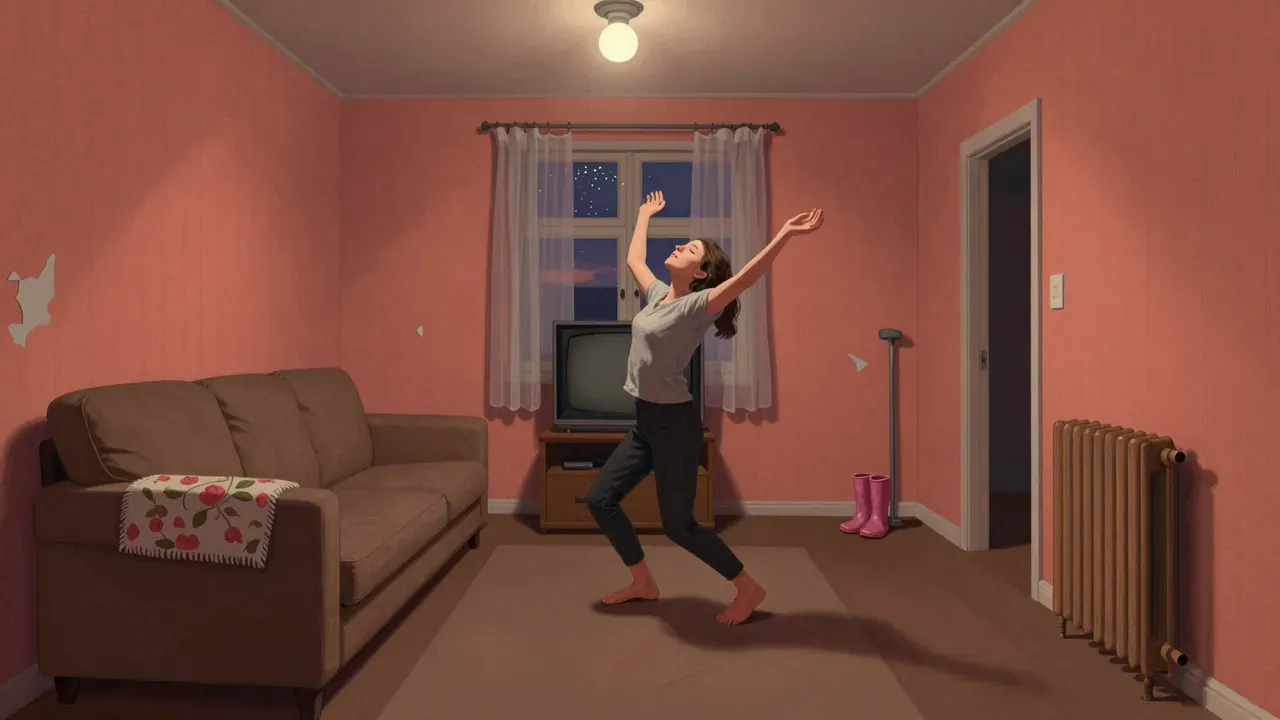
What lands is the weight of unspoken things: the exhaustion in Joanne’s voice when she snaps at Tyler, the way Mia’s hips shift before she speaks, the quiet dread when she first sees Connor’s daughter Keira on camera. The film’s most resonant moments are physically precise — Mia’s bare hands slipping over wet river stones as she tries to catch fish, the jolt of her spine when Connor touches her waist, the way she stops mid-dance at the audition when the music begins. These are not metaphors made visible but actions made unavoidable. The horse — tethered, then gone — works not as symbol but as absence made tangible. Even the film’s ending avoids resolution: Mia and Billy leave for Cardiff without certainty, and the final image is not of departure but of synchronised movement — three women dancing in a cramped living room, bodies briefly aligned in time and rhythm, then returning to their separate orbits. The film trusts its audience to register these shifts without underlining them. It assumes attention, not explanation. That trust is repaid in moments that settle like sediment, long after the screen goes dark. (157 words)
What does not
What does not land is the film’s occasional drift into schematic repetition — the third or fourth iteration of Mia drinking cider before dancing, the second or third scene of her being ignored by adults, begins to feel less like accumulation and more like insistence. The social worker’s visit arrives without consequence, then vanishes; the internet café attack feels abrupt, its aftermath unexamined. Connor’s departure lacks psychological texture: his final conversation with Mia is functional, not revelatory, and the film declines to show him grappling with his own failure beyond a single line. Some viewers may find the lack of narrative scaffolding alienating — no clear turning point, no pivot from ignorance to knowledge, no moment where Mia articulates what she wants beyond ‘out’. The film’s refusal to name certain dynamics — particularly the erotic charge between Mia and Connor — risks leaving ambiguity unresolved rather than charged. It asks the viewer to sit with discomfort without offering interpretive handholds, and that demand will frustrate those who expect cause-and-effect clarity or emotional catharsis as release. (156 words)
What it is about
The themes that matter are not abstract but bodily: containment and release, proximity and violation, competence and dependence. Mia’s dance is not self-expression but rehearsal for agency — a way to command space with her limbs when her voice is routinely dismissed. The council estate is not backdrop but pressure system: its concrete surfaces reflect heat and sound, its corridors amplify footsteps and shouting, its empty flats offer temporary autonomy but no safety. Class operates not as theme but as condition — in the distance between Connor’s suburban home and the Mardyke Estate, in the way Joanne’s exhaustion is treated as character flaw rather than structural fact, in the casual assumption that Mia’s future lies in boarding units or strip clubs. The film treats adolescence not as transition but as state: one where desire is misread as availability, where attention is mistaken for care, where the line between protection and possession blurs without warning. It refuses to separate personal from political — Mia’s isolation is individual, but it is also produced by housing policy, education cuts, and the quiet withdrawal of public services. (159 words)
Who it is for
This film is for viewers who value sustained attention over exposition, who find emotional precision in gesture rather than dialogue, and who accept that some endings are departures without destination. It suits those accustomed to arthouse pacing and resistant to narrative signposting — people who watch films not for plot resolution but for the texture of lived time. It is not for those who require moral clarity, who need characters to articulate their motives, or who expect trauma to yield insight. Anyone unsettled by ambiguous power dynamics, underage desire portrayed without condemnation or redemption, or prolonged scenes of adolescent boredom may find it withholding or oppressive. A viewer who expects cinema to offer answers — about class, abuse, or recovery — will leave dissatisfied. The film’s value lies in its refusal to translate Mia’s experience into terms palatable to adult interpretation. That refusal is its strength and its limit. (158 words)
Is it worth your evening
Yes, it is worth your evening — but only if you arrive prepared to watch, not to decode. Its 123 minutes ask for patience, not passive consumption: the rewards are cumulative, built in glances, silences, repetitions. It is not a film to be ‘got’ quickly, nor one that yields its weight on first viewing. Those who value craftsmanship in performance, sound design and composition will find it richly detailed; those who rely on narrative propulsion may find it slow or opaque. It is not for casual viewing, nor for background watching. Its power depends on full attention — on noticing how Mia’s shoulders drop when she hears Connor’s voice, how the camera stays on her face during a kiss she does not initiate, how the final dance sequence holds stillness and motion in equal measure. To dismiss it as ‘grim’ or ‘unrelenting’ misses its humour, its warmth, its physical joy — all of which exist without softening its gaze. (159 words)