The look of it
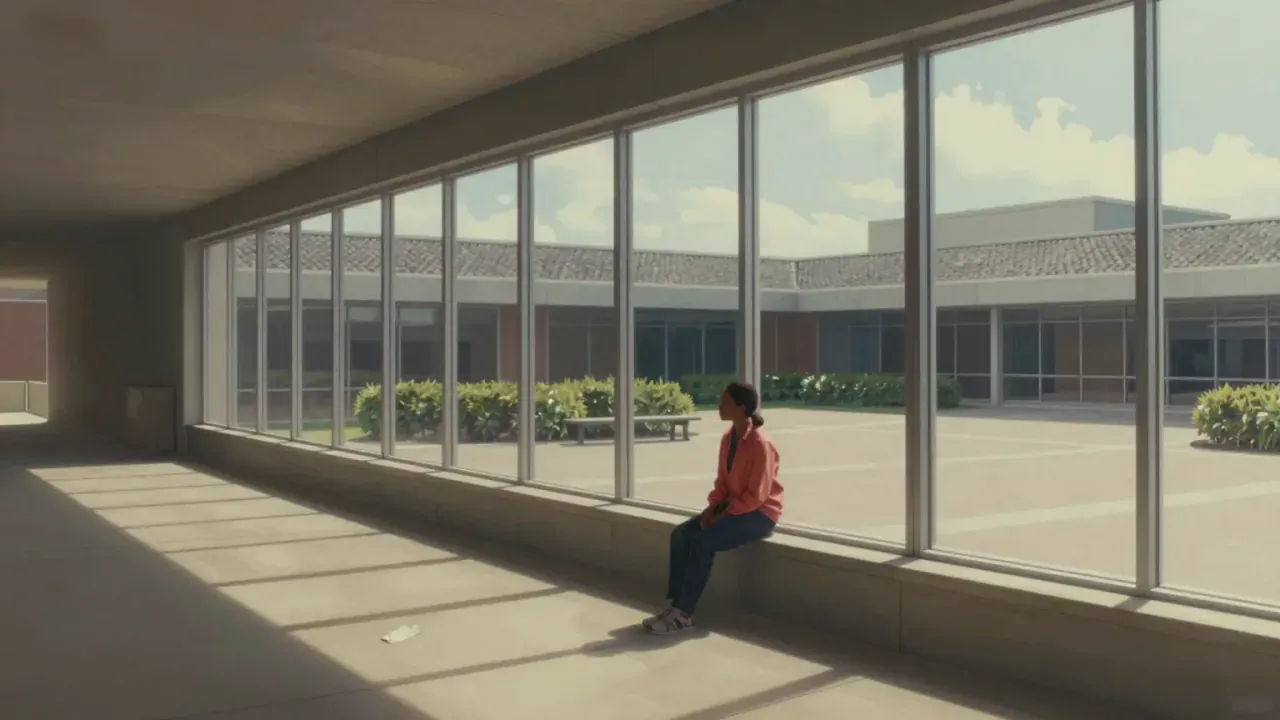
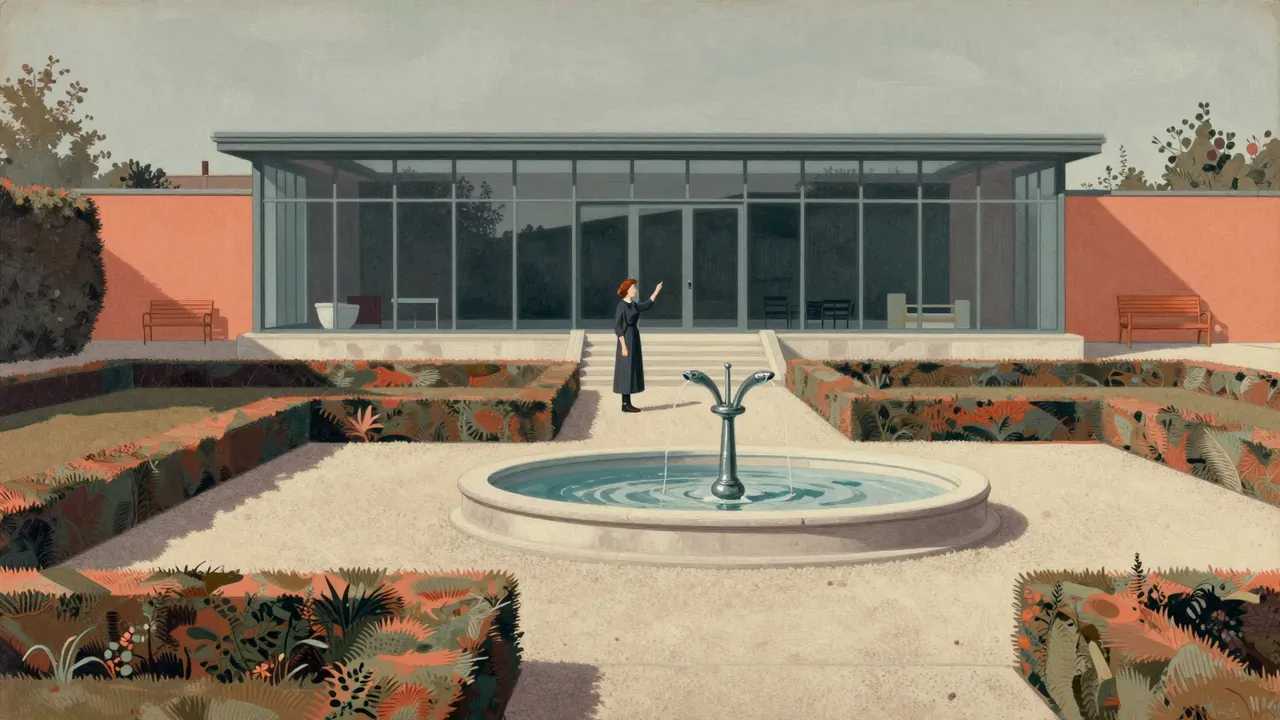
Playtime is a satirical comedy set in a hypermodern, geometric Paris built entirely on a purpose-built 70 mm stage. It attempts to map the friction between human movement and industrial design — not through dialogue or plot, but through choreographed spatial relations, layered sound, and colour as structural punctuation. Jacques Tati does not tell a story so much as conduct an environment: the film’s six sequences — airport, offices, trade fair, apartments, restaurant, roundabout — are architectural movements, each testing how people bend, stall, misalign or improvise within spaces engineered for efficiency and uniformity. The central figure, Monsieur Hulot, appears intermittently, less as protagonist than as a hinge between eras: his physical looseness contrasts with the rigid gait of tourists and office workers. Tati co-wrote the script with Art Buchwald, though little of that collaboration survives in the final film; what remains is almost entirely non-verbal, with language reduced to ambient texture. The ambition is formal and philosophical: to make architecture laughable, and laughter architectural. Word count: 148
How it moves
The film works by refusing conventional narrative propulsion. Story is episodic and loosely tethered by two figures — Hulot and Barbara — whose paths cross without converging meaningfully. Performances are deliberately muted: non-professionals were cast for their posture and gait, not expressiveness, and Tati avoids close-ups entirely, trusting 70 mm resolution to hold multiple actions across deep space. Jean Badal and Andréas Winding’s cinematography keeps the frame wide, shallow in depth of field but deep in information: every background plane contains activity, often unrelated to the foreground. Francis Lemarque’s score is sparse; instead, sound design carries the rhythm — doors, footsteps, neon hums, overlapping chatter — all precisely mixed in stereophonic layers. Dialogue is mostly unintelligible, dubbed post-production, and treated as environmental noise. The set itself functions as a character: its glass, steel and plastic surfaces reflect, distort and fragment movement, while life-sized cutouts and photographic backdrops quietly undermine the illusion of scale and realism. Word count: 152
Where it breathes
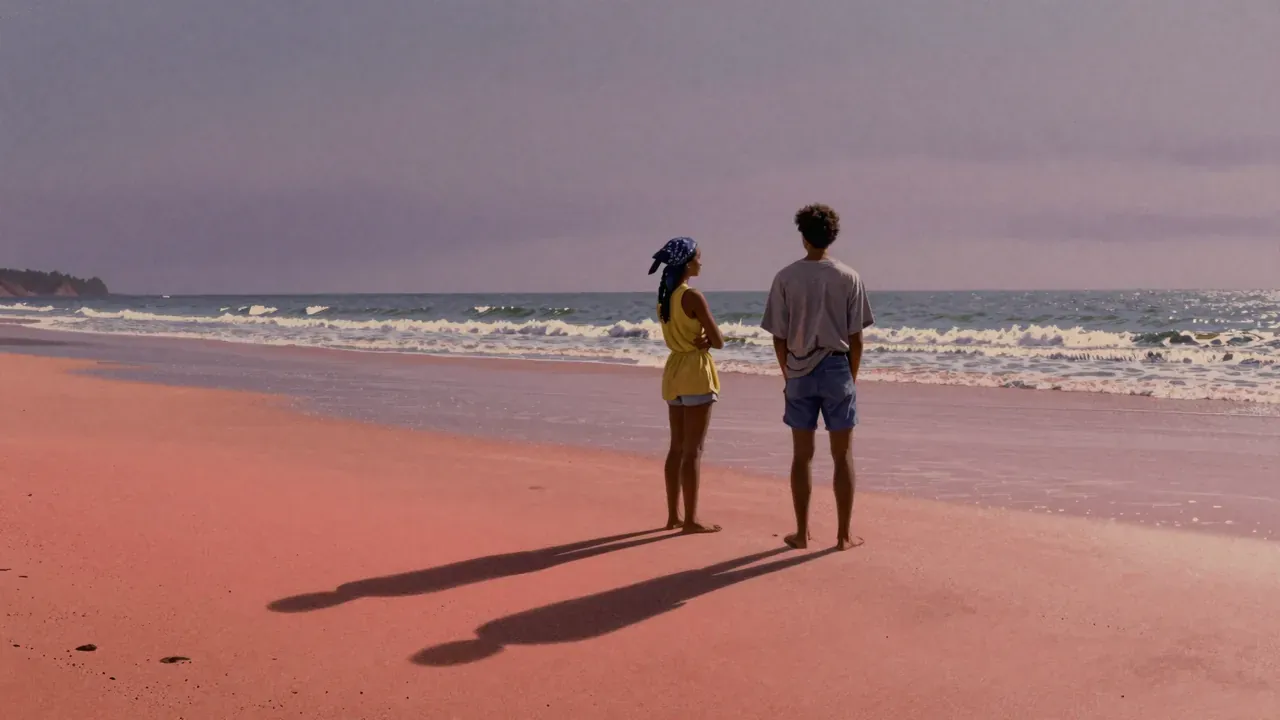
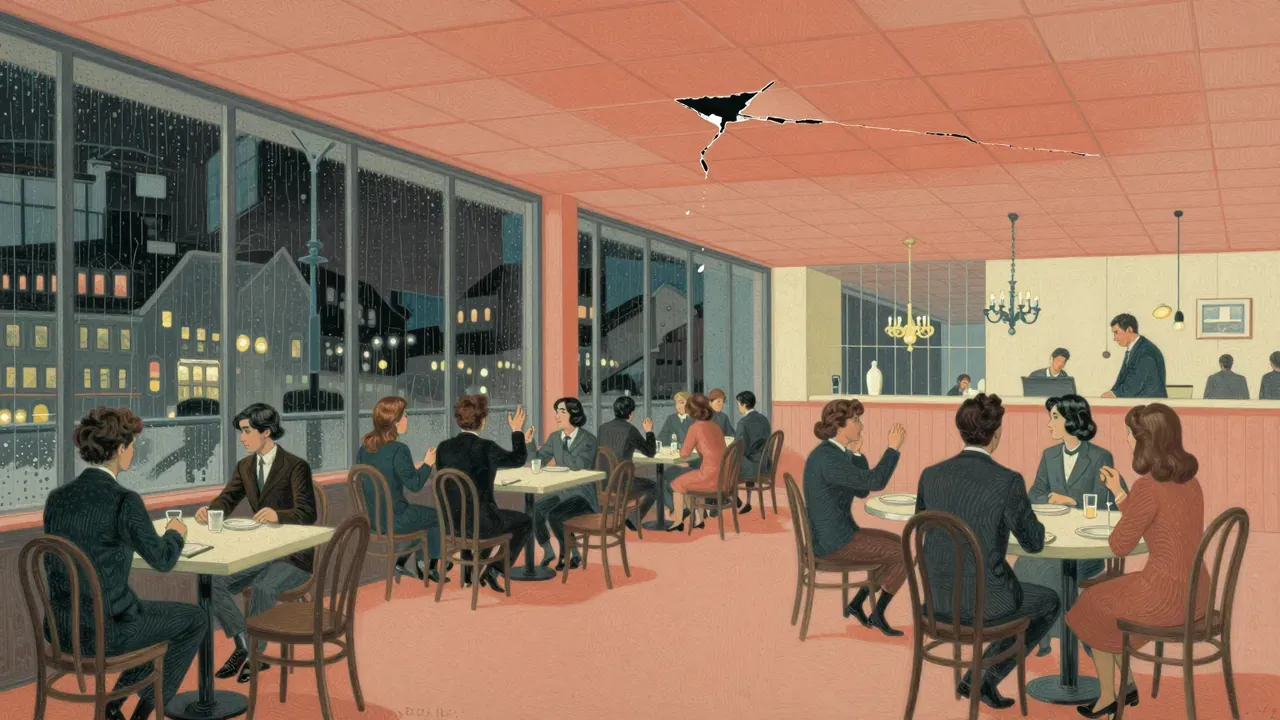
What lands is the cumulative precision of its visual logic. The airport’s sterile symmetry gives way to the offices’ recursive corridors, then the trade fair’s absurd gadgets — a door that closes in ‘golden silence’, a broom with headlights — all rendered with deadpan gravity. The apartment sequence, filmed from street level through uncurtained windows, turns voyeurism into geometry: residents move like figures in a diorama, their private rituals legible only through framing and timing. The Royal Garden restaurant scene builds slowly from brittle formality to joyful collapse, as crockery shatters, walls buckle and guests abandon decorum — a release earned by the film’s earlier restraint. Colour, too, lands with intention: the near-monochrome palette makes Barbara’s emerald dress shock like a biological intrusion, and later, as the party unravels, brighter clothing enters the frame as if the environment itself is thawing. Even the traffic circle finale — a looping, carnival-like ballet of buses and cars — resolves not narratively but kinetically, affirming movement over stasis. Word count: 154
Who is in it
What does not land is any sustained emotional investment in character or consequence. Hulot remains elusive, not enigmatic — he is present but never psychologically anchored, and his intermittent appearances prevent him from functioning as a true guide. Barbara, though visually distinct, has no interior life beyond her function as contrast and catalyst. The satire lacks bite where it aims for universality: the critique of modernism feels detached from material history — there is no labour, no cost, no class tension beyond the brief appearance of construction workers, who vanish after the opening sequence. The film’s refusal of exposition means some gags rely on repeated viewing to register, and its pacing — long takes, minimal cuts, deliberate slowness — can read as withholding rather than patient. Its financial ruin and technical overreach are legible on screen: the set’s artificiality occasionally asserts itself too plainly, especially in the photographed facades and cutout extras, which break immersion not ironically but awkwardly. Word count: 150
What it believes
The themes that matter are architectural determinism, perceptual habit, and the resilience of curvature against linearity. Tati treats the built environment not as backdrop but as behavioural script: people walk in right angles until they forget how to turn. The film charts a slow reclamation of organic motion — first in the teenagers dancing at the airport, then in the restaurant’s unraveling, finally in the roundabout’s circular chaos. Sound functions thematically too: intelligibility recedes as social rigidity loosens, suggesting that language is another system of control, easily discarded when pleasure takes over. The absence of real plants — only plastic imitations — underscores a deeper sterility: not just of design, but of memory and rootedness. Even nostalgia is mediated: reflections of the Eiffel Tower appear only in glass, doubled and distorted. This is not anti-modernism per se, but a study of how environments condition attention, and how attention, once redirected, can subvert intention. Word count: 149
Who it is for
It is for viewers who value composition over confession, who find pleasure in watching a crowd breathe in unison or scatter in confusion, and who trust time as a formal element rather than a constraint. It rewards patience, lateral attention and familiarity with mid-century design discourse. It is not for those who require narrative momentum, psychological motivation or verbal clarity — the film offers none of these as anchors. Anyone expecting the gentle charm of Les Vacances de Monsieur Hulot will find Playtime alienating: it is colder, more rigorous, less forgiving. Those who dislike long takes, ambient soundscapes or films that treat characters as compositional units will feel stranded. Its reputation as a masterpiece rests on formal achievement, not accessibility — and that distinction matters. Word count: 147
Is it worth your evening
Yes, it is worth your evening — but only if you watch it whole, in 70 mm if possible, and without expectation of payoff beyond observation. Its value lies in the density of its frames, the intelligence of its sound layering, and the quiet audacity of building an entire city to prove that people will always find ways to wander off the grid. It does not ask for empathy, only for attention — and repays that attention with a rare kind of clarity about how space shapes behaviour. Those who dismiss it as cold or inaccessible are not wrong, but their verdict assumes the film wants to be liked. It does not. It wants to be seen, heard and remembered as a structure — one that still stands, even if its foundations were nearly bankrupt. Word count: 149