The shape of the vow
The Sacrifice is a Swedish-language drama written and directed by Andrei Tarkovsky in the final year of his life, conceived as a poetic parable about faith, sacrifice and the collapse of meaning in the nuclear age. It does not dramatise geopolitical crisis but uses its outbreak as a catalyst to strip away social veneer and test the coherence of belief — not as doctrine, but as embodied commitment. Tarkovsky aimed for structural clarity absent from his earlier impressionistic work, building episodes into a harmonious whole where image, sound and silence function as interdependent elements of a single argument. The film’s form is deliberate: long takes, sparse dialogue, recurring motifs (water, fire, the planted tree), and a narrative arc that moves from domestic quietude through apocalyptic rupture to ritualised renunciation. Its ambition is theological and formal at once — to make visible the moment when language fails and action must speak instead. It is not a film about nuclear war but about what remains — or must be surrendered — when all guarantees vanish. Word count: 149
The weight of a single take
The story follows Alexander, a middle-aged intellectual played by Erland Josephson, whose world fractures after a radio announcement signals global nuclear conflict. His vow to God — to relinquish everything he loves — sets in motion a sequence of ritual acts culminating in the burning of his home. Susan Fleetwood, Allan Edwall and Sven Wollter deliver restrained, physically grounded performances; Edwall’s Otto functions less as character than conduit, introducing Maria and the idea of ‘witchcraft’ as unmediated spiritual agency. Sven Nykvist’s cinematography avoids Bergmanesque contrast: light is diffused, interiors are hushed and shallow-focus, with long tracking shots that follow movement without commentary. Colour reduction was applied to nearly 60% of the image, lending a bleached, tactile grain. Bach’s ‘Erbarme dich’ frames the film, while shakuhachi drones punctuate silence. Editing by Tarkovsky and Michal Leszczylowski sustains duration without indulgence — the six-minute house-burning take is not spectacle but endurance made visible. Word count: 158
The burn, not the blast
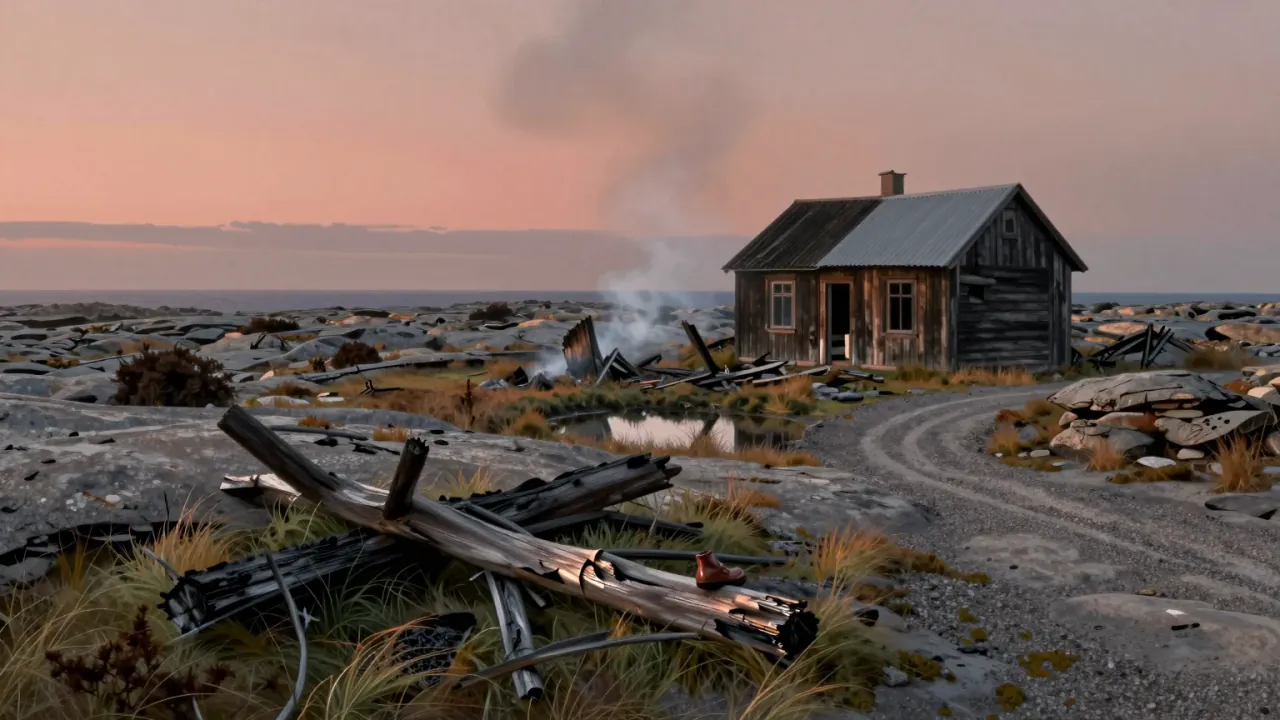
What lands is the film’s gravity of consequence. The burning house is not symbolic shorthand but a physical event with weight, smoke, heat and cost — both financial and emotional, given the need to rebuild it for a second take. The silence after the jets pass, before the news bulletin arrives, holds more tension than any explosion. Little Man’s final line — spoken only after Alexander has enacted his vow — lands because it arrives without explanation, as a quiet reassertion of language rather than its abandonment. The casting choices anchor abstraction: Josephson’s weariness reads as lived, not performed; Fleetwood’s Adelaide conveys fracture through posture and breath rather than outburst. Nykvist’s lighting keeps faces half-submerged, making emotion legible in hesitation, not declaration. Even the decision to shoot on Gotland rather than Fårö — a logistical constraint — yields a landscape that feels neither mythic nor documentary, but materially present: wind-scoured, low-horizoned, resistant to metaphor. The film earns its stillness by refusing to fill it with exposition or score. Word count: 157
The witch without a spell
What does not land is the framing of Maria as witch. Her role hinges on a logic the film declines to articulate: her power is asserted but never demonstrated, her knowledge implied but never shared. The floating sex scene — shot without visible rigging but with no attempt to rationalise its physics — sits uneasily between miracle and evasion. Tarkovsky’s journal notes suggest he revised the script to avoid a ‘weak’ happy ending, yet the resolution here feels structurally necessary rather than emotionally earned: Alexander’s breakdown is abrupt, his removal by ambulance unexamined, his fate left open not as ambiguity but omission. The film’s refusal to explain Maria’s agency or the mechanics of the ‘miracle’ risks reducing her to plot device, despite Guðrún Gísladóttir’s understated performance. Similarly, the repeated invocation of Christian and pagan themes remains textual rather than experiential — cited in interviews and critical writing, but not woven into the film’s sensory fabric with the same rigour as its use of water, fire or silence. Word count: 155
What survives the fire
The themes that matter are not nuclear annihilation or faith per se, but the conditions under which meaning becomes actionable. The film treats language as exhausted — Alexander hates ‘the emptiness of human speech’ — and tests whether meaning can survive its withdrawal. The planted tree, the burned house, the mute child who speaks only at the end: these are not symbols but anchors — objects that persist across rupture and carry consequence forward. Mortality is not abstract: Tarkovsky was terminally ill during editing, and the film’s preoccupation with time — the slow burn, the delayed reaction, the weight of a single day — reads as bodily fact, not philosophical pose. The domestic sphere is neither refuge nor illusion, but the only site where sacrifice can be measured: not in grand declarations, but in the choice to light a match, to walk away from a child, to let a house fall. The film’s engagement with Christianity is liturgical rather than doctrinal — it borrows the structure of prayer, vow and penance, but replaces dogma with gesture. Word count: 152
The terms of attention
This film is for viewers who accept duration as part of meaning — those accustomed to films where silence carries weight, where a six-minute take is not indulgence but argument. It rewards attention to texture: the grain of wood, the dampness of soil, the way light falls across a face mid-sentence. It is not for those who require narrative propulsion, psychological exposition or closure — the ending offers no resolution, only return: to the tree, to the word, to the unresolved question of whether the sacrifice was accepted, witnessed or even real. Some critics argue the film’s austerity borders on asceticism; others find its restraint a failure of empathy. A viewer who values emotional transparency over formal discipline would likely find it withholding. Its value shifts if watched without knowledge of Tarkovsky’s illness — but that context is inseparable from its gravity, not incidental to it. Word count: 150
The first word, not the last
Yes, it is worth your evening — but only if you watch it whole, in one sitting, without interruption, and without expectation of conventional payoff. Its 149 minutes accumulate like sediment: not through plot turns but through repetition, variation and erosion. The film asks for surrender — not of belief, but of habitual viewing patterns: the reflex to interpret, to anticipate, to resolve. Those who find its pace oppressive may prefer Tarkovsky’s earlier work, where metaphysical questions are embedded in more tangible worlds. But for viewers willing to sit with uncertainty, its final image — a child speaking, a woman cycling away, smoke still rising off-screen — lingers not as answer but as threshold. It is not cathartic, but it is consequential. To miss it is not to miss a story, but a calibration of how much weight a single image, a single sound, a single silence can hold. Word count: 150