The framing device
Lola Montès is a biographical film that frames the life of Lola Montez not as linear chronicle but as spectacle: a circus ring where memory is auctioned, performed, and dismantled. Max Ophüls treats her biography as material for formal experiment — not to illuminate historical truth, but to expose how fame, gender, and power conspire to reduce a woman’s life to a sequence of salacious tableaux. The film attempts something rare for 1955: a self-reflexive structure in which narrative is subordinate to staging, and biography serves mise-en-scène. It uses CinemaScope not for spectacle’s sake but as architectural constraint — the wide frame becomes a cage, a ring, a proscenium. Colour is deployed systemically, not decoratively: costumes, paths, even snow are dyed or relocated to sustain chromatic logic. This is not a film about Lola Montez the person so much as about Lola Montès the construct — the name as brand, the body as exhibit, the past as inventory. Its ambition lies in making form carry meaning without exposition, letting the circus apparatus — whip, spotlight, parade, admission fee — articulate the economics of attention. It is less a portrait than a dissection of portraiture itself. (158 words)
The look of it
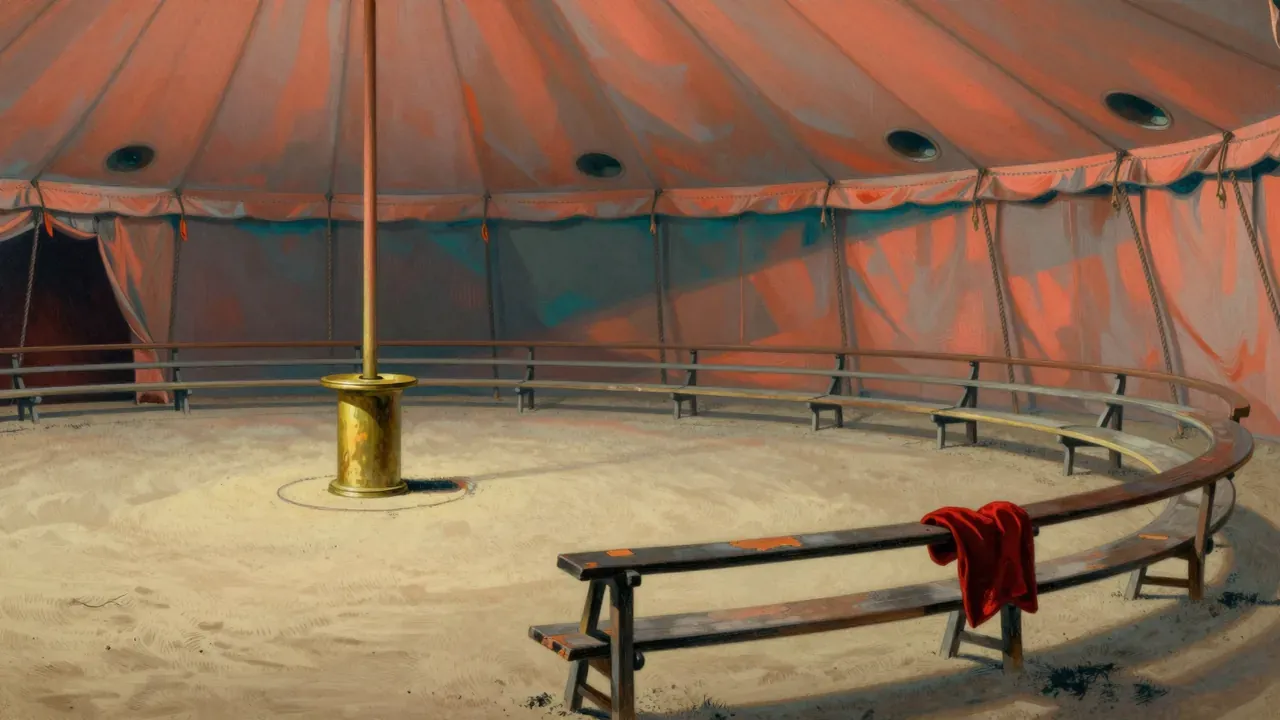
The story unfolds through nested flashbacks triggered by audience questions inside a circus tent, with Martine Carol performing Lola as both subject and performer — often forgetting lines, needing prompting, visibly fraying. Peter Ustinov’s ringmaster controls tone and tempo, his irony never slipping into mockery; Anton Walbrook as King Ludwig moves with ceremonial stiffness that underscores political fragility. Christian Matras’s cinematography keeps the camera in constant, unhurried motion — tracking shots glide along curved paths, pivot around performers, rise and fall with circus rigging — refusing stillness as a default. Editing by Adolf Schlyßleder and Madeleine Gug intercuts French, German and English language versions not as redundancy but as rhythmic counterpoint, reinforcing the film’s insistence on multiplicity over singularity. Georges Auric’s score avoids period pastiche, using waltzes and marches as structural devices rather than emotional cues. The production design — from the purpose-built Munich circus to the re-dyed gravel at Schloss Weißenstein — treats every surface as legible sign. There is no background here: everything is foregrounded, lit, composed, and weighted. (159 words)
The performance
What lands is the film’s sustained tonal control: its refusal to pity Lola, romanticise her lovers, or resolve her contradictions. The Liszt sequence works because it shows intimacy as negotiation — the carriage, the note, the interrupted departure — all rendered without sentiment. The childhood flashback, brief as it is, lands precisely: young Lola sleeping among other girls while her mother entertains a lover in private cabin space, a visual shorthand for inherited precarity. The circus framing device holds across the full runtime, never collapsing into metaphor but remaining literal architecture — a space where performance and exhaustion coexist. The colour palette does not merely decorate but discriminates: warm golds for illusion, cool greys for disillusion, sudden reds for rupture. Even the medical subplot — the clown-manager counting coins while a doctor warns of Lola’s failing heart — lands not as melodrama but as quiet indictment of extraction. These elements do not accumulate toward revelation but reinforce a single proposition: that visibility is a form of labour, and endurance its only reward. Nothing feels gratuitous; every shot serves the central conceit. (157 words)
The colour
What does not land is the film’s reliance on Martine Carol’s star persona as sufficient emotional anchor. Her performance is technically assured but emotionally recessive — less a choice than a limitation of casting against type. She lacks the volatility or wit needed to make Lola’s self-awareness feel earned rather than assigned. Several tableaux vivants — particularly those depicting Lola’s Spanish debut and Russian abduction — remain visually ornate but narratively inert, their symbolism too literal to resonate. The English-language sequences, shot separately, sit uneasily in the final cut: diction and timing diverge just enough to break continuity without adding dialectical tension. The film’s insistence on triple-language production also flattens linguistic texture — no version feels native, all feel rehearsed. Some transitions between circus present and flashback lack spatial or rhythmic logic, relying on dissolve rather than motivation. And while the circus framework is conceptually strong, its repetition risks monotony in the second half: the ringmaster’s patter grows predictable, the parade loses novelty, and Lola’s physical decline is implied rather than embodied. These are not flaws of ambition but of execution — moments where scale outpaces precision. (159 words)
The structure
The themes that matter are not those of biography — love, betrayal, exile — but those of mediation: how stories are framed, sold, shortened, restored, and remembered. The film interrogates the mechanics of reputation, showing how Lola’s identity is assembled from fragments — press clippings, royal decrees, dance reviews — then repackaged for mass consumption. Class operates not as backdrop but as grammar: the baron’s proposal, Ludwig’s abdication, the correctional home donation — each reveals who holds power to define value. Gender is treated structurally: Lola’s body is measured, priced, paraded, examined, and finally exhausted, yet she retains agency in narration — however faltering. Memory is neither reliable nor nostalgic; it is performative, contingent, and commercially exploited. The circus is not metaphor but infrastructure — a system that demands repetition, rewards spectacle, and discards what no longer draws crowds. There is no redemption arc, no moral lesson — only the slow realisation that the ring is not a stage but a condition. The film’s enduring relevance lies in this unsentimental anatomy of attention economy, decades before the term existed. (158 words)
The theme
This film is for viewers who attend to composition before character, who follow camera movement as closely as dialogue, and who find intellectual pleasure in formal rigour. It suits those familiar with Ophüls’s earlier work — La Ronde, Le Plaisir — and those willing to sit with ambiguity, repetition, and unresolved tension. It is not for viewers who require psychological realism, narrative propulsion, or emotional catharsis. Those expecting a conventional biopic will find it withholding; those seeking historical clarity will find it deliberately oblique. Some admirers of the French New Wave may be surprised by its meticulous control — it is avant-garde not in fragmentation but in discipline. A viewer who values pacing over precision, or who reads subtitles as interruption rather than layer, will likely disengage early. The film assumes patience with its own syntax — and rewards it. Those who dislike CinemaScope’s spatial demands, or who find colour used as system rather than mood, will resist its logic. Its ideal viewer is one who watches films as objects made, not just stories told. (159 words)
The afterlife
Yes, it is worth your evening — but only if you watch it as an artefact of cinematic thinking, not as entertainment. Its 115 minutes unfold with the gravity of a ritual, not the urgency of a plot. You will not leave knowing more about Lola Montez the woman, but you will understand more about how cinema constructs women as spectacle. It repays close attention: the way Matras lights Carol’s face in the ring’s glare, the way Schlyßleder cuts between languages to underline artifice, the way Auric’s waltz returns like a recurring debt. Some will call it cold — Andrew Sarris did — but its restraint is its argument. Those who prefer immediacy over implication, or who expect restoration to erase complexity, will find it alienating. A viewer who watches it once for story and again for structure will find two different films. Its value lies not in what it says, but in how relentlessly it asks how meaning is built, frame by frame, question by question, colour by colour. (159 words)