The shape of the argument
Things to Come is a 1936 British science fiction film that attempts to dramatise H. G. Wells’ vision of historical inevitability: war as catalyst, collapse as prelude, and technocratic rationalism as civilisation’s only viable successor. It is not a character study nor a speculative thriller, but a didactic pageant — structured in three distinct temporal acts — charting humanity’s passage from 1940 to 2036 through crisis, regression, and re-engineering. Wells co-wrote the script with Lajos Bíró under Alexander Korda’s production, insisting on fidelity to his philosophical framework rather than narrative convention. The film treats history as thermodynamics: energy must dissipate before renewal, society must fracture before reconstruction. Its ambition is pedagogical, not psychological; its logic architectural, not emotional. It presumes the audience shares its belief in progress as linear, secular, and materially grounded — a belief encoded in every set, shot, and speech. This is not prophecy dressed as fiction, but ideology rendered in concrete, steel, and monochrome light. (158 words)
The look of it
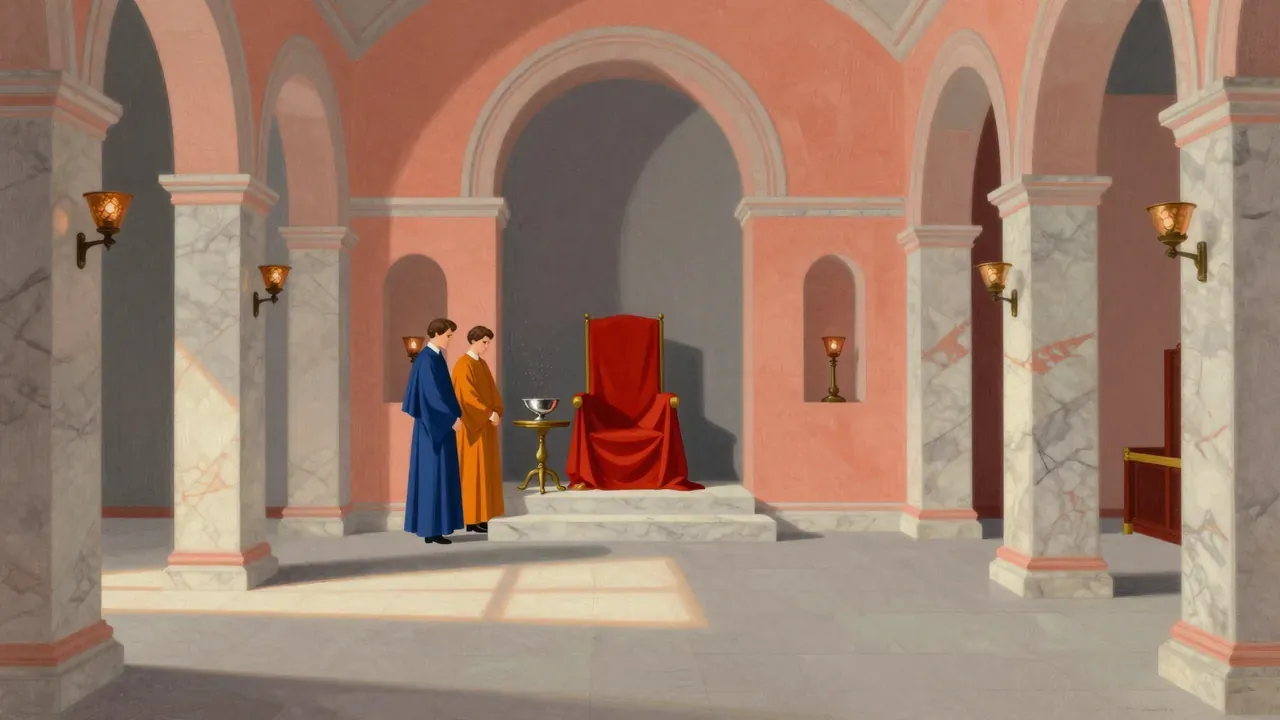
The story moves in broad, declarative strokes: Christmas Eve 1940 gives way to aerial bombardment, then decades of ruin, then the arrival of Wings Over the World, then lunar ambition in 2036. Raymond Massey carries the first and third acts with stoic gravity; Ralph Richardson’s Boss is theatrically vivid but constrained by the script’s schematic needs; Cedric Hardwicke’s Theotocopulos appears late and briefly, embodying dissent without nuance. Georges Périnal’s cinematography favours deep focus and high-contrast composition, especially in the ruined Everytown sequences, where rubble and fog are lit with forensic clarity. Vincent Korda’s production design dominates — the rebuilt city is all clean curves and recessed lighting, the warlord’s domain all ragged cloth and candle smoke. Arthur Bliss’s score was composed before editing began, and the film was cut to its rhythms, giving the action a stately, almost liturgical pace. Charles Crichton’s editing sustains this tempo, avoiding cross-cutting or subjective continuity in favour of tableau-like transitions between eras. (159 words)
What holds the eye
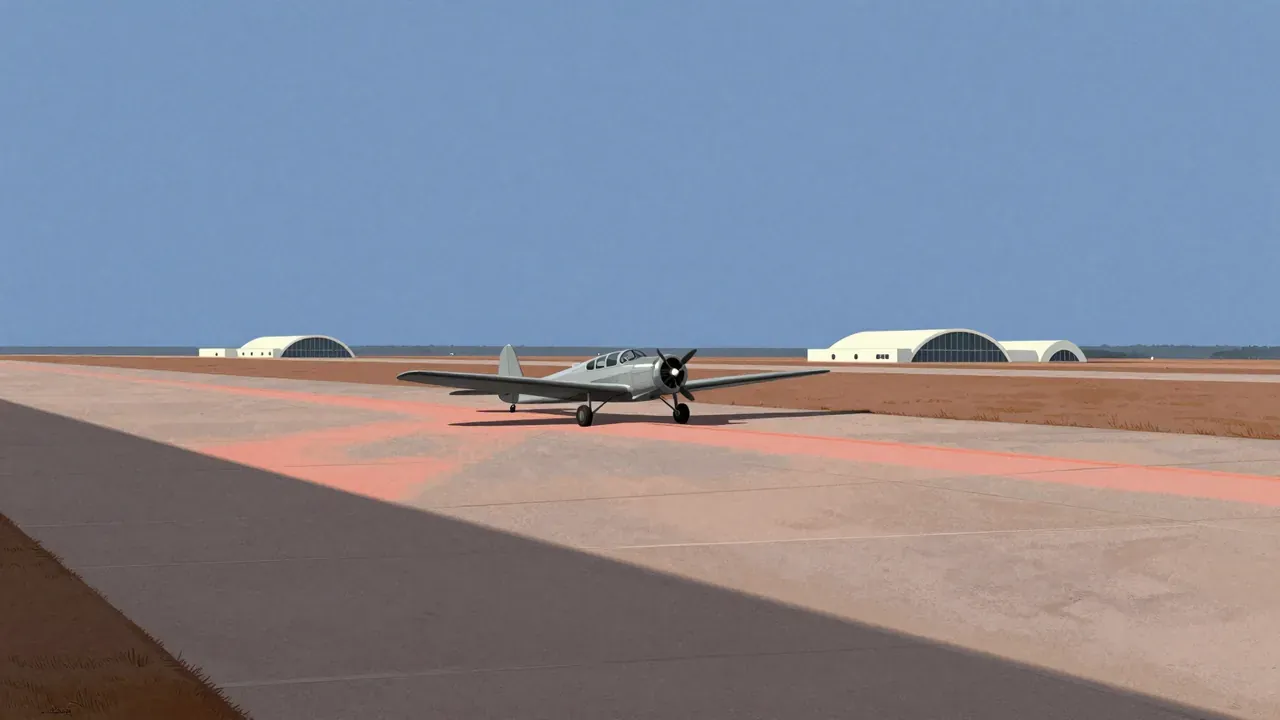
What lands is the film’s visual authority. The 1940 air raid remains unnervingly effective: no music, no dialogue, just the low drone of engines, the sudden glare of searchlights, and the slow, silent descent of incendiaries onto rooftops. The ruins of Everytown in the 1970s are rendered with tactile authenticity — cracked pavement, rusted girders, children playing among collapsed church arches — not as backdrop but as geological stratum. The contrast between the Boss’s crude biplanes and Cabal’s sleek monoplane is more persuasive than any speech about progress. The underground city of 2036 feels plausible because its surfaces are smooth but unadorned, its lighting functional, its scale human rather than monumental. Even the ‘Gas of Peace’ sequence avoids spectacle: it is a quiet, clinical mist settling over sleeping figures, not a burst of colour or sound. These moments succeed because they trust the image over the idea — when the film shows rather than tells, its conviction becomes visible. The design does not argue; it occupies space with quiet certainty. (157 words)
Where the voice fails
What does not land is the dialogue’s insistence on exposition as revelation. Characters state their positions like committee minutes: ‘War is a disease’, ‘Science is our only salvation’, ‘Rest is death’. These lines are not delivered so much as deposited, often with little variation in pitch or rhythm. The middle section — the dark age — suffers most: the ‘wandering sickness’ is described but never shown with physical specificity; the hill people remain offscreen abstractions; the Boss’s tyranny lacks texture beyond costume and shouting. The 2036 sequence collapses into allegory too quickly: Theotocopulos’s rebellion against progress is reduced to a single mob scene, his critique of acceleration left unexamined. Wells’ distaste for Metropolis is legible in the absence of eroticism or spiritual yearning, but the film pays a price for that austerity — it has no counterweight to its own certainty. There is no ambiguity in the architecture, no hesitation in the score, no doubt in the speeches. That rigidity makes the film intellectually coherent but emotionally inert at key junctures. (159 words)
The time it really belongs to
The themes that matter are not futuristic but interwar: the exhaustion of liberal optimism after the First World War, the fear of technological regression, and the seductive appeal of technocratic governance as antidote to democratic drift. It treats war not as moral failure but as systemic friction — inevitable, destructive, yet paradoxically necessary for clearing ground. The film’s real subject is time itself: not as duration but as phase. Everytown is less a place than a stage in a cycle — destruction, dormancy, design. The ‘Wings Over the World’ organisation is not a government but an engineering consortium, its legitimacy derived from competence, not consent. The final lunar launch is not about exploration but about momentum: stopping would mean entropy winning. This is a profoundly materialist utopia — no gods, no markets, no families as units of meaning, only calibrated effort directed at cosmic scale. Its vision of peace is not tranquillity but continuous calibration; its version of freedom is the right to contribute to the machine. That vision feels less dated than alien — a mirror held up not to the future, but to the 1930s’ hunger for order. (158 words)
Who it speaks to
This film is for viewers who value design as argument, who find intellectual coherence more compelling than psychological realism, and who can sit with longueurs as structural necessity rather than pacing flaw. It rewards attention to texture — the grain of concrete, the weight of a flight suit, the geometry of a ventilation shaft. It is not for those who require character arcs, emotional escalation, or narrative surprise. Anyone expecting a precursor to Blade Runner or even Metropolis will find it austere, even arid. Those who dislike exposition-heavy scripts or static staging will disengage early. A viewer who values ambiguity or moral complexity may feel lectured. But the verdict shifts if you accept its terms: it is not flawed because it is didactic — it is didactic by design. To call it cold is to miss that its temperature is deliberate. Its ideal viewer is one who reads The Outline of History for pleasure and finds beauty in blueprints. (159 words)
Why it still stands
Yes, it is worth your evening — but only if you approach it as a historical artefact of thought made visible, not as entertainment in the conventional sense. Its 110 minutes unfold with the gravity of a civic ceremony: measured, unyielding, self-assured. You will not be startled, but you may be recalibrated — reminded that utopianism once wore overalls and spoke in engineering terms. It repays close viewing not for plot twists but for compositional discipline: how a corridor recedes, how light falls on a control panel, how silence holds after an explosion. Those who expect kinetic pacing or layered performance will leave restless. But anyone curious about how ideas become sets, how philosophy becomes furniture, how fear of chaos births faith in systems — that viewer will find it indispensable. Its value lies not in what it predicts, but in how faithfully it renders a particular moment’s conviction about where humanity must go. (159 words)