The shape of it
Stranger Than Paradise is a three-act black-and-white feature built from fixed long takes, deliberate blackouts, and a script pared to near-silence. It does not seek to narrate character arcs or resolve emotional states. Instead, it holds stillness as a compositional principle: each scene is a single unbroken shot, framed with architectural rigour, then cut to black for two seconds before the next. This structure enforces attention on duration, repetition, and minor shifts in posture or expression — not plot. The film treats New York, Cleveland, and Florida not as locations with distinct atmospheres but as interchangeable zones of urban and suburban vacancy. Its ambition is structural and philosophical: to test how much narrative weight can be carried by refusal — refusal of coverage, of music cues, of exposition, of emotional payoff. It asks the viewer to sit inside boredom until boredom reveals its own texture, its own rhythm, its own quiet absurdity. It is not a satire of American life, nor a lament for it; it is a sustained observation of what remains when all conventional storytelling devices are removed. The film’s form is its subject.
The way they are
The story unfolds across three precisely timed acts — ten days, one year, and a road trip — each anchored by a single location and governed by the same visual grammar. John Lurie plays Willie with minimal inflection, his face rarely betraying more than mild irritation or faint curiosity; Eszter Balint’s Eva speaks little, moves deliberately, and absorbs her surroundings without comment; Richard Edson’s Eddie fills silence with low-energy patter that never quite lands as comic relief. Tom DiCillo’s cinematography uses available light and static frames, often placing characters at the edge of the frame or behind doorways, denying centrality. Jim Jarmusch edits the film himself, enforcing the blackouts between scenes like punctuation marks — not transitions, but pauses that reset perception. John Lurie’s score is sparse, mostly absent, returning only in fragments: a bassline here, a saxophone phrase there, always undercutting rather than underscoring. There are no close-ups, no reaction shots, no establishing shots that explain geography. Every decision serves the film’s commitment to withholding — not mystery, but restraint.
What sticks
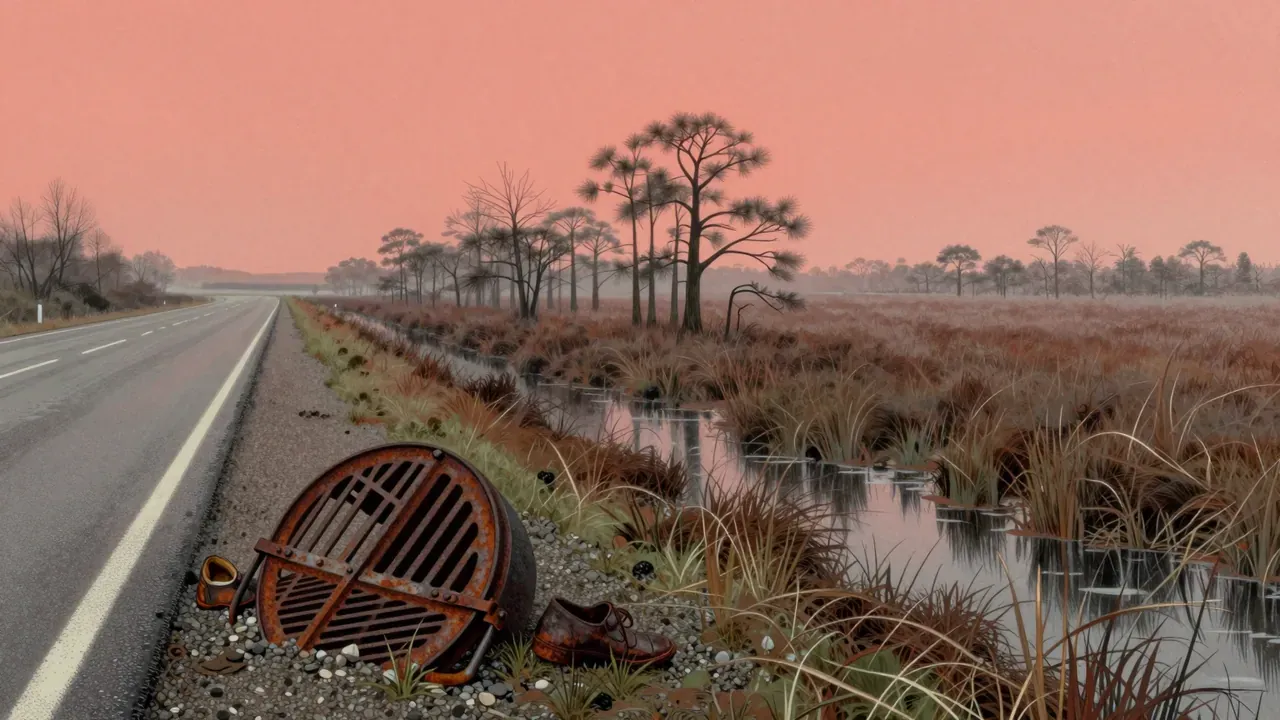
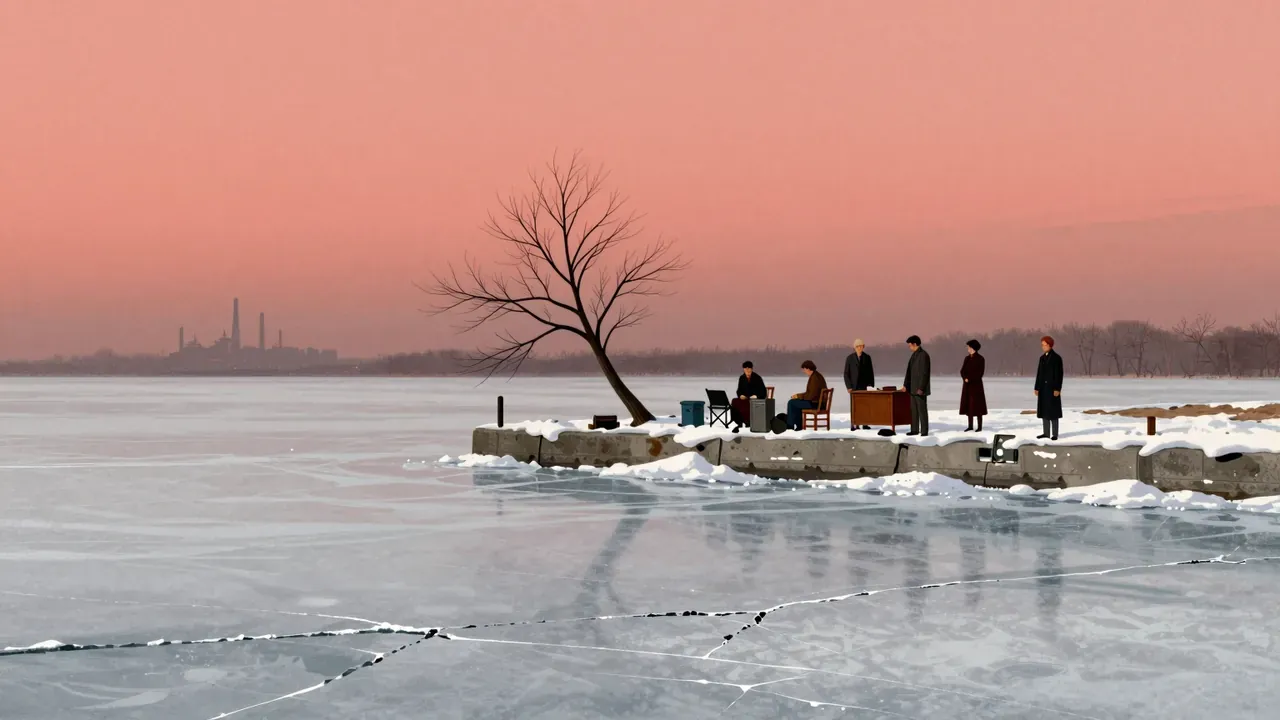
What lands is the cumulative effect of repetition and subtraction. The vacuum cleaner gag — ‘choking the alligator’ — works because it arrives after minutes of silence and stillness, making language itself feel newly strange. Eva discarding the dress on the street lands not as symbolism but as a quiet, unexplained act of agency that lingers because nothing else in the film is explained. The frozen lakefront in Cleveland lands because the camera holds it long enough for cold to become palpable, not atmospheric. The beach in Florida lands because it looks almost identical to the lakefront — same wind, same grey sky, same desolation — and the film refuses to let you mistake it for resolution. The blackouts land because they force recalibration: each time the screen goes dark, the viewer must reassemble context from memory, not from visual continuity. The film’s deadpan tone lands because it is consistent, unwavering, never ironic or self-aware. It does not wink. It waits. And in that waiting, small gestures — a shared cigarette, a hand shake, a glance held half a beat too long — acquire weight no dialogue could confer.
Where it holds back
What does not land is any attempt to read motivation as psychology. Willie’s attachment to Eva is implied but never articulated, and the film offers no internal logic for his decision to go to Cleveland, then Florida, then back for her — it simply happens, without emphasis or consequence. The poker win that triggers the first trip feels arbitrary, not earned; the dog-racing loss in Florida feels unmotivated, not tragic. The characters’ Hungarian background is present but unexplored — no cultural friction, no linguistic barrier beyond surface banter, no sense of displacement beyond geography. The film’s refusal to explain means some viewers will find the characters opaque rather than elusive, their actions inert rather than intentional. The pacing, while deliberate, risks monotony when viewed outside its historical context — the 1984 debut of a no-budget, anti-Hollywood film. Without that frame, the stillness reads less like resistance and more like inertia. Some will hear the silence as contemplative; others will hear it as emptiness. Neither reading is wrong, but the film does not argue for either.
What it keeps saying
The themes that matter are duration, estrangement, and the arbitrariness of place. Time is measured not in plot points but in fixed intervals: ten days, one year, a drive south. Estrangement operates on multiple levels — Eva is estranged from Hungary, Willie from his heritage, all three from the American dream they nominally inhabit. Yet none seek integration; they drift through environments without claiming them. Place is treated as interchangeable: Brooklyn, Cleveland, and Florida are all rendered in the same flat, grey tonality, their differences reduced to weather and signage. The film questions whether ‘home’ is a location or a habit — and suggests it may be neither. Absurdism emerges not through surreal events but through structural rigour: the blackouts, the repetitions, the refusal of cause-and-effect. There is no moral, no commentary, no critique — only a steady gaze at how people occupy time when nothing demands their attention. The film’s quiet insistence on the mundane is not celebration or condemnation, but documentation: this is how attention settles when nothing insists it move elsewhere.
Who it meets
This film is for viewers who value formal discipline over narrative propulsion, who find resonance in restraint, and who trust that meaning accumulates in silence rather than exposition. It rewards patience, rewatching, and attention to composition over character. It is not for those who require psychological clarity, emotional escalation, or even basic cause-and-effect logic. Those expecting a buddy film in the genre’s conventional sense — banter, conflict, bonding — will find it alienating. Those who associate black-and-white cinematography with nostalgia or gravitas may misread its flat, unromantic palette as technical limitation rather than choice. Viewers accustomed to contemporary pacing — rapid cuts, layered sound, continuous scoring — may perceive the film as inert rather than intentional. A change in context would alter the verdict: shown in a cinema with a shared audience, its rhythms cohere differently than on a laptop at home. But its demands remain the same — it asks for surrender to its tempo, not accommodation to yours.
What it gives you
Yes, it is worth your evening — provided you approach it as an object of attention, not entertainment. Its 89 minutes pass slowly, but not emptily: every frame invites scrutiny, every pause recalibrates expectation. It repays close viewing not with revelations but with recalibrations — of how we read faces, how we parse time, how we assign meaning to stillness. It is not ‘enjoyable’ in the conventional sense, but it is rigorously coherent, formally inventive, and historically consequential. Those who dislike it tend to do so on grounds of perceived affectlessness or narrative thinness — valid objections if one expects drama, but misplaced if one accepts the film’s terms. Its value lies in what it refuses: no exposition, no score, no close-ups, no catharsis. To watch it is to experience a different grammar of cinema, one where absence is syntax and duration is argument. That grammar is not for everyone — but for those willing to learn it, the film delivers something rare: a complete, uncompromised vision, sustained from first frame to last.