The shape of memory
Amarcord is a semi-autobiographical memory-film set in a fictionalised Rimini during the 1930s, structured as a seasonal cycle through one year in the life of a coastal village under Fascism. It does not reconstruct history but evokes it through exaggeration, repetition, and stylised recurrence — a method Fellini called ‘remembering forward’. The film avoids linear narrative or psychological realism; instead, it treats memory as associative, porous, and often absurd, where personal recollection blurs with collective myth and political satire. Its aim is not documentary fidelity but emotional and moral resonance: to render the texture of growing up amid authoritarian spectacle, Catholic ritual, and unspoken desire, all filtered through the lens of adult retrospection that is tender, mocking, and never quite certain where nostalgia ends and critique begins. It treats Fascism not as distant horror but as ambient farce — pompous, banal, and easily distracted by fireworks or a woman’s legs. The film’s ambition lies in holding contradiction: warmth and cruelty, reverence and ridicule, intimacy and theatricality, all sustained without resolution. (158 words)
The look of it
The story unfolds episodically, anchored by Titta’s adolescence but rarely following him alone; characters drift in and out like figures in a carnival procession. Bruno Zanin’s Titta is less a protagonist than a focal point — watchful, reactive, often silent — while supporting roles are played with broad physicality and precise timing by non-professionals and veterans alike: Pupella Maggio’s Miranda radiates earthy compassion, Giuseppe Ianigro’s Aurelio carries quiet shame, and Magali Noël’s Gradisca floats just beyond reach, glamorous and untouchable. Giuseppe Rotunno’s cinematography favours deep focus and shallow depth, keeping faces sharp against soft, painterly backdrops — fog, snow, firelight — while Ruggero Mastroianni’s editing stitches scenes with rhythmic insistence, not logic. Nino Rota’s score swells and recedes like breath, alternating between waltz-time melancholy and circus brass. The production design — all curved arches, plaster saints, and papier-mâché Mussolinis — feels deliberately artificial, rejecting naturalism in favour of a stage-bound, dream-logic coherence. (159 words)
What sticks
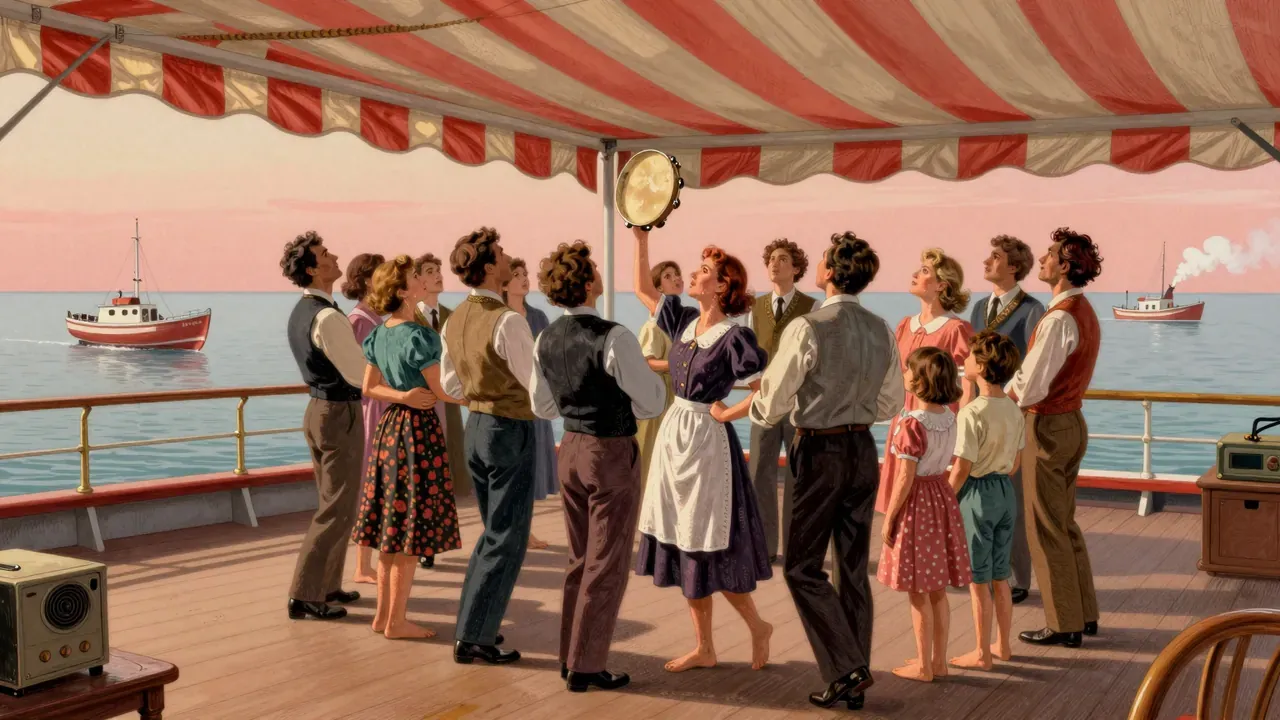
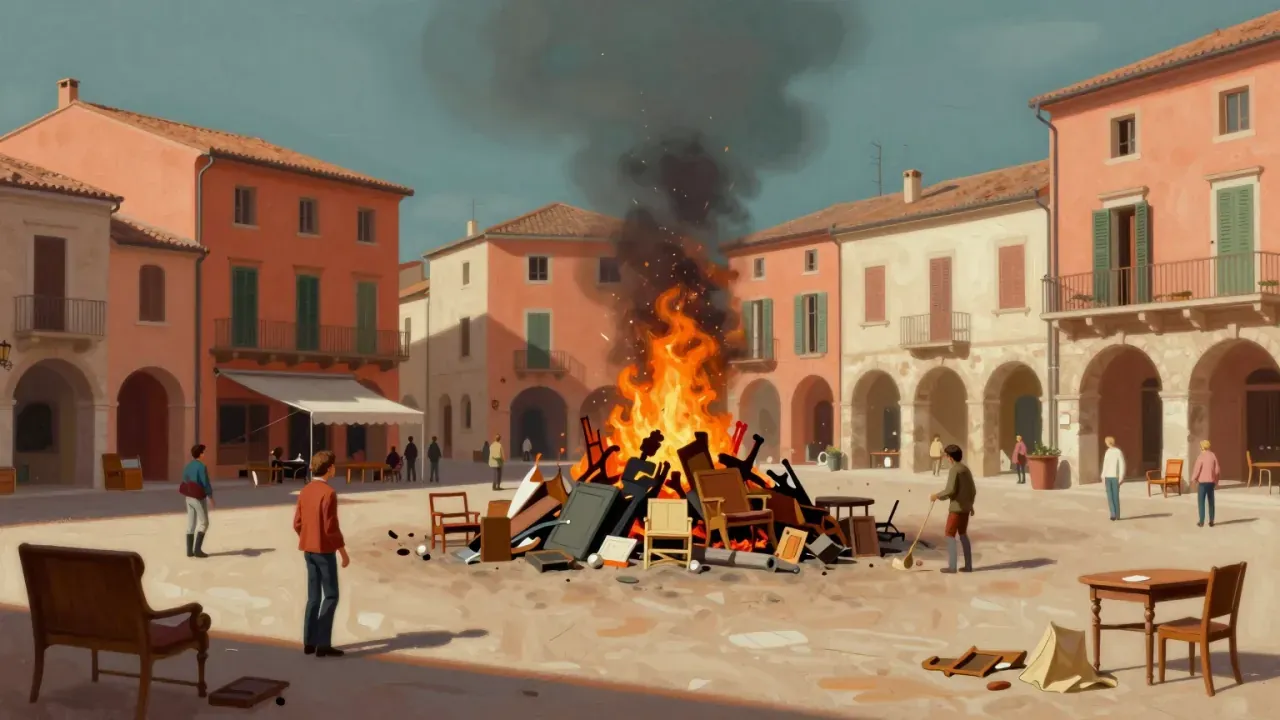
What lands most firmly is the film’s tonal balance: its ability to sustain affection for its characters while never excusing their moral slackness or political passivity. The fogheraccia sequence — bonfire, pranks, lewd noises, civic lectures drowned out — works because it treats communal release and repression as inseparable. Uncle Teo’s tree-climbing episode lands not as grotesque but as heartbreakingly human: his cry for a woman is absurd, yes, but also elemental, and the dwarf nun’s calm authority restores order without condescension. The SS Rex passage succeeds because its awe is undercut by exhaustion — the villagers asleep in boats, capsized not by power but by sheer scale — a quiet rebuke to Fascist grandeur. Even minor moments land: the priest absorbed in floral arrangements during confession, the schoolchildren’s rote recitations dissolving into daydreams. These are not gags but observations, rendered with specificity and restraint. The film earns its sentimentality by refusing sentimentality: Miranda’s death arrives without music or close-up, just silence and snow, making it heavier, not lighter. (157 words)
Where it slips
What does not land consistently is the film’s reliance on caricature when satire tips into stereotype. Some secondary figures — particularly the Fascist officials and certain clergy — remain flat, their absurdity unmoored from psychological plausibility or social function. The repeated visual motif of the segavecchia effigy burning each spring risks becoming rote rather than resonant, its ritual losing edge through repetition. A few sequences — Ciccio’s Mussolini wedding fantasy, the gramophone sabotage — feel structurally necessary but emotionally thin, more schematic than felt. The film’s resistance to narrative consequence means some episodes conclude without weight or echo: Titta’s encounter with the tobacconist ends abruptly, leaving his humiliation unresolved and its thematic purpose unclear. Likewise, the political subtext — Aurelio’s castor oil punishment — is presented with dark humour but little follow-through, its violence softened by farce to the point where its gravity recedes. These are not failures of craft but limits of the mode: Fellini’s style privileges accumulation over causality, and sometimes the accumulation grows opaque. (156 words)
What it’s really about
The themes that matter are memory’s unreliability, adolescence as moral suspension, and the collusion of institutions — Church, State, family — in sustaining national immaturity. Fascism here is not monstrous but infantilising: its rallies mimic school drills, its propaganda echoes nursery rhymes, its leaders are inflated puppets. The Catholic Church appears less as dogma than as ritual furniture — confession booths as stage sets, priests preoccupied with decor. Sexuality is treated as both urgent and ridiculous: Titta’s fumbling desire, Ciccio’s fantasies, Teo’s cries — all framed not as transgressions but as natural forces misdirected by repression. The film’s central irony is that the village remembers everything vividly yet learns nothing: seasons turn, people age, regimes persist, and moral responsibility remains deferred. This is not nostalgia for a lost past but a diagnosis of how memory can mask complicity. The title’s Romagnol root — a m’arcôrd — becomes a refrain that asks not what was remembered, but what was chosen to be remembered, and why. (155 words)
Who it’s for
This film rewards viewers who accept that character is gesture, plot is rhythm, and meaning accrues in layers of image and repetition rather than exposition. It suits those familiar with Fellini’s earlier work — especially La Strada or 8½ — or with mid-century European art cinema’s tolerance for ambiguity and theatricality. It is less suited to viewers who require causal clarity, psychological motivation, or narrative payoff: the film offers none of these as priorities. Those expecting historical analysis of Fascism may find its treatment too elliptical; those seeking adolescent coming-of-age arcs will find Titta’s development deliberately stunted. A viewer who values tight structure, verbal precision, or realist aesthetics will likely resist its looseness. That said, resistance is not dismissal — the film’s openness invites rewatching, not rejection. Its verdict shifts with attention: it deepens with patience, flattens with impatience. (159 words)
Is it worth your evening?
Yes, it is worth your evening — provided you watch it whole, in one sitting, without interruption or expectation of conventional storytelling. Its 127 minutes unfold like a waking dream: dense, associative, occasionally opaque, but cumulatively immersive. It repays attention not with explanation but with texture — the grain of Rotunno’s film stock, the timbre of Rota’s oboe, the weight of snow on Miranda’s shawl. Those who dislike it tend to cite its sprawl or perceived self-indulgence; they are not wrong, but they mistake scale for excess. What changes the verdict is not the film’s length or looseness, but whether you grant it the same licence memory grants itself: to loop, omit, exaggerate, and return. It is not a film to solve but to inhabit. And in that inhabitation, it reveals something rare: how a society remembers itself not as it was, but as it felt — foolish, fond, frightened, and fiercely, tenderly alive. (158 words)