The shape of the stories
Kwaidan is a four-part Japanese horror anthology, adapted from Lafcadio Hearn’s English-language retellings of Edo-period folktales. It does not aim to frighten in the manner of shock or suspense, nor does it seek psychological realism or social critique in the way Masaki Kobayashi’s earlier Harakiri did. Instead, it attempts something rarer: a sustained, painterly invocation of the uncanny as atmosphere — where moral consequence is slow, spectral, and indifferent, and the boundary between life and afterlife is porous but never explained. The film treats folklore not as narrative material but as formal constraint: each segment obeys its own internal logic of colour, sound, space and duration, rejecting naturalism in favour of theatrical artifice. Kobayashi built custom soundstages in a former military hangar to achieve this; he rejected depth, perspective, ambient noise, even conventional scoring. The ambition is aesthetic reclamation — not of ‘tradition’ as heritage, but of pre-militarist Japanese visual and auditory sensibility, stripped of propaganda weight and restored to ritual precision. It is a film made in deliberate opposition to realism, both cinematic and historical.
The look of it
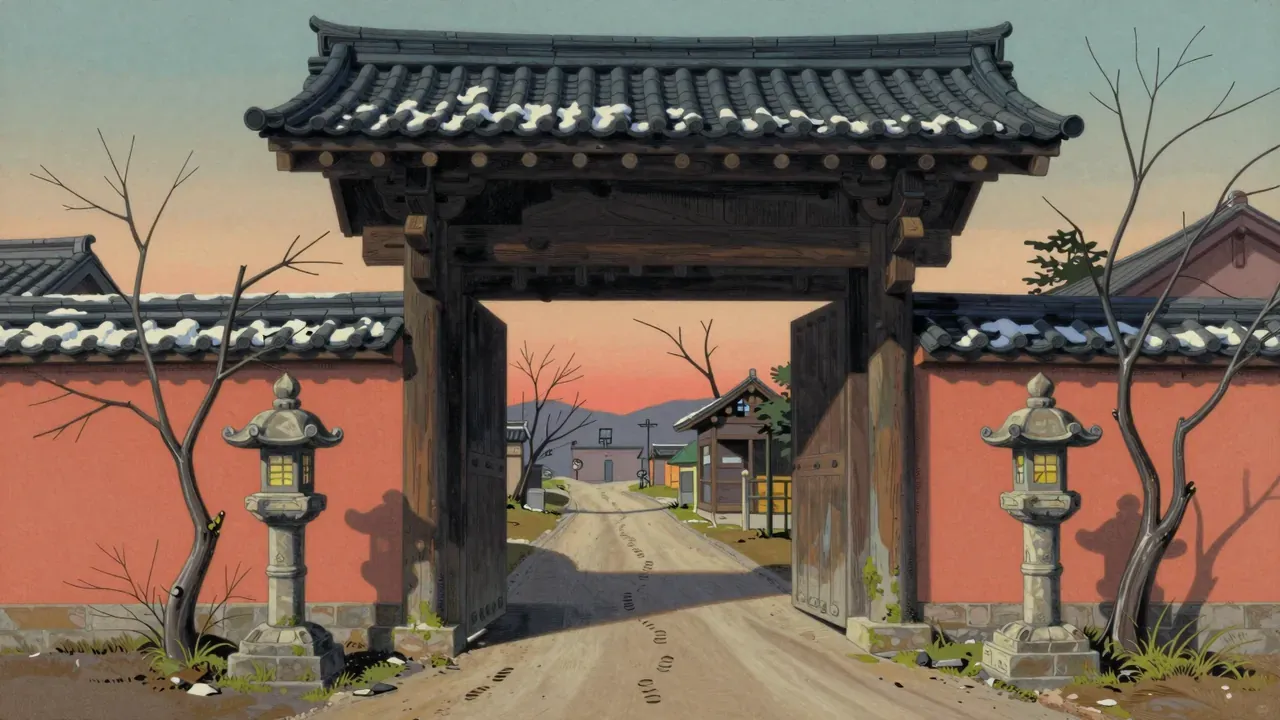
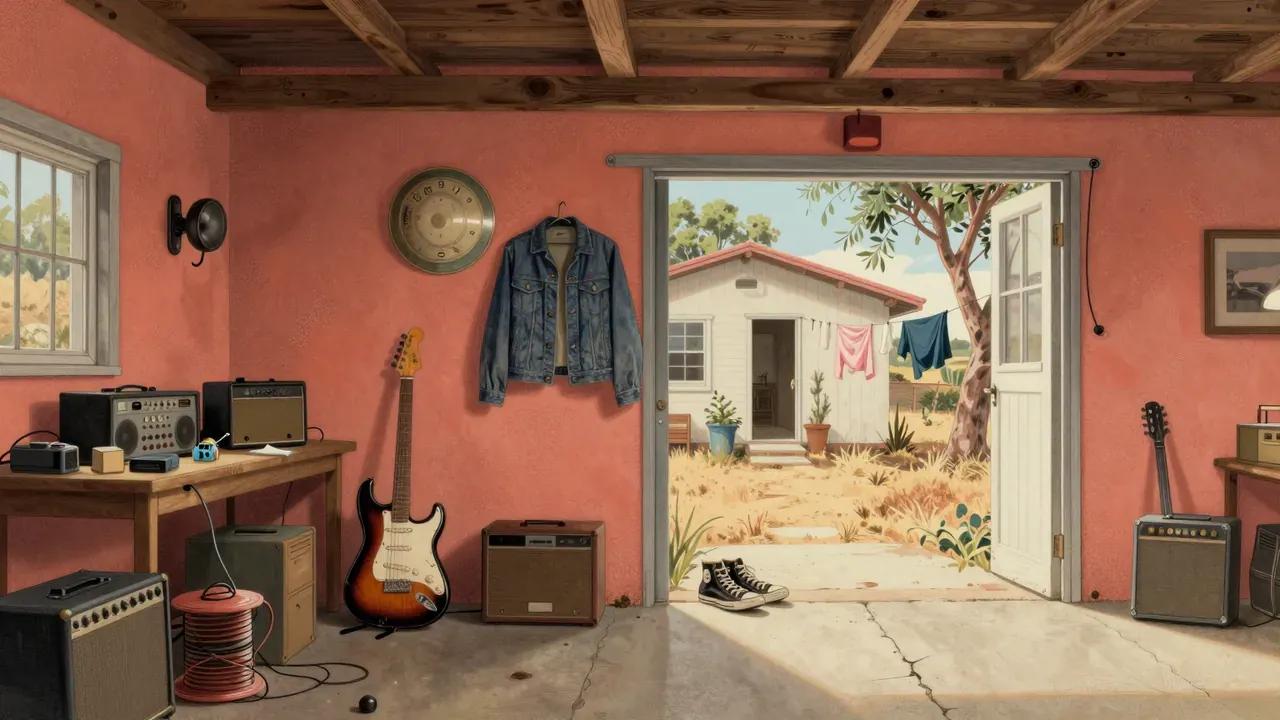
The film works through radical control of craft elements rather than performance or plot momentum. Yoshio Miyajima’s cinematography avoids depth cues: sets are flat, backdrops painted, lighting gelled to isolate hues — crimson, indigo, bone-white — with no attempt at continuity of time or weather. Tōru Takemitsu’s score uses prepared piano, electronic distortion and long silences not to underscore action but to punctuate absence; sound effects are decoupled from source — bamboo creaks without wind, wood splinters without impact. Each story is self-contained, with no actor recurring across segments; performances are restrained, often masked or still, prioritising gesture over expression. Yōko Mizuki’s script preserves Hearn’s measured, archaic diction, translated into formal Japanese that feels liturgical rather than conversational. The editing is slow, deliberate, sometimes static for minutes at a time. There are no jump cuts, no close-ups for emphasis, no music swells on revelation. Even the archery scene in ‘The Black Hair’ uses exaggerated hoofbeats not for realism but for rhythmic abstraction. This is not storytelling as transmission, but as incantation — every frame calibrated to hold attention without yielding meaning.
What holds the eye
What lands is the cumulative weight of its artificiality. The film’s refusal to simulate reality becomes persuasive over time: the painted skies in ‘The Woman of the Snow’, the ink-wash emptiness of Hoichi’s temple courtyard, the lacquered stillness of the cup in ‘In a Cup of Tea’ — all accrue a gravity that realism could not sustain. The silence between Takemitsu’s notes carries more dread than any shriek. The moral architecture of each tale — betrayal punished by spectral return, curiosity punished by dissolution, compassion punished by erasure — lands not as message but as inevitability, like weather. Tatsuya Nakadai’s minimalism in ‘The Black Hair’ and Keiko Kishi’s quiet devastation in ‘Hoichi the Earless’ register precisely because they are framed by such rigorous restraint. The film’s most effective moments are those where nothing happens: a woman’s hair uncoiling across tatami, snow falling in unmoving air, a scroll unfurling in darkness. These are not pauses in the narrative but its substance — time held, not spent. The viewer does not watch events unfold; they witness thresholds being crossed, slowly, irrevocably.
What slips away
What does not land is narrative momentum or emotional accessibility for viewers expecting progression, motivation or resolution. The film offers no exposition, no psychological explanation for why spirits act as they do, no character arcs, no redemption — only consequence, delayed and absolute. ‘In a Cup of Tea’, the final segment, risks feeling like an afterthought: its metafictional framing — a writer reading a story that consumes him — lacks the tactile presence of the others, its scale too small, its tone too dry. The roadshow cut omitted ‘The Woman of the Snow’ entirely, and while Kobayashi approved, its removal suggests the segment’s vulnerability to misreading as mere mood piece rather than structural anchor. Some performances, particularly in ‘Hoichi’, verge on stiffness when read outside the film’s stylistic contract — a problem not of acting but of expectation. And the sheer length — 183 minutes — tests patience not because it drags, but because it demands unwavering attention to minute shifts in hue, texture, silence. Viewers who require cause-and-effect logic or cathartic release will find little purchase here.
What stays beneath
The themes that matter are not fear, guilt or vengeance in the ordinary sense, but the persistence of form beyond function, and the indifference of consequence to intention. Spirits in Kwaidan do not haunt out of rage or sorrow but because their shape — a vow, a debt, a name — must be completed. A man breaks a promise and is reclaimed not by wrath but by the slow, inevitable return of what he discarded. A musician’s ears are removed not as punishment but because his body has become irrelevant to the task of recitation — only voice remains, then only memory, then only the scroll. The film treats time not as line but as layer: past actions sediment into present conditions, visible only in the grain of painted silk or the tremor in a hand. There is no salvation, no growth, no learning — only alignment or misalignment with invisible structures. This is not Buddhist karma as moral accounting, but as physics: action creates resonance, and resonance endures. The film’s pacifism is not stated but embedded — in its rejection of militarist realism, its use of repurposed barracks as studio, its insistence that beauty need not serve power to be potent.
Who it meets
It is for viewers who value sustained formal discipline over narrative payoff, who find tension in stillness and dread in silence, who accept that some stories exist not to be understood but to be inhabited. It rewards attention to colour, texture, rhythm — not plot. Those who prefer psychological realism, clear motivation or emotional catharsis should not watch it; neither should those who expect horror to deliver adrenaline, jump scares or moral clarity. Some critics have called it ‘cold’ — a fair observation if one expects warmth as virtue. But its austerity is not indifference: it is precision. A viewer who finds Takemitsu’s prepared piano unsettling, or who lingers on the way light falls on a lacquer bowl, will feel addressed. Someone who needs characters to explain themselves, or stories to resolve, will leave frustrated. The film makes no concession. Its audience is narrow by design — not because it is obscure, but because it asks for a different kind of labour: watching without interpreting, listening without translating, sitting with ambiguity until it ceases to feel like lack.
What remains after
Yes, it is worth your evening — but only if you are willing to surrender the expectation that time spent watching must yield explanation, resolution or even comprehension. Its 183 minutes pass without hurry, yet never waste a second; every frame serves the film’s singular purpose. You will not leave with answers, but you may leave with altered perception — noticing how light pools in corners, how silence holds weight, how colour can carry moral charge. Those who dismiss it as ‘slow’ or ‘cold’ are not wrong, but they mistake its terms: it is not withholding emotion, but refusing sentimentality. It is not avoiding narrative, but replacing it with pattern. A viewer who values craft as argument — where cinematography, sound and set design do the work of dialogue — will find it richly rewarding. Someone who watches to be told what to feel, or to see characters ‘grow’, will find it alienating. Nothing in the film would change that verdict — not a tighter edit, not added exposition. Its power lies precisely in its refusal to accommodate.