The look of it
Accattone is Pier Paolo Pasolini’s first film, a deliberate and unsentimental entry into Italian neorealism’s aftermath — not as continuation but as recalibration. It seeks to render the moral and material texture of Rome’s borgate, the shanty towns on the city’s periphery, without recourse to uplift, redemption or sociological explanation. Pasolini adapts his own literary preoccupations — from Ragazzi di vita and Una vita violenta — into cinematic form, treating poverty not as circumstance but as condition: unchanging, unimprovable, structurally enforced. The film refuses documentary framing; there are no voiceovers, no explanatory captions, no cutaways to institutions or officials. Its ambition is formal and ethical: to place the viewer alongside Vittorio ‘Accattone’ Cataldi without mediation, without judgment, and without the comfort of narrative resolution. It does not ask for empathy so much as endurance. This is not realism in service of reform, but realism as witness — austere, unblinking, and anchored in the physical presence of non-professional actors who inhabit their roles not as performers but as extensions of their own lives. Word count: 148
The way it moves
The story follows Accattone’s slow, unheroic collapse: from pimp to abandoned lover to thief to corpse. There is no arc, only attrition. Franco Citti, cast from the streets for his Roman face and bearing, delivers a performance stripped of technique — not raw, but inert, weighted, resistant to projection. Adriana Asti, one of the few professionals, grounds her scenes with quiet precision; Monica Vitti’s uncredited dubbing of Paola Guidi adds a subtle disjunction between voice and body. Tonino Delli Colli’s cinematography avoids both gloss and grime: his 35mm black-and-white frames are composed with classical restraint, often static, favouring medium shots that hold characters at a distance. Bach’s music — mostly the St Matthew Passion and Goldberg Variations — is deployed not as commentary but as counterpoint: solemn, liturgical, alien to the world it scores. Nino Baragli’s editing sustains this rhythm — long takes, minimal cuts, no emphasis on reaction shots. The film’s craft is anti-dramatic by design: no close-ups to solicit feeling, no score swells to cue response, no montage to suggest meaning. Word count: 152
What stays with you
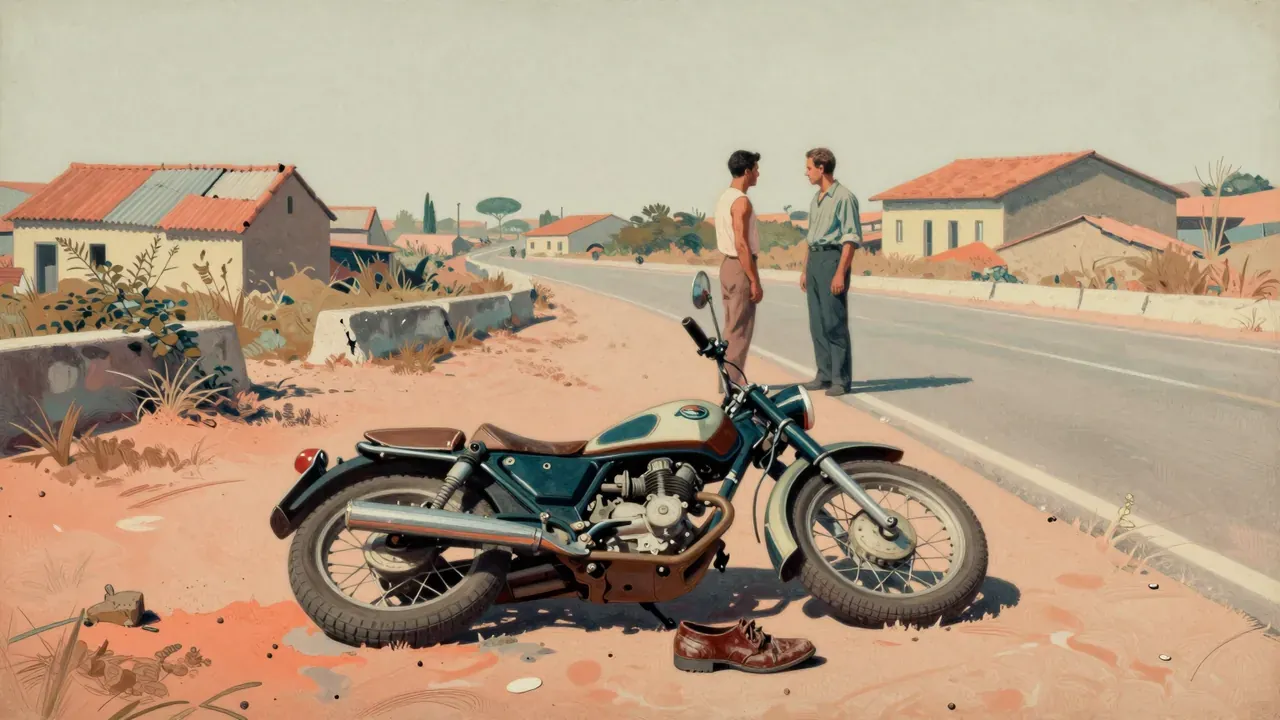
What lands is the sheer, unrelenting weight of existence as lived outside social contract or moral framework. Accattone’s final motorcycle crash is not cathartic but abrupt, banal, almost careless — a detail, not a climax. The dream sequence, with Polidor as a gravedigger, lands not through surrealism but through its literalness: death is not metaphor but infrastructure, already built into the landscape. The film’s refusal to aestheticise poverty — its rejection of picturesque squalor — lands with cumulative force. So too does its use of language: Roman dialect spoken without subtitles or translation, forcing the viewer into the position of outsider, of listener who does not fully comprehend. The casting works because it denies theatricality: these are people who do not perform for the camera, and therefore cannot be mistaken for characters. Even the minor roles — the prostitutes, the thieves, the prison guards — carry the unvarnished specificity of lived time. Nothing here feels rehearsed, and that lack of rehearsal is precisely what gives the film its gravity. Word count: 149
Where it refuses
What does not land is any attempt to read Accattone as psychological portraiture. His motivations remain opaque, his shifts in behaviour unexplained — not as mystery, but as indifference. The film offers no interiority, no voiceover, no flashback, no gesture that invites interpretation. For viewers accustomed to causal storytelling, this can feel like withholding rather than discipline. The relationship with Stella collapses without emotional scaffolding; her trauma is shown but not parsed. Likewise, the Mafia subplot dissolves without consequence — Ciccio never appears, the vendetta evaporates. These are not flaws in execution but failures of alignment: if you expect narrative logic or character development, the film will frustrate. Its resistance to exposition extends to politics: though censorship forced its withdrawal and provoked neo-fascist protests, the film itself contains no polemic, no speechifying, no ideological signposting. That silence may register as evasion to some, austerity to others. Word count: 150
What it’s really about
The themes that matter are not abstract but embedded: the impossibility of work as dignity when labour is either absent or dehumanising; the way love becomes another transaction when survival is the sole metric; the theological weight of grace in a world that has no church, only ruins and rubble. Class is not discussed — it is the air the characters breathe, the reason Accattone cannot return to his child’s mother, the reason Stella’s tears are met with dismissal, not comfort. Religion appears only through Bach and a single crucifix glimpsed in a doorway — not as belief but as cultural residue, a soundtrack to secular despair. Death is not tragic but procedural: a traffic accident, a prison sentence, a police report. The film treats mortality not as event but as horizon — always present, never deferred. There is no critique of capitalism here, only its unremarked architecture: the absence of jobs, the presence of pimps, the ease of theft, the difficulty of honesty. These are not ideas argued but conditions observed. Word count: 147
Who it’s for
This film is for viewers who accept that cinema need not offer solace, explanation or identification — those who find value in sustained attention to lives usually excluded from representation, and who trust that form can be argument. It is not for those who require narrative momentum, emotional payoff or moral clarity. Anyone expecting social realism with a reformist bent, or arthouse provocation with stylistic fireworks, will leave unrewarded. Those who dislike long takes, untranslated dialect, or music that refuses to underscore emotion will find it alienating. A viewer who values psychological insight over physical presence, or who needs characters to articulate their pain, will struggle. What would change the verdict? A different opening — one that signals its terms more plainly — might ease entry, but would compromise its rigour. Word count: 148
Is it worth your evening
Yes, it is worth your evening — but only if you arrive prepared to sit still, to watch without interpreting, to let the film’s duration settle on you like dust. It is not entertaining in any conventional sense, nor is it designed to be. Its power accumulates slowly, through repetition of gesture, tone, light: the way Accattone lights a cigarette, the sound of a scooter engine fading, the silence after a slap. Some will call it punishing; others, necessary. Those who dismiss it as grim or nihilistic miss its quiet insistence on presence — on the fact of being, even when being offers nothing but breath and weight. It is not a film to be enjoyed, but one to be endured, then remembered. Its value lies not in what it says, but in how relentlessly it refuses to look away. Word count: 149