The look of it
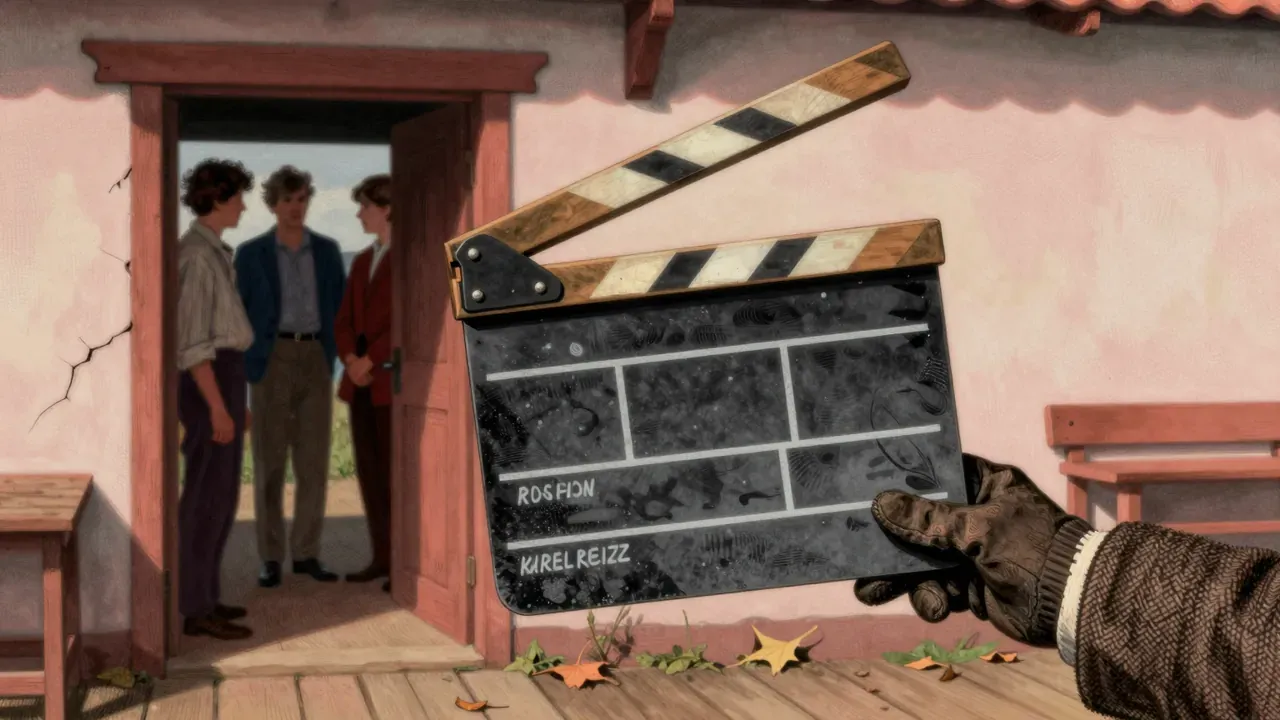
The French Lieutenant’s Woman is a dual-layered romantic drama that adapts John Fowles’s 1969 novel while framing it within the making of its own film. It attempts two things at once: to render the Victorian narrative with psychological fidelity and period precision, and to stage a deliberate, self-aware contrast between that repressed world and the comparatively unmoored emotional conduct of its modern performers. Karel Reisz and Harold Pinter do not treat the novel as source material to be streamlined but as a structural proposition — one that invites reflection on how desire, agency and narrative closure are shaped by historical constraint. The film does not hide its scaffolding: the clapperboard appears in the first shot; crew members move through frame; costume and lighting shifts mark transitions between timelines. This is not metafiction for its own sake, but a calibrated device to hold Victorian moral rigidity and late-twentieth-century relational ambiguity in sustained tension. It assumes the viewer will register both stories as equally real, neither subordinate nor illustrative of the other.
Two actors, four names
The structure rests on parallel performances by Jeremy Irons and Meryl Streep, who play both Charles Smithson and Mike, Sarah Woodruff and Anna. Irons gives Charles a tightly coiled physicality — posture rigid, speech measured, hands rarely still — while his Mike is looser, more tentative, less certain of where he ends and the role begins. Streep’s Sarah is deliberately opaque: her gaze avoids direct contact, her silences are weighted but unreadable; as Anna, she is warmer but emotionally guarded, her modern detachment sharpened by small gestures — a glance away, a pause before answering. Freddie Francis keeps the Victorian sequences cool and shallow in focus, the light diffused and grainy, while the contemporary scenes are brighter, sharper, less formally composed. Assheton Gorton’s production design anchors the past in tactile authenticity: damp stone, wool coats stiff with salt air, ink-stained fingers. Carl Davis’s score uses viola solos to thread melancholy through both timelines without conflating them. John Bloom edits the cuts between eras with rhythmic discipline, never letting either story settle into convention.
What she says, and what he hears
What lands is the quiet accumulation of moral unease. The Victorian plot gains force not from melodrama but from withheld information — Sarah’s lie about the French lieutenant, Charles’s delayed comprehension of her autonomy, Ernestina’s legal action against him. These are not plot twists but slow dawns, each revelation altering the ground beneath the characters’ feet. The modern storyline works because it refuses catharsis: Mike’s final call — ‘Sarah!’ — is neither triumphant nor pathetic, just a man naming a fiction he cannot let go of. Streep’s performance sustains this ambiguity: she never lets Anna fully explain herself, nor does she make Sarah’s motives legible. The film’s restraint in exposition allows space for the audience to sit with discomfort — the discomfort of watching someone choose solitude over reconciliation, or dignity over explanation. Even the Windermere ending feels provisional, not resolved: the boat glides, but the water is flat and windless, the horizon unbroken but uninviting.
The last line, spoken twice
What does not land is the modern storyline’s emotional logic when viewed outside the film’s formal architecture. Mike’s attachment to Anna feels under-motivated beyond professional intimacy; his persistence lacks the psychological texture given to Charles’s crisis of belief. The film assumes familiarity with mid-1980s British film culture — the unspoken hierarchies between American and English actors, the gendered expectations around extramarital affairs — but offers no exposition for those unfamiliar with that context. Some supporting performances falter under Pinter’s sparse dialogue: David Warner’s Dr. Grogan and Leo McKern’s Mr. Freeman are vivid in outline but thin in duration, their functions purely expository. The intercutting, though formally elegant, occasionally blunts emotional momentum: a moment of Victorian tension is followed by a banal modern exchange, breaking rhythm without adding counterpoint. The film’s refusal to clarify whether Anna’s withdrawal is principled, weary or simply indifferent leaves a gap where empathy might otherwise take root.
Fossils and film stock
The themes that matter are not love or fidelity in the abstract, but the conditions under which choice becomes legible — or even possible. In the Victorian strand, Sarah’s agency is constrained by law, class, gender and reputation; her ‘fall’ is defined by others, her redemption conditional on male forgiveness. In the modern strand, Anna has legal and financial independence, yet her choices remain opaque, her motivations obscured by irony and distance. The film treats time not as progress but as rearrangement: the same impulses recur, but the grammar of consequence changes. Palaeontology recurs as motif — Charles studies fossils, evidence of deep time and extinction — while Anna reads William Acton’s 1857 study of prostitution, a document that quantifies suffering but offers no remedy. Both stories examine how systems — medical, legal, cinematic — catalogue human behaviour without understanding it. The film’s central question is not whether people change across centuries, but whether they ever truly understand themselves within their own moment.
Where the rules begin
It is for viewers who value structural intelligence over narrative ease, who find interest in the friction between form and feeling, and who do not require emotional pay-off to feel satisfied. It rewards attention to gesture, silence and composition over plot mechanics. It is not for those who need clear moral positions, strong forward momentum or character arcs that resolve cleanly. Viewers expecting a conventional romance or a straightforward adaptation may find the dual timeline frustrating or emotionally withholding. Those who dislike ambiguity in motivation — particularly where female characters are concerned — will likely resist Sarah’s opacity and Anna’s reticence. A viewer who values psychological realism above all else may object to the film’s deliberate artifice: the clapperboard, the visible crew, the theatrical lighting. That artifice is not a flaw but the point — but it demands acceptance as method, not mere decoration.
The water holds its breath
Yes, it is worth your evening — not as escapism, but as calibration. Its 119 minutes ask you to hold two temporal logics at once, to notice how lighting cues mood, how editing shapes expectation, how silence can carry more weight than dialogue. It repays rewatching not for hidden clues but for shifts in emphasis: a glance that seemed neutral on first viewing acquires gravity later; a line of Pinter’s dialogue gains irony only after the modern storyline clarifies its subtext. It is not a film that yields easily, but it does yield consistently — to patience, to attention, to the willingness to sit with unresolved tension. Those who dismiss it as ‘cold’ or ‘distant’ mistake its discipline for indifference. Its warmth lies in its refusal to simplify — in its insistence that some questions, across centuries, remain open. To skip it is to miss a precise, unsentimental portrait of how people navigate desire when the rules keep changing.