The premise
White Dog is a 1982 American drama that uses a trained German Shepherd as a literal vessel for racism: the dog attacks Black people on sight, having been conditioned by a white supremacist. Samuel Fuller directs with surgical intent—not to provoke spectacle, but to test whether hatred, once implanted, can be unlearned. The film adapts Romain Gary’s 1970 novel but strips away its allegorical framing and replaces its original Muslim trainer with Paul Winfield’s Keys, a Black dog trainer who attempts behavioural rehabilitation. Fuller’s aim is structural, not symbolic: he treats racism not as prejudice or ideology but as a learned reflex, embedded in neural pathways like any other conditioned response. The narrative does not ask whether racism is wrong—it assumes that—but whether it is reversible. That question anchors every scene, every edit, every silence. The film refuses moral ambiguity not out of dogma, but because its central metaphor only holds if the dog’s behaviour is both deterministic and unambiguous. It is less a story about people than about the mechanics of indoctrination, made visible through animal behaviour. (158 words)
The look of it
The story moves in tight, procedural increments: Julie Sawyer finds the dog, misreads its loyalty as innocence, then witnesses its violence twice before seeking help. Kristy McNichol plays Julie with restrained disbelief—her confusion is credible, never naive. Paul Winfield’s Keys carries quiet authority; his physical presence in protective gear, his methodical routines, his exhaustion—all are rendered without flourish. Bruce Surtees’ cinematography avoids expressionism: interiors are lit with flat, even light; exteriors are sun-bleached and unromantic. Ennio Morricone’s score is sparse, often absent—when it appears, it is low brass and dissonant strings, not theme or commentary. Bernard Gribble’s editing sustains tension through duration: we watch Keys endure repeated lunges, not cut away from them. There is no music cue for horror, no slow-motion for impact—the violence arrives abruptly, then ends. The dog is never anthropomorphised; its actions are filmed at eye level, neither heroic nor monstrous, just consistent. Samuel Fuller appears briefly as a studio executive, a dry counterpoint to the film’s gravity. The craft serves restraint, not emphasis—every decision narrows the frame to the question at hand. (159 words)
The weight of it
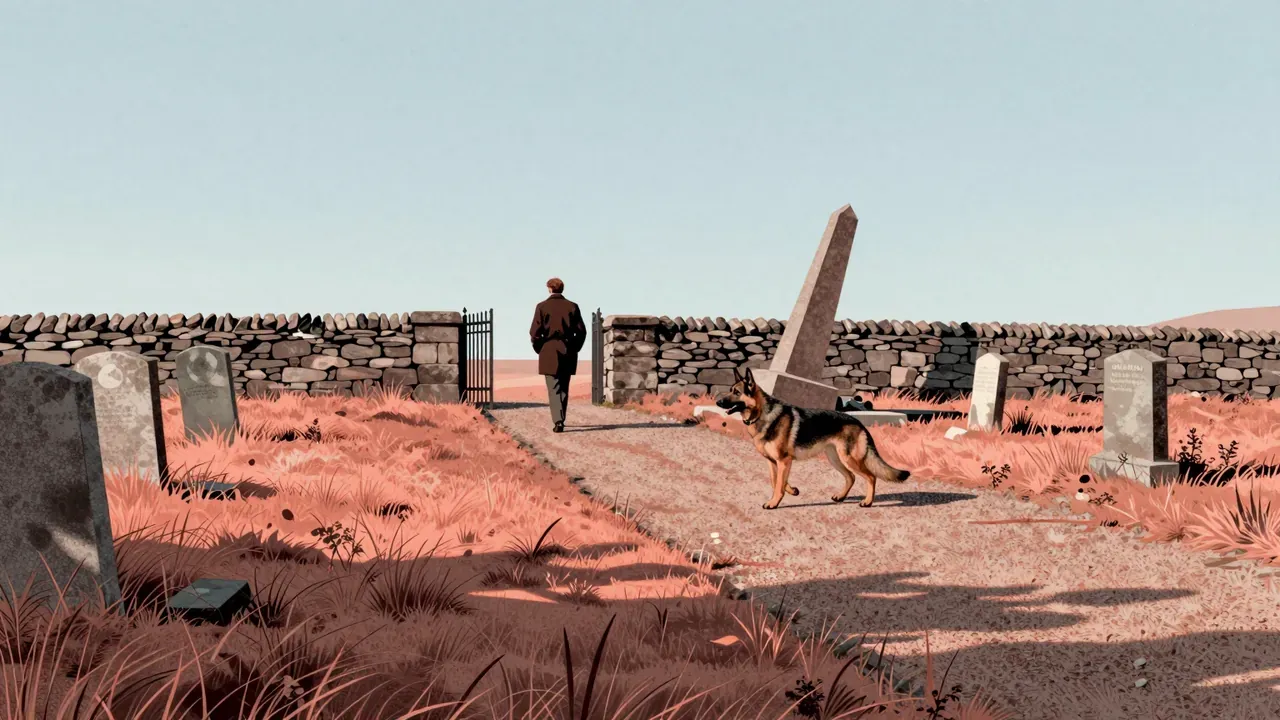
What lands is the film’s unwavering commitment to its premise. The dog’s attacks are not dramatised for shock but recorded with forensic clarity: the truck driver’s death happens off-screen, reported in a police bulletin; the churchyard killing is shown in long shot, the dog moving with purpose, not rage. This refusal to aestheticise violence forces attention onto consequence, not spectacle. Keys’ training regimen feels plausible—repetition, isolation, controlled exposure—because it mirrors real behavioural therapy, stripped of optimism. The film’s most effective moment is not an attack but a pause: when the dog hesitates mid-lunge, tail lowering, then snaps back into aggression. That sliver of doubt is where the film’s argument lives—not in triumph, but in the fragility of reversal. The ending, in which Keys abandons the training and the dog remains unreformed, lands not as defeatism but as structural honesty. It does not suggest racism is inevitable, only that its undoing requires more than goodwill or technique. The film’s power lies in how little it asks the viewer to feel—and how much it demands they reckon with cause and effect. (156 words)
The gaps in it
What does not land is the script’s underdeveloped social architecture. Julie’s world—her acting career, her relationship with Roland Graele—is sketched in shorthand, leaving her motivation opaque beyond generic empathy. Burl Ives’ Carruthers, the euthanasia-advocating trainer, functions solely as foil, his conservatism unexamined. The film avoids showing how the dog was trained, reducing its origin to exposition rather than dramatisation—this weakens the parallel between individual conditioning and systemic reinforcement. Some performances strain under the weight of exposition: Jameson Parker’s Roland reads as reactive rather than conflicted, and Dick Miller’s cameo as a studio guard adds texture but no thematic weight. The film also sidesteps the political context it invokes: the Atlanta child murders, mentioned in passing in the encyclopedia context, are absent from the film itself, depriving the urgency of grounding. Fuller’s decision to locate the conflict entirely within the dog—rather than in institutions, media, or policy—makes the metaphor potent but narrow. It risks implying racism is a problem of individual reprogramming, not collective dismantling. That limitation is not accidental, but it leaves certain questions unanswered by design. (157 words)
The thinking in it
The themes that matter are learning, irreversibility, and the distinction between behaviour and belief. The film treats racism as operant conditioning—reinforced, repeatable, and physically embodied—not as opinion or ignorance. Keys’ training is not about changing the dog’s ‘mind’ but altering its responses; the failure is not moral but neurological. This grounds the film in behaviourism, not psychology or theology. It also foregrounds embodiment: the dog’s body remembers what its brain cannot articulate. The film’s pessimism is not about human nature but about the durability of learned violence—how deeply it settles, how easily it resurfaces. It refuses redemption arcs, rejecting the idea that exposure to kindness alone dissolves hatred. Instead, it suggests that some patterns, once encoded, resist rewiring not from malice but from repetition. The racial dimension is inseparable from this: the dog does not discriminate abstractly—it reacts to skin colour as a stimulus, making race a visible, measurable variable in the experiment. That clinical framing is uncomfortable, but deliberate. The film’s enduring relevance lies in how precisely it isolates the mechanism of bias—without ever mistaking the mechanism for the whole. (154 words)
The watching of it
This film is for viewers who approach cinema as inquiry, not escape—those willing to sit with unresolved tension and accept that some arguments conclude in silence, not resolution. It suits students of film history, civil rights pedagogy, or behavioural science, and anyone attentive to how form encodes ideology. It is not for those seeking catharsis, narrative closure, or character-driven warmth. Its pacing is deliberate, its emotional palette narrow, its rewards intellectual rather than visceral. Some will find its clinical tone alienating; others, its refusal to soften its thesis admirable. Critics who praised its rigour—including those who gave it 94% on Rotten Tomatoes—tend to value formal discipline over emotional accessibility. A viewer who expects moral clarity or uplift will leave unsettled, not satisfied. What would change that verdict? A different ending—one that showed Keys succeeding, or Julie organising community resistance—would shift the film toward hope, but also dilute its central claim. As it stands, its austerity is its argument. (159 words)
The staying with it
Yes, it is worth your evening—if you treat it as a case study, not a story. Its ninety minutes pass without filler, each scene calibrated to sustain its central question. It repays close attention: the way Surtees frames Keys’ face behind mesh, the rhythm of the training sessions, the absence of reaction shots after violence—all deepen its logic. It is not ‘entertaining’ in the conventional sense, but it is rigorously engaged with its own terms. Those who dismiss it as bleak or didactic miss how precisely it measures its despair: the film’s sadness is structural, not sentimental. Its box office failure ($46,509) reflects distribution, not merit—Paramount shelved it, not audiences. A viewer who values films that argue with precision, that trust the audience to follow implication rather than exposition, will find it compelling. Anyone needing reassurance, resolution, or emotional release should look elsewhere. Its value lies not in comfort, but in clarity—and clarity, here, is uncompromising. (159 words)