The idea of it
Three Colours: Red is the concluding film of Krzysztof Kieślowski’s Three Colours trilogy, conceived as a triptych on the French Revolutionary ideals — liberty, equality, fraternity — with Red assigned to the last. It is not a political essay but a quiet, structural meditation on how lives converge without intention, bound by coincidence, repetition, and unspoken moral responsibility. Kieślowski and co-writer Krzysztof Piesiewicz treat fraternity not as solidarity or shared cause but as the fragile, almost accidental recognition of kinship across distance, age, and temperament. The film avoids allegory by embedding its ideas in concrete detail: a dropped textbook, a dog’s name, a weather forecast, a ferry crossing. Its ambition is architectural — to assemble a set of parallel lives so that their intersections feel inevitable yet unforced, and to suggest that ethical awareness begins not with action but with attention. It is also Kieślowski’s farewell: a film about endings that refuses closure, holding its final image in freeze-frame like a question held mid-breath. (158 words)
The look of it
The story follows Valentine Dussaut, a Geneva student and part-time model, whose path crosses that of Joseph Kern, a retired judge who eavesdrops on neighbours’ phone calls. Their relationship unfolds through restrained dialogue, glances, and spatial separation — Valentine often above him, or below, never level. Irène Jacob’s performance is calibrated to minimalism: her stillness reads as thoughtfulness, not vacancy; her reactions are delayed, weighted. Jean-Louis Trintignant gives Kern a dry, watchful gravity, his face a ledger of withheld judgment. Piotr Sobociński’s cinematography uses red not as accent but as ambient condition — in curtains, slot machines, chewing gum banners — never flamboyant, always present. Zbigniew Preisner’s score anchors the film with variations on a single theme, ‘Bolero’, its repetitions mirroring the cyclical returns of character, motif, and moral dilemma. Jacques Witta’s editing sustains a rhythm of pause and return, letting scenes breathe without hurry. There is no exposition, no flashbacks, no voiceover: meaning accrues in the gaps between shots, in what characters do not say or do not see. (159 words)
The rhythm of it
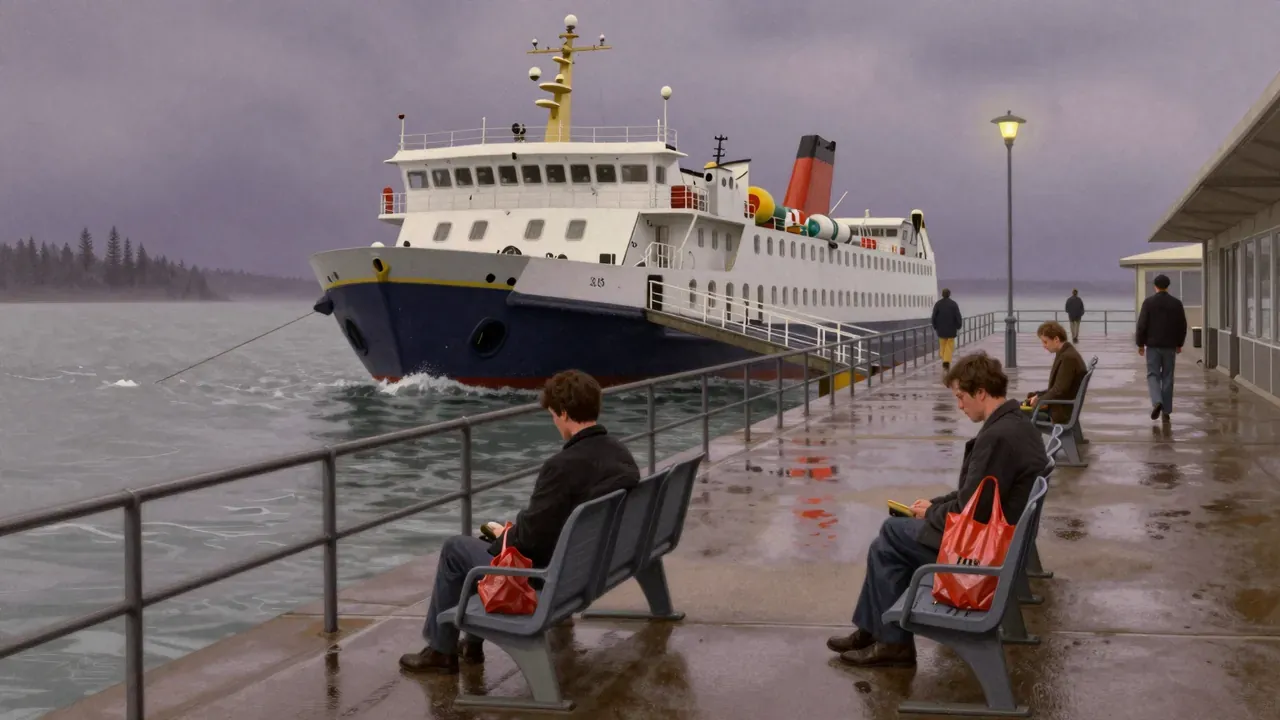
What lands is the cumulative weight of small, repeated gestures: Valentine pushing a bottle into a recycling bin after two prior films showed others ignoring it; Joseph writing confessions he never sends; Auguste passing his exam because a book fell open at the right page. These are not plot points but ethical micro-decisions, each landing because they are unremarked upon within the film — treated as ordinary, not symbolic. The ferry disaster does not shock because it arrives without music or cutaways; it is reported on television, grainy and matter-of-fact, its significance revealed only in the number of survivors — seven, matching earlier repetitions. The freeze-frame of Valentine’s face mirrors her advertising portrait, collapsing artifice and reality without comment. Even the voyeurism feels grounded: Joseph’s eavesdropping is shot from behind glass, muffled, unglamorous. The film trusts the viewer to notice the parallels — between Auguste and Joseph, between Valentine’s brother and Joseph’s past — without underlining them. This restraint makes the emotional payoffs — Valentine’s pity, Joseph’s relief, the unspoken pact between them — land with quiet force. (157 words)
The weight of it
What does not land is the film’s structural conceit when read too literally: the idea that fraternity emerges cleanly from pattern alone. The recurrence of the number seven, the recycled bin motif, the mirrored compositions — these risk feeling like scaffolding rather than substance if the viewer expects thematic resolution. Some performances sit outside the film’s register: Samuel Le Bihan’s Auguste is earnest but thinly sketched, his arc functioning more as counterpoint than character. Julie Delpy and Juliette Binoche appear only in the final news report, their cameos serving continuity over coherence — a nod to the trilogy rather than an organic beat. The Swiss setting remains atmospheric rather than social; Geneva’s real-life drug crisis (Platzspitz) is referenced only through a newspaper photo, its context unexplored. The film’s refusal to explain Joseph’s motives — why he spies, why he confesses, why he lets Valentine go — may frustrate viewers who seek psychological causality over moral resonance. And while the colour red saturates the frame, its symbolism stays associative, never declarative: it evokes warmth, danger, blood, love, but never settles on one. That ambiguity is deliberate, but not all viewers will accept it as sufficient. (159 words)
The silence of it
The themes that matter are privacy and proximity, silence and consequence, repetition and choice. Red treats fraternity not as shared belief but as the slow dawning that another person’s life is as dense, flawed, and consequential as one’s own — and that seeing this changes nothing and everything. The telephone recurs not as technology but as threshold: Valentine and Michel speak across a channel they never truly occupy; Joseph listens in but never intervenes; Auguste climbs a building to witness betrayal, then walks away. Voyeurism is less about transgression than about the limits of knowledge — Joseph hears voices but misreads lives. Ageing is present in Joseph’s weariness and Valentine’s youth, but not as contrast: both are suspended in uncertainty, neither certain of what comes next. Law appears not as system but as metaphor — the Criminal Code chapter Auguste drops, Joseph’s past verdicts — suggesting justice is less about rules than about attention paid and withheld. The film’s deepest concern is with moral habit: how small acts of noticing, of withholding judgment, of choosing kindness without reward, accumulate into something like grace. (156 words)
The audience for it
This film is for viewers who tolerate slowness as method, not flaw; who find tension in silence and resonance in repetition; who value precision of gesture over exposition of motive. It suits those familiar with the trilogy’s architecture, though it stands alone — its references to Blue and White are visual echoes, not narrative dependencies. It is not for viewers who require causal clarity, psychological explanation, or narrative propulsion; those who expect character arcs to resolve in action rather than implication will find it withholding. Fans of conventional romance or mystery will be disappointed: there is no love triangle, no crime to solve, no revelation that rewrites the past. Nor is it for those who need cultural specificity — Geneva is backdrop, not subject. A viewer who values emotional directness over moral indirection, or who reads symbolism as instruction rather than invitation, will likely disengage. What would change the verdict? A tighter edit of the courtroom sequence, or deeper integration of Karin’s subplot, might sharpen its stakes — but that would compromise the very reticence that defines its power. (159 words)
The time for it
Yes, it is worth your evening — provided you give it your full, unhurried attention. Its ninety-nine minutes unfold at the pace of thought, not plot, and its rewards are cumulative, not immediate. It repays rewatching not for hidden clues but for new alignments: how Rita’s puppies echo the seven survivors, how the broken glass beside Auguste’s cigarettes prefigures the shattered windows of Joseph’s neighbours. Those who watch it while distracted will register only its surface — a moody French drama about a model and a judge — and miss its architecture. But for those willing to sit with its pauses, its repetitions, its quiet insistence on the weight of small choices, it offers rare clarity about how connection forms not through grand declarations but through sustained, unflinching attention. It is not comforting, nor urgent, nor entertaining in the usual sense — but it is exact, unsentimental, and deeply humane. To call it ‘slow’ is to mistake its tempo for its intent. (159 words)