The subject of it
The Ascent is a Soviet war film set in German-occupied Belarus during the Second World War, adapted from Vasil Bykaŭ’s 1970 novel Sotnikov. It does not seek to depict partisan action as resistance or heroism in any conventional sense. Instead, it uses a single winter mission — two partisans sent to find food — as a vessel for an unflinching examination of moral collapse under extremity. Larisa Shepitko and co-writers Yuri Klepikov and Bykaŭ strip away narrative momentum and historical context to focus on interior states: how belief, shame, and self-knowledge hold or fail in the face of physical dissolution. The film refuses the consolations of ideology, patriotism or even coherent memory. Its ambition is theological in structure but secular in substance: to ask what remains of personhood when every external anchor — comradeship, duty, survival instinct — has been tested and found wanting. It treats betrayal not as a political lapse but as a physiological inevitability, then asks whether endurance without meaning is still endurance. (158 words)
The look of it
The story follows two partisans — the frail, principled Sotnikov and the pragmatic, physically robust Rybak — captured after a failed supply run. Their interrogation and slow disintegration unfold across sparse interiors and frozen exteriors, shot in high-contrast black-and-white by Pavel Lebeshev and Vladimir Chukhnov. Anatoly Solonitsyn plays Rybak with a tightly coiled weariness; Boris Plotnikov’s Sotnikov moves with deliberate slowness, his face often held in tight close-up, eyes unblinking, breath shallow. Vladimir Gostyukhin’s Gestapo officer is neither caricatured nor psychologised — he speaks little, watches more. Alfred Schnittke’s score avoids militaristic motifs, favouring dissonant strings and choral fragments that hover between liturgical chant and nervous system feedback. Shepitko’s direction is exacting: no gesture is improvised, no cut feels accidental. Each frame is composed for weight, not movement — characters are often centred, immobile, dwarfed by snow or ceiling beams. The pacing is deliberate, sometimes glacial, enforcing the sensation of time thickening under pressure. (159 words)
What stays with you
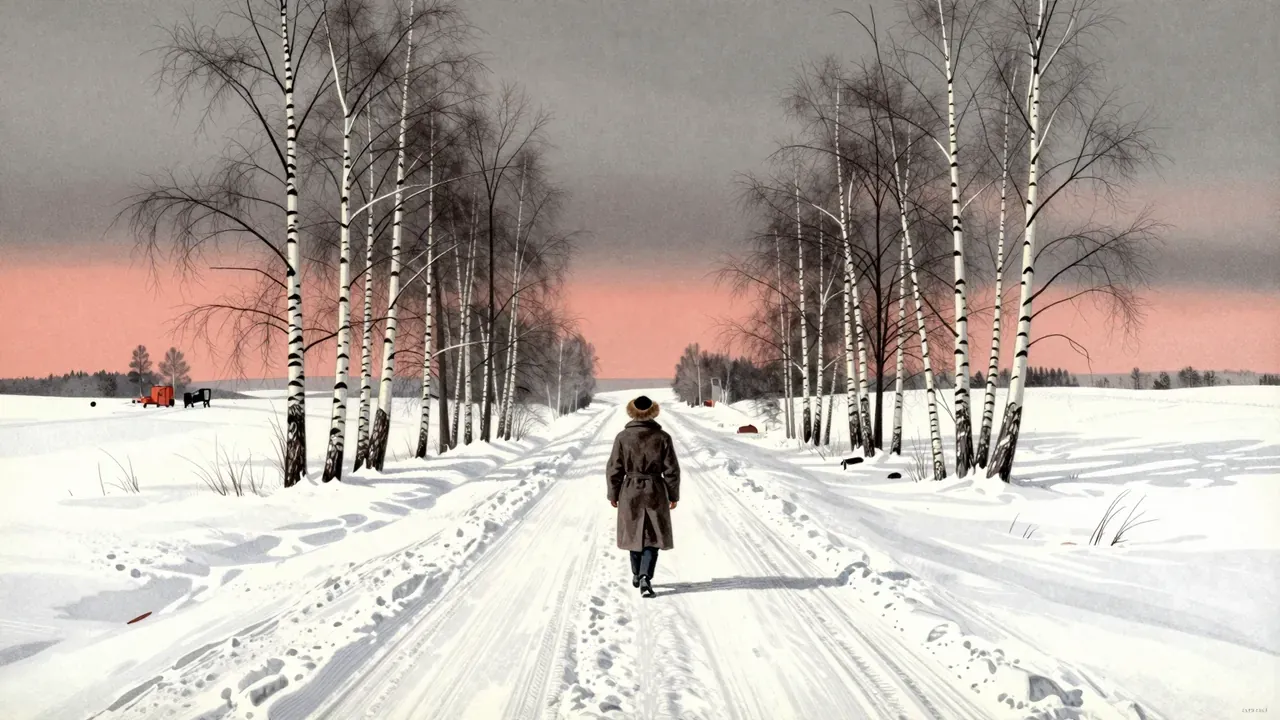
What lands is the cumulative force of its restraint. The film’s refusal to explain, justify or dramatise its central moral crisis makes the final moments — Sotnikov’s silent execution, Rybak’s solitary walk into blinding snow — land with unbearable clarity. Plotnikov’s performance holds the film’s ethical centre: his stillness reads not as passivity but as the last intact boundary between self and surrender. The cinematography’s monochrome austerity denies visual comfort; the cold is felt not through dialogue but through the way light pools on frozen eyelashes or vanishes into wool scarves. Schnittke’s music does not underscore emotion but amplifies silence — a low cello note sustained until it vibrates in the teeth. Even the casting works precisely as intended: Solonitsyn’s familiar face (from Tarkovsky’s Andrei Rublev) carries no heroic baggage here, only exhaustion. The film’s power resides in what it omits — no flashbacks, no exposition, no redemption arc — and what remains is stark, unadorned, and irrevocable. (157 words)
Where it resists
What does not land is the film’s structural rigidity when viewed outside its philosophical frame. Some scenes — particularly extended static shots of characters sitting in silence or staring into firelight — risk monotony if the viewer is not already attuned to its method. The absence of period detail or geopolitical context may alienate those expecting historical texture; this is not a film about occupation but about the interior architecture of capitulation. The script’s fidelity to Bykaŭ’s novel means certain psychological transitions happen off-screen or in near-subliminal glances, which can read as opacity rather than economy. A few supporting roles — notably the peasant woman who shelters the partisans — feel underwritten, their motivations left ambiguous not for resonance but for omission. And while Schnittke’s score is formally brilliant, its relentless austerity can overwhelm rather than deepen, especially in the final third where sound and image both narrow to near-absolute minimalism. These are not flaws in intent, but consequences of a vision so singular it leaves little room for variation. (159 words)
What it is really about
The themes that matter are endurance without purpose, the asymmetry of moral courage, and the physicality of conscience. The film treats betrayal not as a sudden act but as a slow accrual of small surrenders — a withheld glance, a delayed answer, a hand pulled back from another’s. It insists that integrity is not heroic but metabolic: something worn down by cold, hunger, fatigue, and the sheer duration of being watched. Sotnikov’s suffering is not redemptive; it is diagnostic. Rybak’s survival is not triumphant; it is anatomical. The film’s preoccupation with embodiment — trembling hands, laboured breathing, the weight of boots in snow — grounds its metaphysics in tissue and bone. There is no afterlife, no divine witness, no historical vindication: only the body’s limits and the mind’s capacity to name its own failure. This is not existentialism as abstraction but as lived erosion. The film’s quietest theme is also its most radical: that dignity may reside not in resistance, but in the refusal to misname one’s own collapse. (156 words)
Who it is for
This film is for viewers who accept that moral inquiry need not be discursive, that silence can carry more argument than speech, and that a film’s rhythm may be calibrated to breath rather than plot. It suits those accustomed to Tarkovsky, Dreyer or Bresson — audiences who do not require narrative propulsion to sustain attention. It is not for those who rely on character arcs, exposition, or emotional signposting; nor for viewers who expect war films to clarify allegiance or affirm collective values. Anyone needing catharsis, resolution or even clear moral binaries will find it withholding. Those who associate ‘arthouse’ with stylistic flourish rather than structural discipline may mistake its austerity for emptiness. The film demands patience not as a virtue but as a condition of entry — and rewards it with a rare kind of intellectual and sensory gravity. To reject it is not wrong; it simply means the terms of engagement — slowness, ambiguity, embodied ethics — are not yours. (159 words)
Whether it is worth your evening
Yes, it is worth your evening — provided you arrive prepared to sit with discomfort without seeking relief. Its 110 minutes do not pass quickly, but they do accumulate: each shot deepens the sense of moral gravity until the final image — Rybak alone in white — feels less like an ending than a diagnosis. It is worth it because few films articulate the physiology of compromise with such precision, or treat spiritual exhaustion as a material fact. It is not worth it if you measure value in narrative efficiency, emotional payoff or historical instruction. Those who find its pace oppressive, its tone unremitting, or its conclusion ethically unsatisfying would not be mistaken — they would simply be outside the film’s intended contract. A different verdict would follow if the film offered explanation, mercy or even irony; but it offers none of these. Its worth lies in its refusal. (158 words)