The last film
An Autumn Afternoon is Yasujirō Ozu’s final film, a domestic drama set in early-1960s Tokyo that observes the quiet dissolution of a family unit as its patriarch arranges his daughter’s marriage. It does not seek to dramatise crisis or rupture but to register the weight of habit, duty and unspoken feeling within ordinary routines: shared meals, bar visits, school reunions, seasonal food. Ozu and co-writer Kōgo Noda work within a tightly circumscribed social world — civil servants, shopkeepers, retired naval officers — where emotional life is measured in glances, silences, and minor deviations from custom. The film’s aim is not explanation but registration: it traces how responsibility shifts across generations, how loneliness accumulates without fanfare, and how tradition both sustains and confines. There is no exposition of backstory, no psychological excavation; instead, character emerges through posture, placement in frame, and the rhythm of daily repetition. Its project is structural and ethical: to show what endures when nothing is said, and what vanishes when nothing is done.
The ellipsis
The story proceeds by accumulation rather than causality, using Ozu’s signature ellipses to omit weddings, proposals and arguments, leaving only their emotional residue. Chishū Ryū’s Shūhei Hirayama carries the film with minimal inflection: his face registers fatigue, deference, guilt and resignation in near-identical stillness. Mariko Okada and Keiji Sada give restrained performances as the son and daughter-in-law whose small domestic negotiations — over refrigerators, golf clubs, handbags — quietly expose generational friction. Yūharu Atsuta’s Agfacolor cinematography is muted and precise: interiors are lit for clarity, not mood; compositions are centred, low-angle, unadorned. Takanobu Saitō’s score is sparse, often absent; diegetic sound — clinking glasses, noodle broth, the Warship March record — carries more narrative weight. Editing by Yoshiyasu Hamamura sustains Ozu’s 30-degree rule and avoids cross-cutting, letting scenes breathe at their own pace. Every craft choice serves containment: no gesture exceeds its function, no shot lingers beyond necessity.
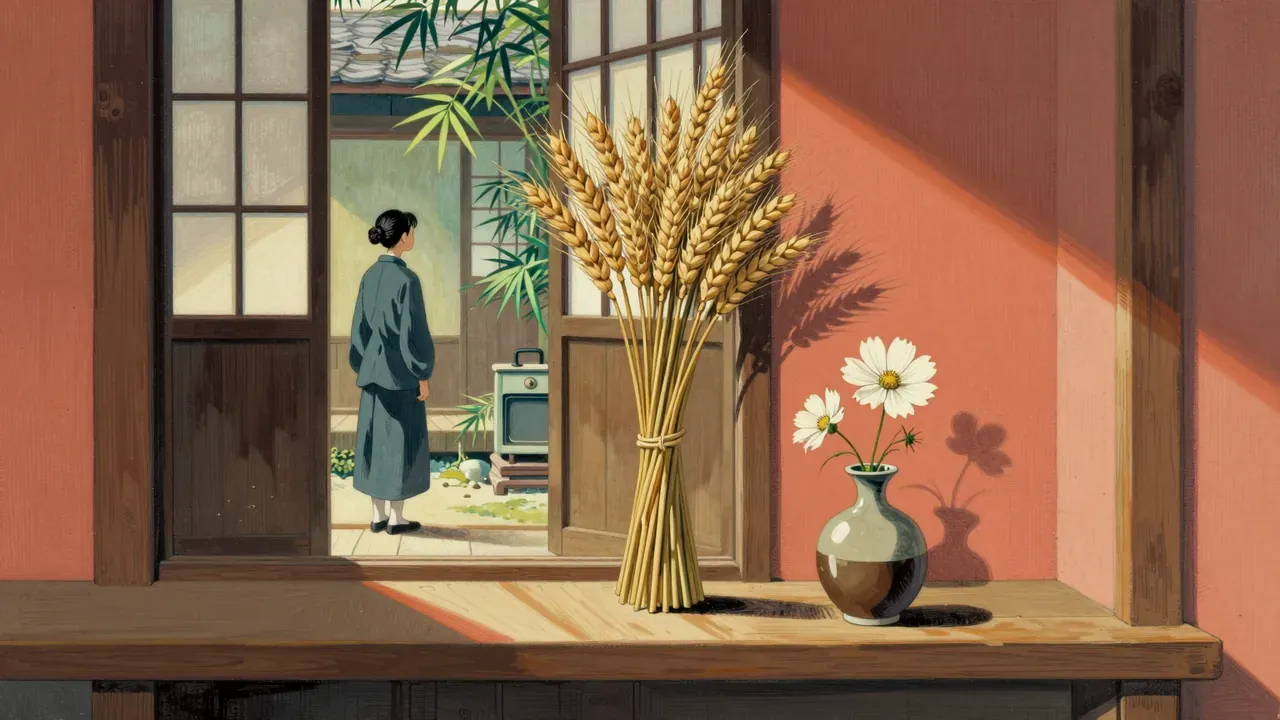
The look of it
What lands is the cumulative pressure of time passing without announcement. The film’s refusal to underline emotion makes Hirayama’s final line — ‘Alone, eh?’ — land not as revelation but as quiet confirmation. The school reunion scenes work because they feel lived-in: the banter about virility pills, the awkwardness of visiting a fallen teacher, the way old men measure dignity against dwindling means. Michiko’s silent retreat after hearing Miura is engaged lands because it follows three scenes in which she has already been shown listening, serving tea, adjusting her collar — all acts of presence that make her absence felt more acutely. The wedding kimono sequence lands precisely because it omits ceremony: the formality of dress, the absence of groom or guests, the cut to Hirayama alone in a bar — these register consequence without commentary. Even minor details land: the painted fronds behind the credits signal a slight formal departure, a subtle acknowledgment that this is an ending; the sanma on the dinner table recurs without emphasis, yet becomes inseparable from the season, the loss, the taste of memory.
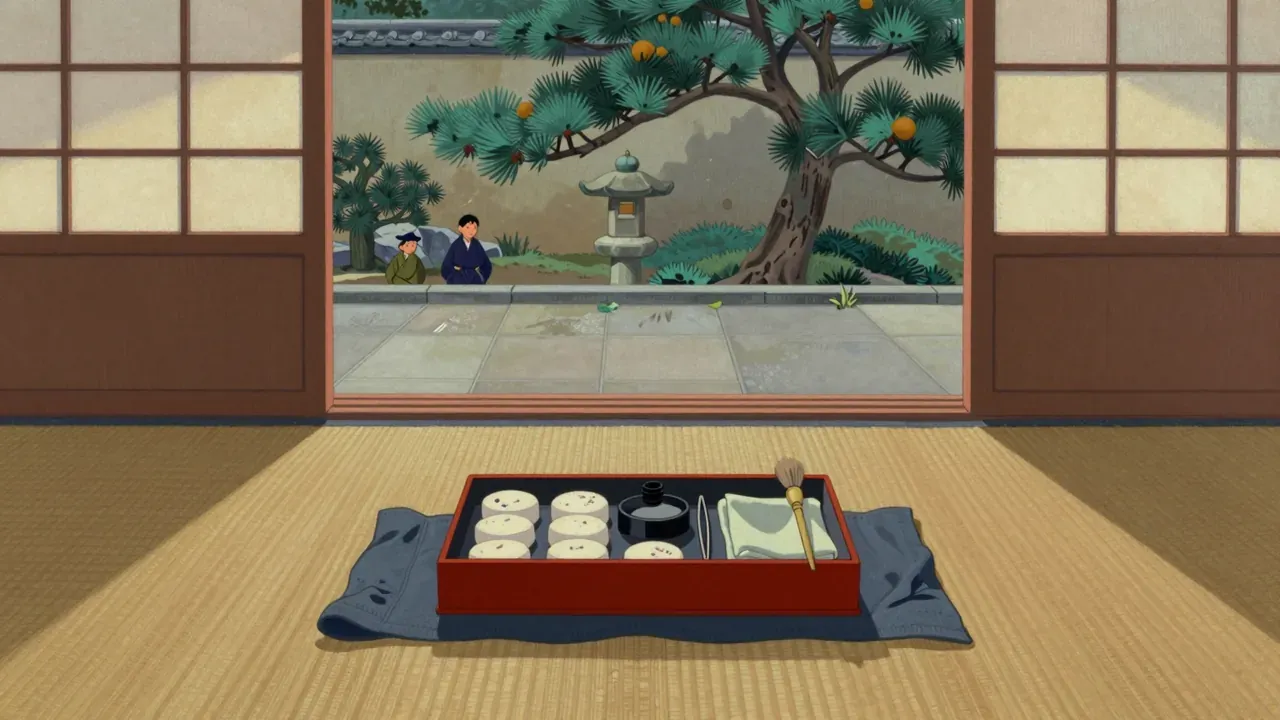
The silence
What does not land is any attempt to read the film as socially diagnostic. It offers no critique of post-war Japan’s economic shift, no engagement with labour politics or urban redevelopment — though these form its backdrop. The naval past is mentioned once and never revisited; the war’s impact is implied only through the mother’s absence and the children’s ages, never dramatised. Characters like Kaoru, the bar hostess who resembles Hirayama’s wife, remain deliberately opaque: her resemblance functions as motif, not psychology. The film resists assigning motive to Kōichi’s borrowing or Akiko’s handbag demand — they are gestures, not symptoms. Some viewers may find the pacing too deliberate, the repetitions too exacting, the emotional withholding too absolute. Those expecting narrative propulsion, moral resolution or even clear cause-and-effect between Sakuma’s plight and Hirayama’s decision will be frustrated: the link is associative, not logical. The film assumes patience with ambiguity and declines to translate feeling into speech.
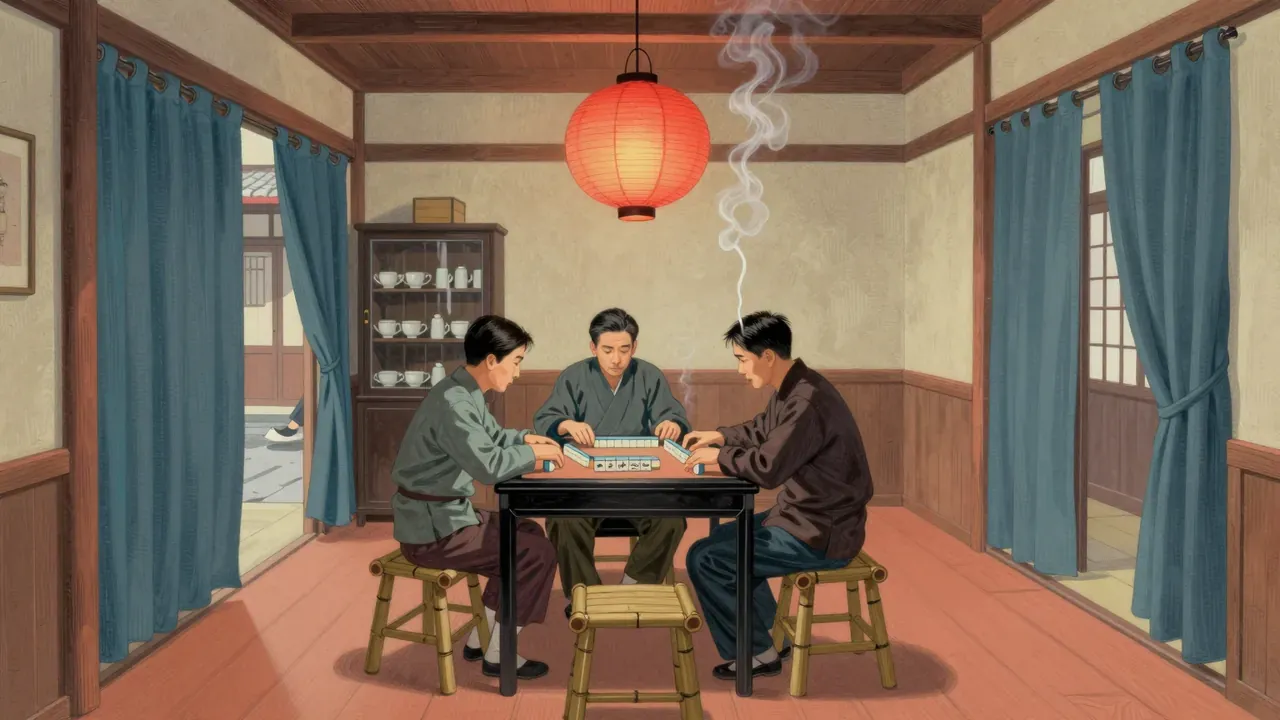
The dinner table
The themes that matter are filial duty as self-deception, the asymmetry of care across generations, and the quiet violence of routine. Hirayama’s realisation is not that he loves Michiko too much, but that he has mistaken dependence for devotion. His naval discipline — the salute, the march, the record — persists as ritual long after its purpose has vanished, just as his keeping Michiko home persists after her mother’s death has ceased to justify it. Ageing is not framed as decline but as accrued silence: the older characters speak less, listen more, and occupy space with increasing stillness. Loneliness is structural, not situational — it inheres in the empty chair at the dinner table, the unshared sake cup, the bar stool taken alone. Seasonality matters not as metaphor but as condition: sanma appears only in autumn, just as certain choices — marriage, departure, retirement — arrive only once, and only at their appointed time. The film treats time not as linear progression but as sediment: each scene deposits a layer of unspoken history, visible only in what remains unsaid and undone.
The bar stool
This film is for viewers who accept that stillness can be dramatic, that omission can be expressive, and that a single glance may carry more weight than a monologue. It rewards attention to composition, to the weight of objects (a teacup, a fish bone, a record sleeve), and to the rhythm of pauses. It is not for those who require plot momentum, psychological exposition or emotional catharsis — viewers who expect Michiko’s tears to be followed by dialogue, or Hirayama’s drunkenness to resolve into clarity, will find the film withholding. Those who associate ‘arthouse’ with stylistic flamboyance rather than formal discipline may misread its austerity as emptiness. A viewer who values narrative efficiency over emotional resonance, or who finds ambiguity indistinguishable from evasion, would likely leave unrewarded. The film’s value depends entirely on willingness to meet it on its own terms: slow, specific, uninflected.
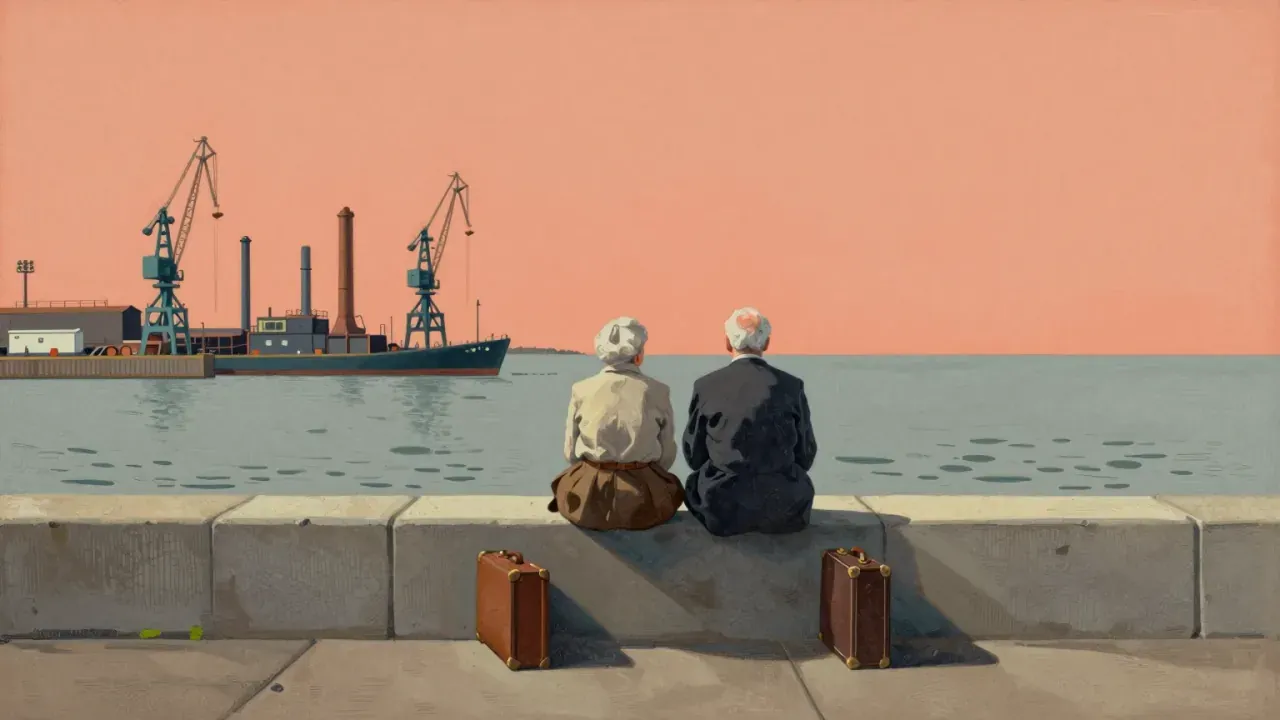
The last line
Yes, it is worth your evening — provided you set aside the expectation of event and accept duration as meaning. Its 113 minutes unfold with the inevitability of a season turning: no scene rushes, none lingers unnecessarily, and every cut serves the film’s quiet logic. Those who find value in films that trust the viewer to infer, to remember, to sit with discomfort without resolution will find it deeply sustaining. It is not for viewers who need narrative payoff, thematic summary or emotional signposting — a person who prefers the explicit over the implicit, or who measures a film’s worth by how much it tells them, would likely consider it inert. What changes the verdict is not the film’s quality but the viewer’s contract with time: if you bring stillness, it returns depth; if you bring impatience, it returns silence.