A Tsar for the State
Ivan the Terrible, Part I is a Soviet biographical film directed by Sergei Eisenstein, released in January 1944, that dramatises the early reign of Ivan IV of Russia — his coronation as Tsar in 1547, consolidation of autocratic power, and conflict with the boyar aristocracy. It is not a neutral historical survey but a deliberate, state-sanctioned allegory: Ivan stands for the centralised, uncompromising authority required to unify and defend the nation against internal decay and external threat. Eisenstein wrote, produced, and edited the film himself; its structure, rhythm, and symbolism are tightly controlled, less concerned with psychological realism than with moral and political typology. The film assumes the viewer’s familiarity with Russian history and Orthodox iconography, and it treats historical narrative as a vessel for ideological argument — specifically, the legitimacy of forceful leadership in times of national peril. Its ambition is monumental: to forge a mythic foundation for Soviet statehood through the stylised resurrection of a sixteenth-century ruler.
The Look of It
The film works through stark visual composition, choreographed movement, and symbolic contrast rather than naturalistic storytelling. Eduard Tisse and Andrei Moskvin’s cinematography favours high-contrast lighting, deep shadows, and static, frontal framings that recall medieval icons and Renaissance altarpieces; interiors remain under-lit, faces half-obscured, architecture looming and oppressive. Nikolay Cherkasov’s Ivan is neither charismatic nor cruel in a modern sense — he is monumental, hieratic, his gestures measured and ritualistic. Supporting performances are equally stylised: Serafima Birman’s Empress Anastasia radiates fragile grace, while Mikhail Zharov’s boyar Fyodor Basmanov embodies sly, conspiratorial menace. Sergei Prokofiev’s score is percussive and liturgical, punctuating key moments with brass fanfares and choral chants. Eisenstein’s editing avoids continuity logic in favour of rhythmic juxtaposition — a glance cuts to a dagger, a crown to a coffin — reinforcing thematic parallels over narrative flow. There is no attempt at psychological motivation; cause and effect operate on the level of moral archetype and historical necessity.
What Holds Weight
What lands is the film’s sheer formal authority — its ability to make ideology palpable through image, sound, and rhythm. The coronation sequence, with its slow procession up cathedral steps under a vaulted ceiling, conveys sacred investiture without dialogue; the banquet scene, where Ivan’s silence spreads like frost across the table, makes political tension physically felt. Cherkasov’s physical presence — tall, still, eyes unblinking — anchors the film’s moral gravity. Prokofiev’s music does not accompany but interrogates the action: the ‘Song of the Flea’ is both mocking and ominous, its jaunty melody undercutting the boyars’ complacency. The film’s use of colour — limited to selective reds and golds against monochrome — isolates symbols of power and blood with surgical precision. Even viewers unfamiliar with Muscovite history register the weight of the throne, the menace of the council chamber, the exhaustion of sustained vigilance. This is not persuasion through argument but through sensory conviction: the film makes autocracy feel inevitable, even sacred, within its own logic.
Where It Keeps Its Distance
What does not land is the film’s emotional accessibility outside its intended ideological frame. The characters do not develop; they incarnate positions — loyalty, treachery, piety, ambition — and their interactions rarely generate suspense or empathy in a conventional sense. The pacing is deliberate to the point of austerity: long takes, repeated gestures, pauses held beyond comfort. Some sequences — particularly the extended council debates — rely on rhetorical density and historical allusion that resist immediate comprehension without prior knowledge of the Oprichnina or the Livonian War. The stylisation, while coherent, can feel remote: Ivan’s grief after Anastasia’s death is conveyed through rigid posture and a single tear, not through performance that invites identification. Viewers expecting psychological realism or narrative momentum may find the film withholding, even alienating. Its power lies in its rigour, but that rigour demands surrender to its terms — a demand some will refuse, rightly, on grounds of aesthetic or ethical preference.
The Cost of the Crown
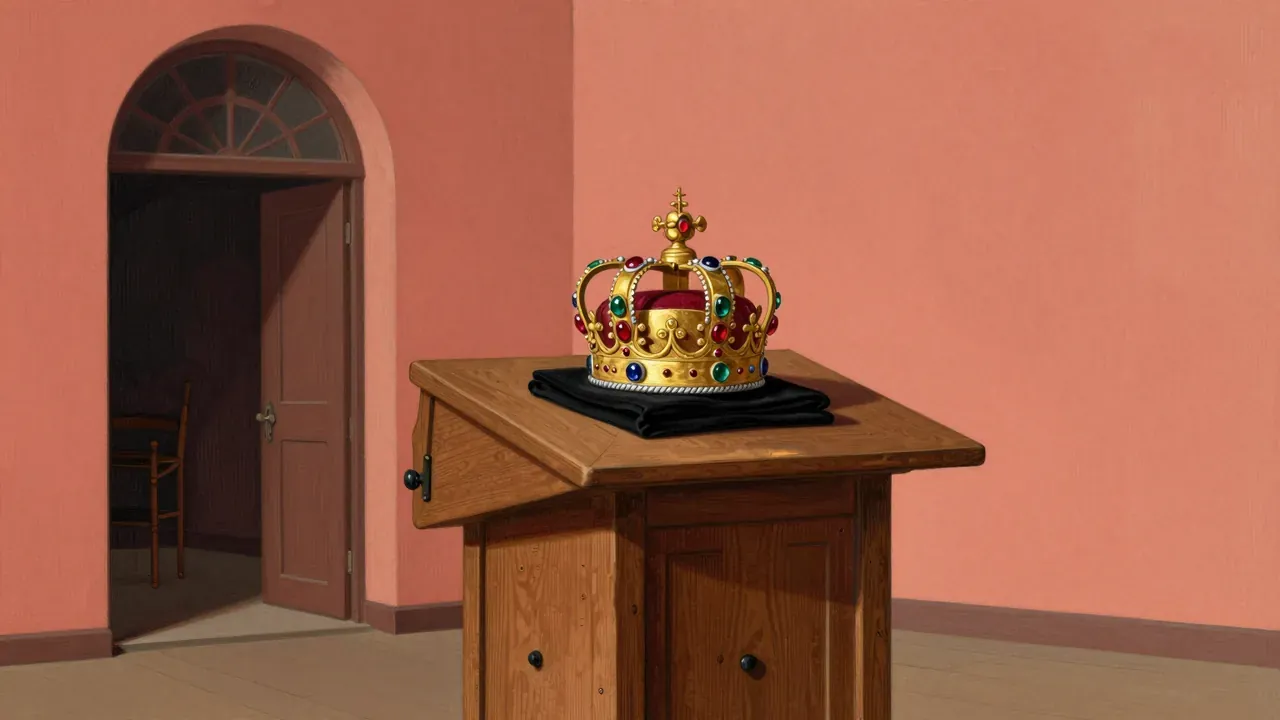
The themes that matter are sovereignty and sacrifice, unity and suspicion, the burden of rule and the corrosion of trust. Ivan’s authority is not asserted through conquest alone but through ritual, orthodoxy, and the elimination of ambiguity — hence the film’s fixation on oaths, crowns, relics, and confessionals. The boyars represent not mere self-interest but structural fragmentation: their whispered councils, shifting alliances, and ornamental dress signify a polity incapable of collective defence. Eisenstein treats history as dialectical theatre: each act of consolidation provokes counter-force, each gesture of mercy invites betrayal. The film’s most persistent motif is the mirror — literal and metaphorical — reflecting Ivan’s face back at him, suggesting that tyranny begins not in malice but in the unbearable weight of being the sole locus of responsibility. Faith, here, is inseparable from fear; orthodoxy from surveillance; mercy from weakness. These are not abstract ideas but embodied conditions — visible in the set design, audible in Prokofiev’s dissonant harmonies, legible in the actors’ immobile faces.
Who Stands Before It
This film is for viewers who approach cinema as architecture of thought — those willing to sit with symbolic density, historical allusion, and formal discipline over narrative ease. It rewards attention to composition, musical counterpoint, and the politics of staging. It is not for those who require character-driven arcs, exposition, or emotional release; its austerity is intentional, not incidental. Some historians and critics reject its propagandistic framing — notably its rehabilitation of Ivan’s terror as necessary statecraft — and that disagreement is valid, rooted in evidence, not taste. A viewer who finds the film cold or didactic would not be wrong; they would simply be responding to what Eisenstein built: a monument, not a portrait. That verdict would change only if one accepted the film’s premise — that history judges rulers by outcomes, not intentions — and submitted to its visual grammar as a language worth learning.
Why It Endures
Yes, it is worth your evening — but only if you treat it as a primary source, not entertainment. Ninety-nine minutes spent with Ivan the Terrible, Part I is time spent inside a specific, highly wrought political imagination: Stalinist Russia refracting itself through sixteenth-century Muscovy. Its value lies not in escapism but in confrontation — with how power justifies itself, how art serves ideology, and how form can harden belief into sensation. Those who watch for plot or catharsis will leave unsatisfied; those who watch to understand how images accrue moral weight will find few films more instructive. It is demanding, yes — but its difficulty is not obscurity; it is precision. To dismiss it as dated or dogmatic is to miss how deliberately its techniques were forged: every shadow, every cut, every chord was chosen to make inevitability feel visible. That effort deserves attention, even from those who reject its conclusions. It remains a benchmark of cinematic intentionality — and intentionality, when this absolute, is never trivial.