A First Film That Feels Like a Last Word
Le Beau Serge is Claude Chabrol’s first feature and a foundational text of the French New Wave—not because it announces stylistic rupture, but because it applies Cahiers du cinéma’s critical rigour to fiction filmmaking: observing provincial life without condescension, trusting narrative economy over exposition, and treating moral ambiguity as structural rather than incidental. It does not aim to shock or dazzle, but to register how habit, silence, and unspoken obligation shape behaviour in a village where everyone knows everyone’s business and no one speaks plainly about damage. The film’s ambition is modest in scale but precise in intent: to trace the slow erosion of hope in two men bound by childhood loyalty, and to ask whether intervention—however well-meaning—is ever anything more than another form of intrusion. Its method is observational, its tone restrained, its moral coordinates deliberately unsettled. It assumes the viewer will notice what is withheld: the absence of score during key confrontations, the refusal to cut away from discomfort, the way snow accumulates on shoulders without comment. It is not a manifesto. It is a calibration.
The Look of It
The story unfolds in chronological order, anchored by François’s return to Sardent and his increasingly futile attempts to ‘save’ Serge. Gérard Blain plays Serge with physical slackness and sudden, unmoored violence; Jean-Claude Brialy’s François carries conviction but little authority—their arguments land because neither wins, and neither yields ground. Bernadette Lafont’s Marie is drawn with quiet specificity: her gestures are small, her silences weighted, her vulnerability never theatricalised. Henri Decaë and Jean Rabier’s cinematography avoids flourish: interiors are lit by available sources, exteriors by winter light that flattens contrast and bleaches colour. Jacques Gaillard’s editing sustains duration—long takes hold on faces mid-thought, on hands fumbling with coat buttons, on snow falling uninterrupted for twelve seconds. There are no establishing shots to orient the viewer; geography emerges through repetition and consequence. Dialogue is sparse and often functional, yet charged by what precedes or follows it. Chabrol’s script leaves gaps not for mystery, but for implication: Glomaud’s assault on Marie is heard off-screen, then confirmed only by Marie’s posture and François’s delayed reaction.
What Sticks
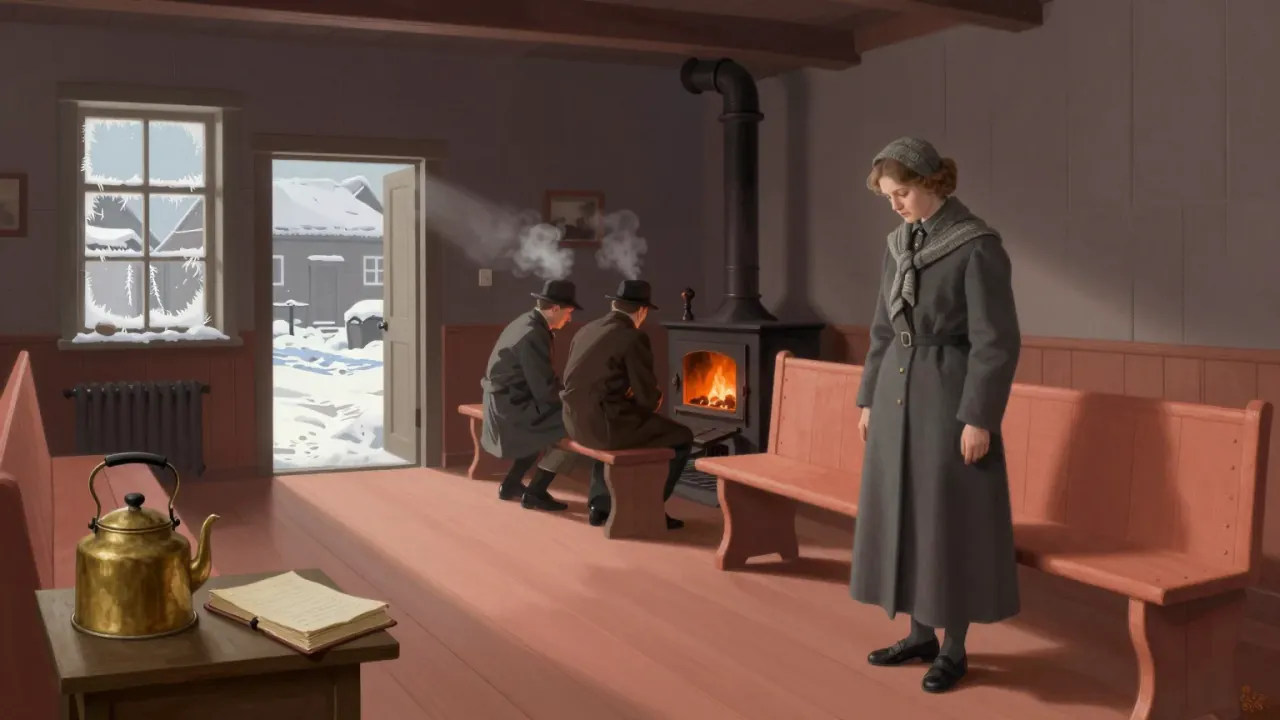
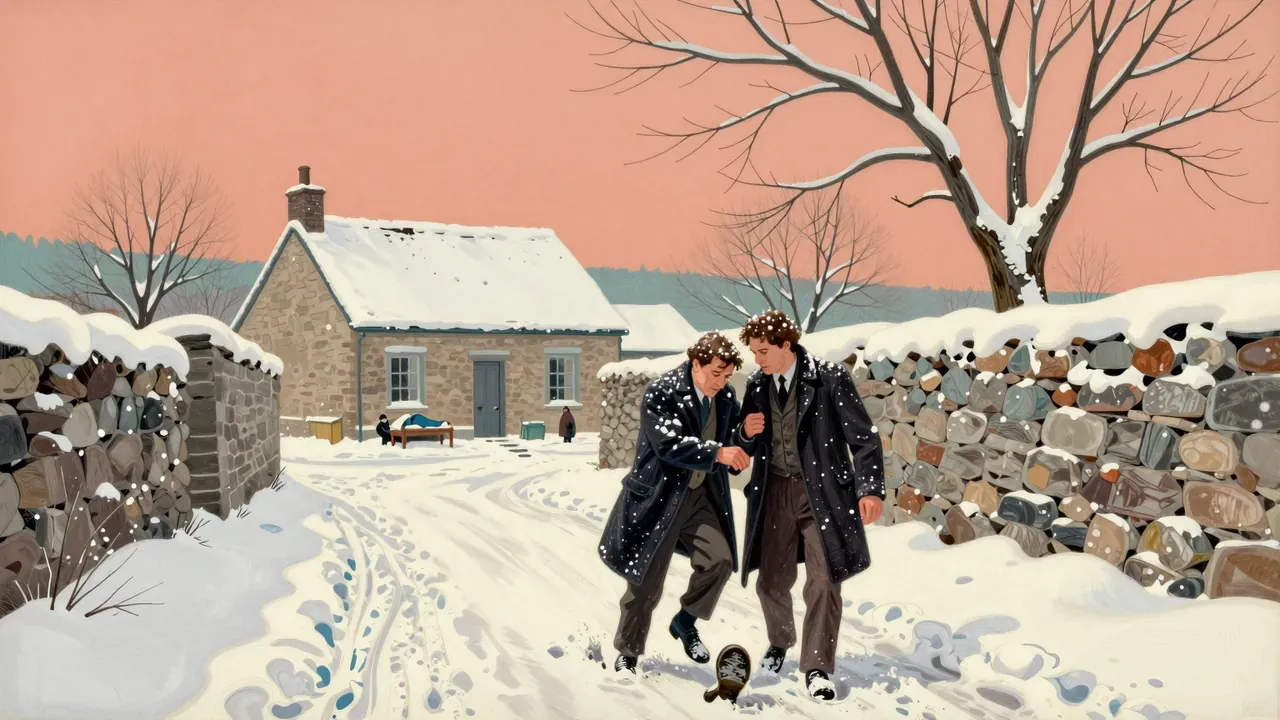
What lands is the film’s unblinking attention to consequence. When François drags Serge through snow to Yvonne’s bedside, the effort registers in his breath, his stumbling gait, the way his gloves slip from numb fingers—no music swells, no cut to a reaction shot. The birth scene works because it refuses catharsis: the baby is premature, the mother exhausted, the father weeping with relief and shame, and François collapses not in triumph but from sheer depletion. The film’s restraint makes these moments legible as human rather than symbolic. The performances avoid psychology-as-explanation: Blain’s Serge does not gesture toward inner torment; he simply drinks, slurs, and lashes out, and the film trusts the viewer to infer cause from pattern. The village itself lands as a character—not picturesque, not oppressive, but dense with unspoken histories, where the baker’s glance at Marie carries the weight of communal knowledge, and the priest’s advice is delivered without judgment, just weariness. Even minor roles—Glomaud’s drunken menace, the doctor’s reluctant professionalism—feel inhabited, not assigned.
Where It Falters
What does not land is the film’s occasional drift into schematic contrast: François the Parisian intellectual versus Serge the stunted provincial feels less like lived tension and more like a thesis statement made flesh. Some exchanges—particularly between François and the priest—tip into didacticism, their dialogue functioning as exposition rather than speech. The subplot involving Marie’s paternity, while thematically resonant, is introduced too abruptly and resolved too quietly to carry the emotional weight it needs; Glomaud’s final act lands with force, but the groundwork for his motive remains thin. The film’s austerity sometimes reads as omission rather than discipline: we never see Serge before his decline, never hear him articulate his ambitions beyond vague regret, and Yvonne’s interiority is almost entirely absent. Chabrol’s later films would deepen such omissions into active ambiguity; here, they occasionally feel like gaps left unfilled by time or budget. The 1957–8 winter shoot imposed constraints, and some scenes bear the marks of compromise—repetition of locations, reliance on natural sound that muffles key lines.
What It’s Really About
The themes that matter are endurance, complicity, and the illusion of agency in closed systems. The film treats alcoholism not as pathology but as sedimented response—Serge’s drinking is less a choice than the slow settling of disappointment into habit. François’s desire to help is shown as equally entangled: his moral certainty masks a need to impose order on chaos he cannot control. The village operates as a microcosm of inherited structures—religious, familial, economic—where departure is rare and reinvention impossible without cost. Class is present but unspoken: François’s Paris clothes, his fluency in medical terminology, his assumption that action can fix things—all mark him as alien, yet his privilege does not grant insight, only misdirection. The film questions whether care can exist without condescension, whether memory binds or paralyses, and whether redemption requires change—or merely survival long enough to witness a new life enter the world. It treats faith not as belief but as practice: the priest’s quiet presence, the ritual of the town dance, the unspoken pact of silence around Glomaud’s violence.
Who It’s For
This film is for viewers who value precision over pace, implication over explanation, and moral unease over resolution. It rewards attention to gesture, pause, and spatial relationship—not because it hides meaning, but because it embeds it in behaviour. Those who expect narrative propulsion, psychological exposition, or stylistic flamboyance will find it inert. It is not for viewers who require clear antagonists, redemptive arcs, or tonal consistency: the film shifts from bleakness to dark humour to tenderness without transition, trusting the viewer to hold the contradictions. Anyone put off by long takes, untranslated French, or winter landscapes devoid of visual relief may disengage early. A viewer expecting New Wave as stylistic rebellion will be disappointed; this is New Wave as ethical recalibration—and those who mistake austerity for emptiness will miss its density. Its demands are formal and philosophical, not technical or sensational.
Is It Worth Your Evening?
Yes, it is worth your evening—if you accept that its value lies in accumulation, not climax. Ninety-nine minutes pass without a single false note in performance or framing, and its ending lands not as closure but as quiet, hard-won continuity: a baby born, a man weeping, another fainting—not in victory, but in exhaustion. It repays rewatching because its power resides in what is withheld: no score tells you how to feel, no close-up tells you what to think, no voiceover explains the stakes. Those who dislike it tend to cite its stillness, its lack of overt commentary, or its refusal to condemn Glomaud outright—criticisms that misunderstand its project. Change the verdict? Only if you believe moral seriousness requires emphasis, not restraint. For anyone willing to sit with uncertainty, it remains urgent—not as history, but as method.