The premise
The Night Porter is an Italian art film from 1974 that attempts to dramatise the psychological and moral entanglement between a former Nazi concentration camp officer and a survivor he re-encounters in postwar Vienna. Directed by Liliana Cavani and co-written with Italo Moscati, it seeks not to document history but to probe complicity, eroticised power, and the persistence of trauma through stylised, morally ambiguous fiction. Its ambition lies in unsettling the viewer’s assumptions about victimhood, agency, and desire — not by offering explanation or resolution, but by sustaining discomfort through narrative restraint and visual austerity. It operates outside historical realism, favouring symbolic recurrence over exposition: repeated gestures, mirrored framing, and confined interiors suggest internal states rather than external facts. The film does not claim authority on the Holocaust; it uses its shadow as a condition for examining how violence reshapes subjectivity, long after the camps have closed. Its project is neither didactic nor cathartic — it is forensic in tone, theatrical in gesture, and deliberately unresolved in moral implication. (158 words)
The look of it
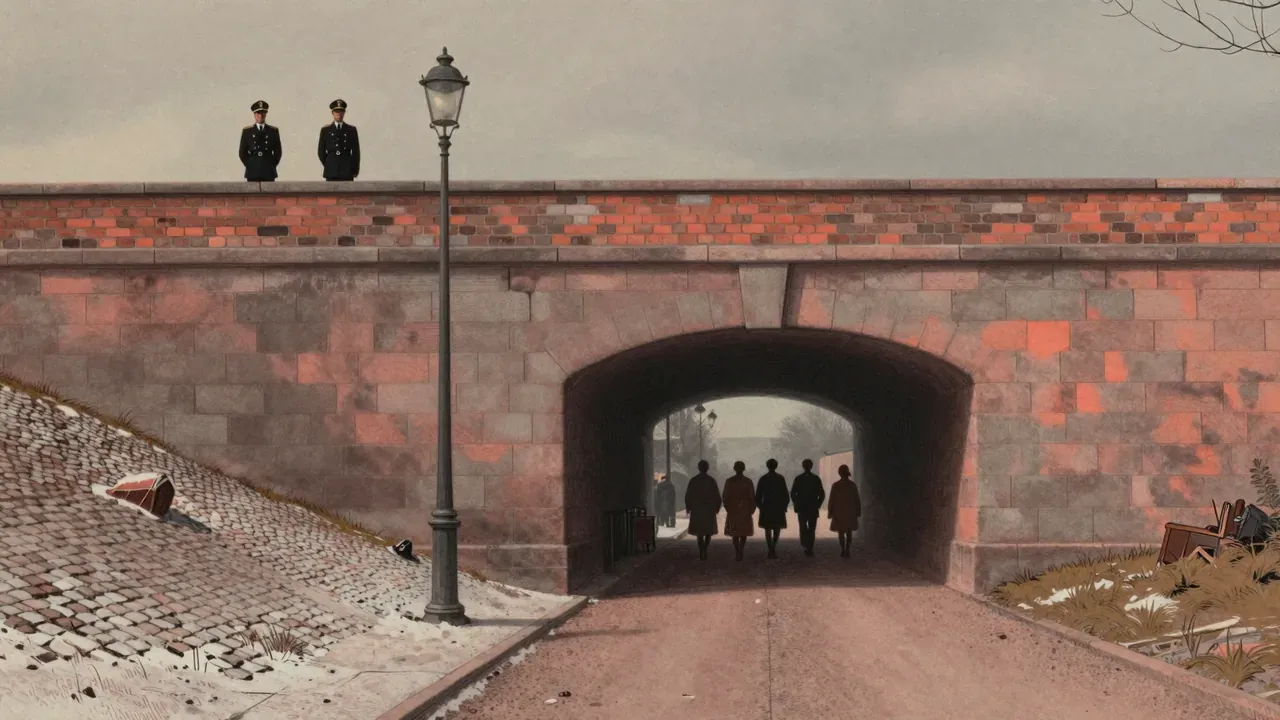
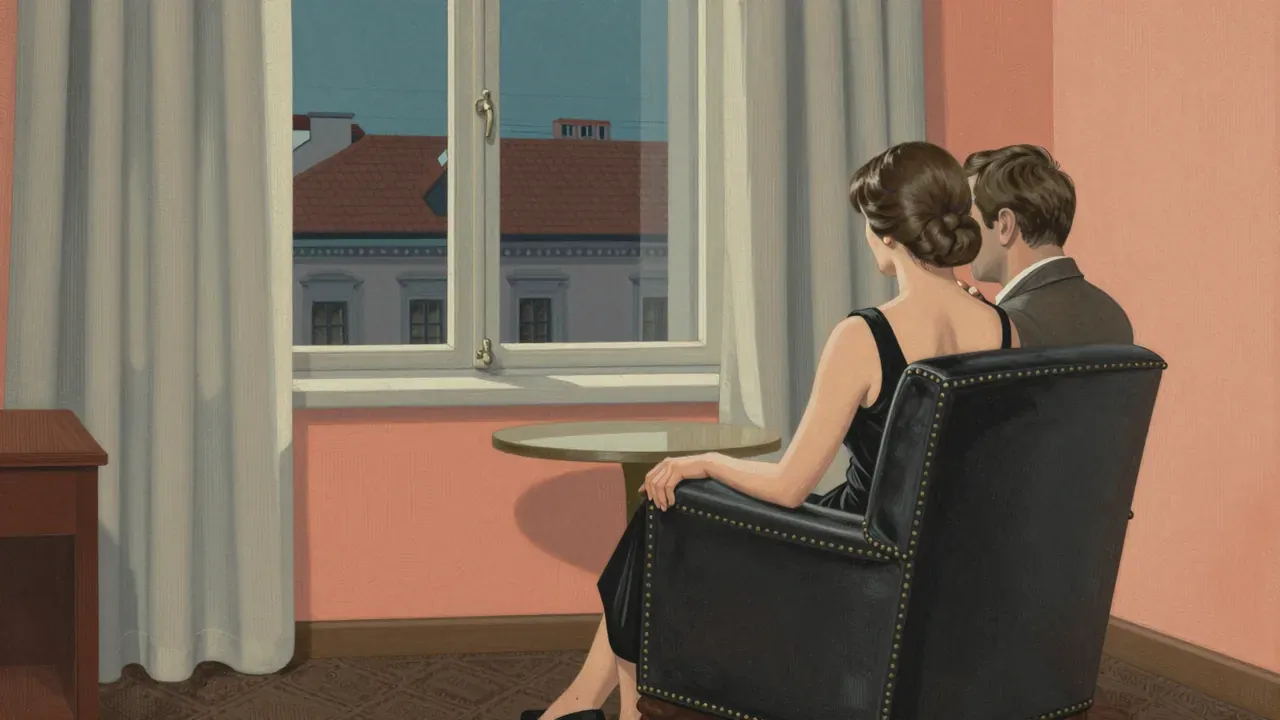
The story follows Max (Dirk Bogarde), a Vienna hotel night porter with a concealed SS past, and Lucia (Charlotte Rampling), a concert singer who recognises him and re-enters his orbit. Their relationship unfolds in hushed, claustrophobic spaces — corridors, stairwells, hotel rooms — where Alfio Contini’s cinematography keeps light sparse and surfaces reflective, heightening unease without melodrama. Bogarde performs with controlled stillness, his physical presence more threatening than any outburst; Rampling’s Lucia is less reactive than enigmatic, her gaze often withholding judgment or surrender. Franco Arcalli’s editing avoids conventional rhythm, favouring abrupt cuts and lingering pauses that resist emotional cues. Daniele Paris’s score is minimal — strings held in suspension, motifs recurring like half-remembered commands. The supporting cast, including Philippe Leroy and Gabriele Ferzetti, function as counterpoints: bureaucratic, indifferent, or quietly predatory. There are no flashbacks, no archival footage, no voiceover — the past enters only through gesture, glance, and the weight of silence. Every craft choice serves containment, not expansion. (159 words)
What holds
What lands is the film’s oppressive atmosphere — the sense of time folded in on itself, of choices already made and unmade. The hotel becomes a microcosm where hierarchy reasserts itself without uniforms or orders: Max opens doors, Lucia waits, others observe without intervening. Bogarde and Rampling hold the frame not through charisma but through mutual gravity — their scenes together generate tension because neither character yields narrative control to the other, nor to the viewer. Contini’s use of shallow focus isolates faces within doorways or behind glass, reinforcing enclosure and surveillance. The film’s refusal to moralise — to label Max a monster or Lucia a victim — lands with cumulative force. It forces attention onto behaviour rather than motive, gesture rather than speech. Even minor moments — a hand resting on a shoulder, a delayed blink, a cigarette lit without looking — accrue meaning through repetition and context. This is not suspense built on plot turns but on the slow erosion of certainty about who is acting and who is acted upon. The film’s power resides in its rigour: every shot sustains its central question without answering it. (156 words)
Where it slips
What does not land is the film’s attempt to sustain ambiguity when its symbolism grows rigid. The recurring motif of the black glove, for instance, begins as a subtle marker of suppressed identity but hardens into a prop, its meaning fixed rather than deepened. Some performances — particularly those of secondary characters like Isa Miranda or Giuseppe Addobbati — feel underwritten and theatrically broad, disrupting the film’s otherwise muted register. The English-language dialogue, though delivered with precision, occasionally strains against the actors’ accents and the script’s clipped syntax, creating moments where phrasing feels imposed rather than lived. More significantly, the film’s aesthetic discipline cannot fully compensate for its thin historical scaffolding: the absence of any concrete reference to camp structure, ideology, or even dates risks reducing atrocity to backdrop. Viewers familiar with Holocaust historiography may find the film’s abstraction ethically precarious — not because it fictionalises, but because its formal economy leaves too little room for the specificity of suffering or resistance. Its restraint begins to read as evasion where context is most needed. (157 words)
What it means
The themes that matter are power as habit, memory as recurrence, and desire as entanglement. The film treats domination not as exceptional violence but as routine — something that persists in posture, in the way a man holds a key or stands behind a woman’s chair. Trauma here is not recalled but re-enacted, not processed but performed, often without conscious intent. Lucia’s return is neither revenge nor rescue; it is recognition — of herself in him, of him in herself — and that symmetry is the film’s ethical core. Sexuality is rendered not as liberation or corruption but as a language of power that predates and survives ideology. Class, too, matters: the hotel staff, guests, and patrons move in parallel orbits, insulated from consequence, while Max and Lucia occupy a liminal zone where social rules dissolve and older ones reassert themselves. The film resists assigning blame to individuals alone, instead tracing how systems embed themselves in bodies, gestures, and silences. Its preoccupation is not with what happened in the camps, but with what remains — in architecture, in institutions, in the nervous system — after the war ends. (155 words)
Who it’s for
This film is for viewers who value sustained tonal control over narrative clarity, who can sit with moral dissonance without demanding resolution, and who approach historical trauma through metaphor rather than testimony. It rewards attention to composition, pacing, and subtext — not just what is said, but where a character stands in relation to a doorframe or a window. It is not for those seeking historical accuracy, psychological realism, or ethical guidance; its refusal to condemn or exonerate will frustrate viewers who require moral anchoring. Those who expect Holocaust representation to foreground survivor agency or systemic critique may find its focus on perpetrator-victim symbiosis alienating or irresponsible. A different verdict would follow if the film engaged more directly with postwar denazification, survivor networks, or Austrian complicity — but it does not. Its value lies precisely in its narrow, unwavering lens. To ask it to widen that lens is to misread its purpose. (158 words)
Is it worth your time
Yes, it is worth your evening — provided you watch it as a study in cinematic containment, not as a historical document or psychological case study. Its 118 minutes unfold with deliberate slowness, but that pace is structural, not indulgent: every pause, every withheld reaction, every dimmed corridor serves its inquiry into repetition and complicity. It repays close viewing not because it reveals hidden truths, but because it trains attention on how power circulates in quiet spaces. Those who dismiss it as exploitative or shallow often do so because they expect it to perform a different function — to educate, indict, or memorialise — functions it never claims. Its endurance lies in its refusal to simplify. That said, it demands patience and tolerance for ambiguity; viewers who prefer narrative propulsion or clear moral stakes will likely leave unsatisfied. Its worth is conditional, not absolute — but the condition is clearly stated, and the film honours it without compromise. (159 words)