The face of it
Monsieur Verdoux is a black comedy drama that reframes the true-crime figure of Henri Désiré Landru as a rationalised, almost bureaucratic murderer — a former bank clerk turned serial husband-killer who justifies his crimes as economic necessity and moral symmetry with wartime mass death. It attempts something rare for 1947: to strip Chaplin of the Tramp’s pathos and physical grace, place him in a tailored suit and a morally inverted logic, then use that dissonance to dissect capitalism, militarism, and societal hypocrisy. The film does not ask for sympathy but for recognition — that Verdoux’s arithmetic of survival mirrors the state’s arithmetic of war, and that his private violence is merely scaled-down public policy. It is not satire in the sense of mockery, but diagnosis: clinical, deliberate, unflinching. Chaplin wrote it after thirty years of building goodwill through vulnerability; here he trades warmth for precision, and charm for accusation. The ambition is structural: to make the audience complicit in Verdoux’s reasoning before withdrawing the ground beneath them. That it was released weeks after Chaplin’s political troubles intensified — and months before his re-entry permit was revoked — gives its timing the weight of inevitability, not coincidence.
The rhythm of it
The story unfolds with procedural rigour: Verdoux marries, extracts funds, eliminates, repeats — each step calibrated like a bank ledger. Chaplin’s performance is restrained, precise, almost detached; he moves with the economy of a man who has stopped believing in gesture. Martha Raye’s cameo as a brash, life-affirming widow provides the only real tonal counterweight, while William Frawley and Cyril Delevanti anchor the minor roles with dry, unembellished naturalism. Roland Totheroh and Curt Courant’s cinematography avoids expressionist shadows or theatrical framing; instead, interiors are lit with flat, even clarity, as if Verdoux’s world refuses the consolations of visual poetry. Chaplin’s score is sparse, often absent — when present, it leans on waltz-time irony rather than melody. Editing is unhurried but never slack; scenes hold just long enough to register motive, then cut without emphasis. There is no voiceover, no flashback justification, no psychological exposition — Verdoux’s rationale emerges from action, not confession. The courtroom speech is not a climax but a summation, delivered without rhetorical flourish, as though stating an obvious, inconvenient fact.
The weight of it
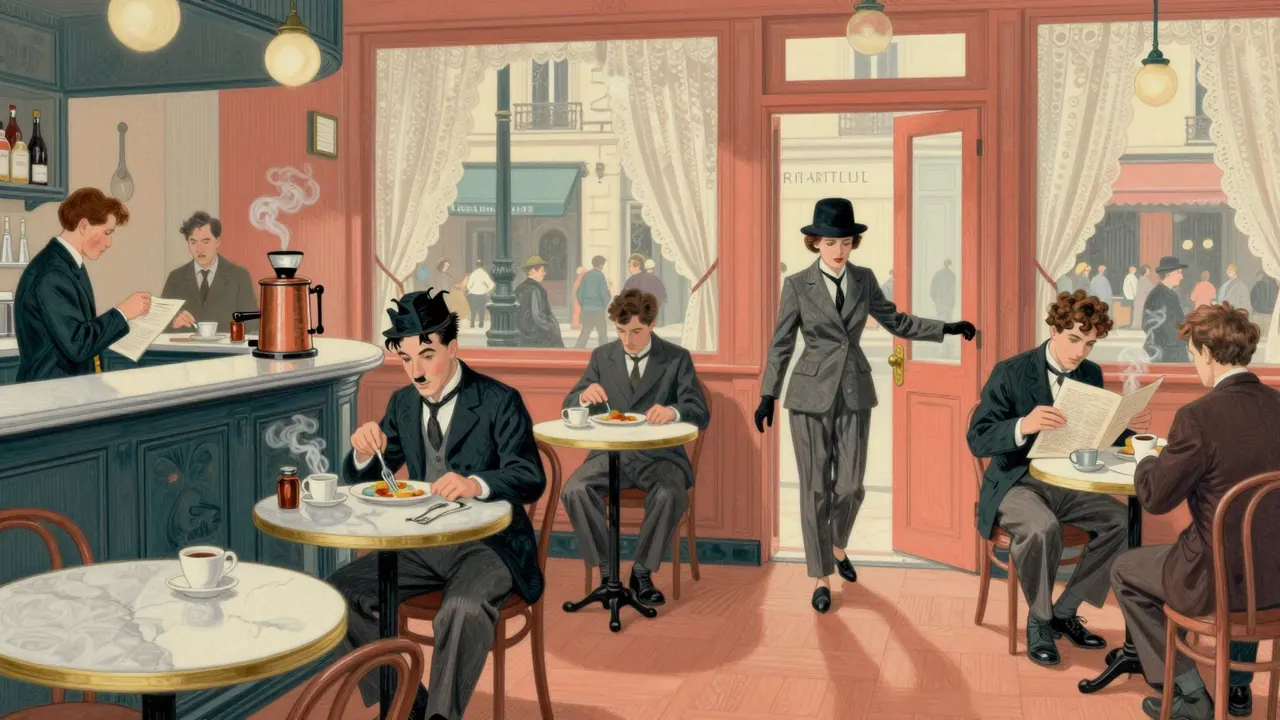
What lands is the cumulative weight of Verdoux’s quiet certainty. His refusal to repent, his insistence that murder is not exceptional but systemic, gains force through repetition and understatement. The scene where he spares the ex-convict — not out of mercy, but because her story disrupts his algorithm — lands with chilling subtlety: it is the one moment his logic fails, and the film does not underline it. The final restaurant sequence works because it is neither chase nor climax, but quiet collapse: recognition arrives not with fanfare but with a glance across a crowded room, and surrender follows without resistance. The guillotine sequence avoids grandeur; the rum, the Latin prayer, the absence of last words — all feel like documentary footnotes. Even the opening, credited to Welles, functions as exposition without exposition: a newsreel-style montage establishing economic precarity before Verdoux appears. What lands is not laughter or catharsis, but a slow, sustained unease — the kind that settles in the ribs and stays.
The friction of it
What does not land is the pacing in the middle stretch, where Verdoux’s repetitive methodology begins to blur rather than accumulate. Several courtship sequences — particularly with Annabella Bonheur — repeat structural beats without sufficient variation in tone or consequence, making them feel like narrative placeholders rather than dramatic developments. The chemist subplot, while thematically resonant, sits awkwardly: its introduction lacks setup, its payoff minimal, and its presence feels more schematic than organic. Some supporting performances — notably Barry Norton and Arthur Hohl — are underwritten and under-directed, registering as types rather than characters. The film’s refusal to dramatise Verdoux’s inner life beyond his stated logic leaves little room for ambiguity or contradiction; this is a strength in principle, but in practice it risks monotony where complexity might have deepened the provocation. The ending’s moral equation — individual killer versus state-sanctioned slaughter — is clear, but its delivery relies on the viewer already sharing its premises; without that alignment, it reads as dogma, not argument.
The logic of it
The themes that matter are economic determinism, the banality of sanctioned violence, and the hypocrisy of moral hierarchy. Verdoux’s crime is not that he kills, but that he kills individually — outside the machinery of law, profit, or patriotism. The film treats unemployment, inflation, and bank failure not as background but as causal agents; his first murder follows directly from being laid off after thirty years’ service. War is not backdrop but parallel: Verdoux’s poison is modelled on a banned veterinary drug, while munitions executives thrive. Class is rendered materially — in the difference between Grosnay’s wedding reception and the flower girl’s doorway shelter — but never named. The film’s critique of capitalism is not Marxist in rhetoric but forensic in method: it shows capital’s logic applied to human life, then asks why that logic is acceptable in boardrooms and battlefields but monstrous in a Paris apartment. Its most persistent theme is scale: how society absolves violence by multiplying it, and punishes it only when it remains legible, singular, and inconvenient.
The audience for it
This film is for viewers who value intellectual provocation over emotional release, who can sit with moral discomfort without needing resolution, and who trust a filmmaker’s restraint over exposition. It suits those familiar with interwar European history, the Great Depression’s social fallout, and the early Cold War’s ideological tightening — not because the film explains these, but because it presumes their presence in the viewer’s mind. It is not for those who require narrative momentum, character arcs, or tonal consistency; nor for those who expect Chaplin to perform kindness, even in extremis. Anyone seeking consolation, uplift, or traditional comic rhythm will find it alienating. Those who reject its central analogy — between Verdoux and the warmonger — will read it as glib, not incisive. A viewer who values satire that bites rather than tickles, and who accepts that comedy can be a scalpel, not a spoon, will find it indispensable. Others may find its austerity exhausting, its logic too rigid, its bitterness too unrelenting.
The time for it
Yes, it is worth your evening — but only if you approach it as a document of its moment, not as entertainment. Its 124 minutes unfold with the gravity of evidence, not the glide of diversion. It repays attention not through plot twists or performance pyrotechnics, but through the slow accumulation of implication: every frame, line, and pause serves the central equation. Those who dismiss it as ‘too bleak’ or ‘too cold’ are not wrong about its temperature — they are simply not its intended audience. Its value lies in its refusal to flatter, to soothe, or to separate art from argument. To watch it today is to encounter a version of Chaplin who had stopped performing for approval and begun speaking as witness. It demands patience, but offers no false comfort — and that, for some, is the highest form of respect a film can pay its viewer.