From student play to feature film
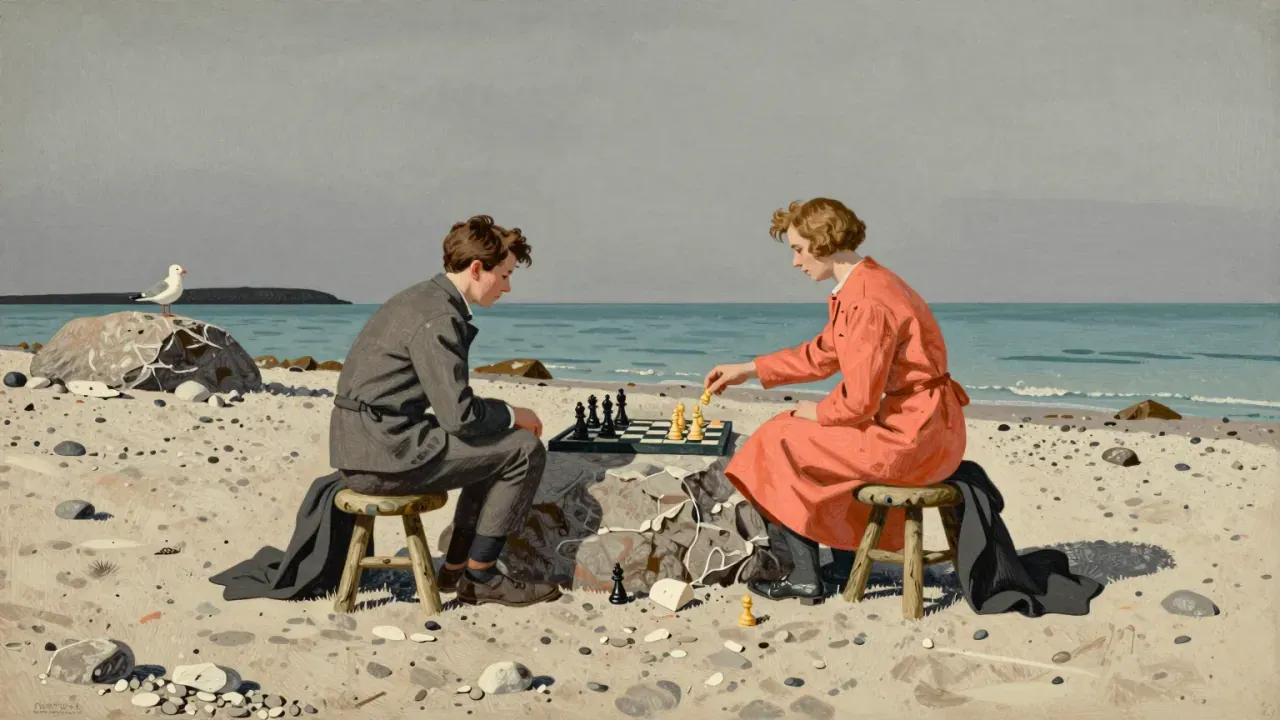
The Seventh Seal grew out of Wood Painting, a one-act play Bergman wrote in the mid-1950s for acting students in Malmö, and it keeps that origin’s compressed, parable-like shape even at feature length. Antonius Block, a knight home from the Crusades, finds his country ravaged by plague and meets Death on a beach, where he proposes a chess match to buy himself time. Bergman isn’t interested in medieval spectacle; he wrote and shot the film as a direct argument about what happens to a person’s need for meaning when the God he was promised stays silent. It’s a film built around a wager rather than a plot, and everything else grows out of that single, doomed negotiation.
A knight, a squire, and a game with no real stakes
Max von Sydow, in his first major role for Bergman, plays Block with a stillness that makes his private despair legible without much dialogue; Gunnar Björnstrand’s cynical squire Jöns supplies the film’s argument from the other direction, mocking the pieties Block still half-believes. Their journey across plague country brings them into contact with a troupe of travelling actors, a woman condemned as a witch, and a fresco painter chronicling the Dance of Death on a church wall. Bengt Ekerot’s Death, patient and faintly amused, never needs to raise his voice, because the game was decided before it started. Bergman rewrote the script five times before Svensk Filmindustri agreed to fund it, on a budget of roughly $150,000 and a 35-day shoot.
Two locations doing the heavy lifting
Nearly all of the film was shot at the Filmstaden studios outside Stockholm, with two exceptions: the opening chess scene by the sea and the closing Dance of Death, both filmed at a rocky beach called Hovs Hallar. Gunnar Fischer’s photography turns that single location into the film’s most recognisable image, figures in silhouette against a darkening sky, and Bergman later described shooting it in a rush at the end of a working day, with crew members standing in as extras because the cast had already left. That improvisation produced the shot most people picture when they think of the film, which says something about how little the production needed beyond a stark coastline and precise composition.
Where the allegory shows its seams
The film’s allegorical machinery is sometimes visible in a way that undercuts its drama. Characters occasionally state the film’s theological questions almost as dialogue-form essays, particularly in the church confessional scene, and viewers looking for the psychological interiority of Bergman’s later work may find some of the supporting figures function more as positions in an argument than as people. The travelling actors, Jof and Mia, exist largely to embody an innocent faith that Block has lost, and while that contrast is the point, it can flatten them compared to Block and Jöns’s more layered exchanges. The film’s economy is mostly a virtue, but a few scenes move so fast toward their idea that they skip past feeling.
Silence where an answer should be
The chess game is a stand-in for Block’s real question, whether there’s anything behind the silence he’s been met with since returning from a war fought in God’s name. Bergman frames that silence, drawn from the Book of Revelation passage that gives the film its title, as the central wound rather than a plot device, and Block’s attempts to extract meaning from a condemned woman, from a priest, from Death himself, all fail in the same way: nobody on the other side is answering. The famous strawberries-and-milk picnic scene, offered as the one moment of unclouded contentment in the film, works precisely because Bergman has made scarce everything else that might feel like grace.
Who gets something from this and who won’t
This suits viewers with some patience for a film that argues rather than entertains, and anyone drawn to the period’s stark visual language of plague, penance, and religious terror. It’s also a reasonable place to start with Bergman, since its parable structure is more approachable than the more interior dramas that followed it. It won’t satisfy anyone wanting a historical adventure with the trappings of the Crusades used for spectacle, and viewers who find overt religious allegory heavy-handed rather than clarifying may find the confessional and witch-burning scenes trying. It rewards a willingness to sit with unresolved questions rather than a wish for the film to answer them for you.
Ninety-six minutes, decades of influence
At 96 minutes, The Seventh Seal doesn’t ask for a large commitment, and it won the Special Jury Prize at Cannes the year it premiered, a result that established Bergman internationally almost overnight. Its imagery has been referenced, borrowed, and parodied for decades since, to the point that the Dance of Death silhouette is recognisable even to people who haven’t seen the film it comes from. That familiarity can work against a first viewing, robbing the ending of some surprise, but the film’s central question, what a person does with the time they’ve bought themselves, still lands. It’s a short evening for what it gives back, and worth setting aside on its own terms.