What the film is trying to do
Under the Roofs of Paris is René Clair’s first sound film and a deliberate, self-aware negotiation with the new medium. It is not a musical in the later sense — there are no production numbers, no diegetic orchestra — but a street-level romance set in a constructed Paris tenement, where song emerges organically from character and situation: a street singer’s refrain, a café ditty, a drunken chorus. Clair sets out to prove that sound need not flatten cinema into filmed theatre; instead, he treats voice, music and noise as plastic elements, to be layered, withheld, or counterpointed against image. The film’s ambition is structural and philosophical: to preserve the visual grammar of silent film — expressive framing, rhythmic editing, symbolic mise-en-scène — while assigning sound a distinct, non-literal role. It is an argument made in practice, not theory: every chime, every muffled conversation, every sung line is placed with the precision of a composer who distrusts realism but trusts rhythm, irony and suggestion. This is not nostalgia for silence, but a proposal for how sound might serve cinema rather than replace it. (158 words)
How it works
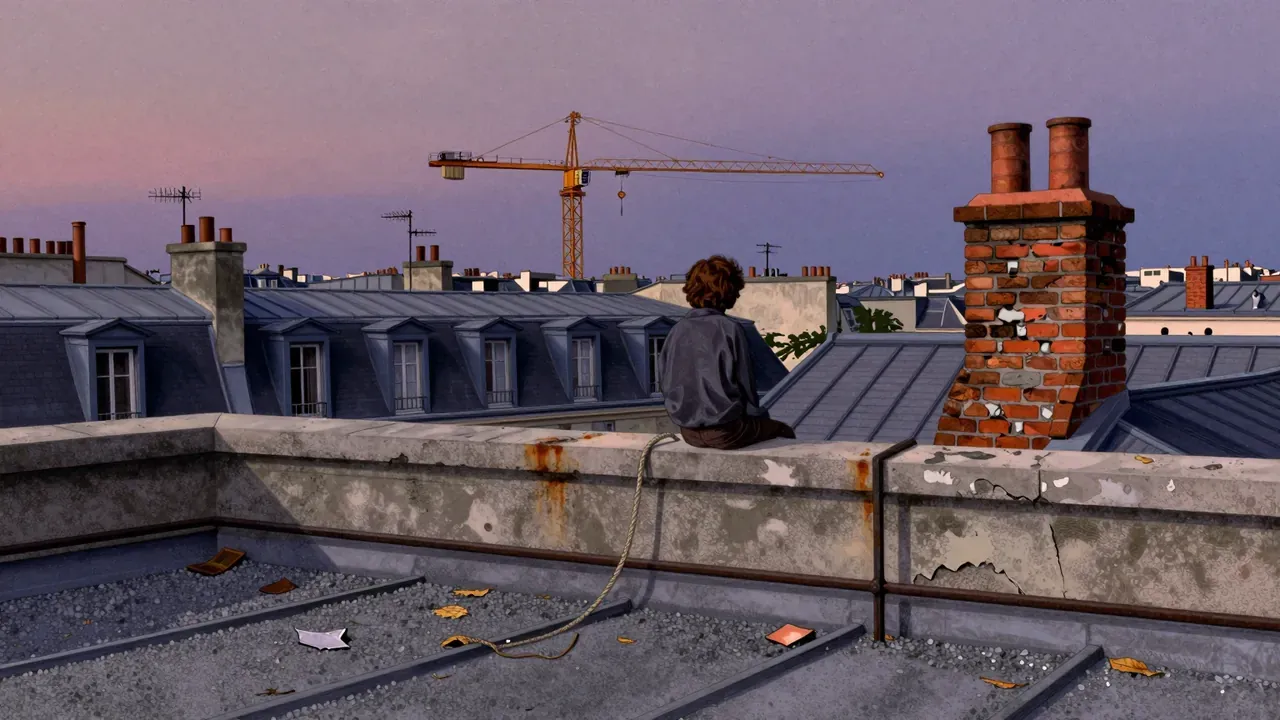
The story follows Albert, a street singer played by Albert Préjean with unforced charm and physical ease, as he falls for Pola Illéry’s enigmatic Romanian immigrant amid competing claims from his friend Louis and the gangster Fred. The plot is slender, almost schematic — a love triangle crossed with a false accusation — but functions as scaffolding for Clair’s formal experiments. Georges Périnal’s cinematography moves with quiet authority: the opening crane descent from rooftops to street is both literal and metaphorical, establishing a world at once intimate and observed. Lazare Meerson’s sets are densely detailed yet stylised, evoking Montmartre without reproducing it. André Gailhard’s score is woven into the texture rather than imposed upon it; songs arise diegetically and fade back into ambient hum. Performances avoid theatrical declamation: dialogue is often truncated, overlapped or cut off — a glass door closes mid-sentence, a train drowns out a fight — reinforcing Clair’s belief that sound should suggest, not state. Editing by René Le Hénaff sustains a gentle, unhurried pace, trusting rhythm over exposition. Even the ‘criminal’ subplot feels incidental, less about justice than about how chance disrupts fragile affections. (159 words)
What lands
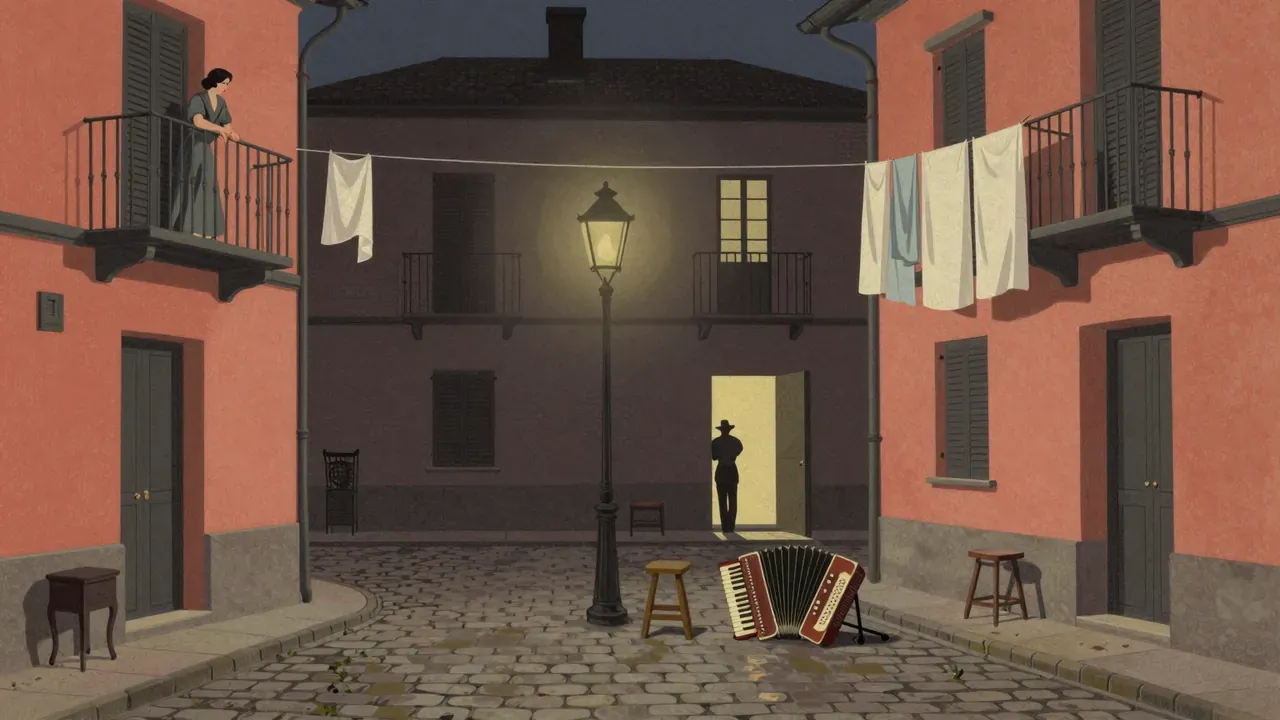
What lands most firmly is the film’s tonal control: its ability to hold warmth and melancholy in equilibrium. The Paris it shows is neither picturesque nor sordid, but lived-in and lightly mythologised — a place where romance flickers under gaslight and hardship wears a shrug. The singing scenes work because they feel earned: Pola’s hesitant, wordless vocalise when she first hears Albert’s song; the communal, slightly ragged chorus in the café; the title song returning at the end, now imbued with memory. Clair’s sound devices land not as tricks but as recognisable human experience — the way sound arrives late, cuts out, or carries further than sight. The performances ground the artifice: Préjean’s easy grace, Illéry’s watchful stillness, Gaston Modot’s quietly menacing Fred, all avoid caricature. Even minor figures — the fat woman with the purse, the drunken customer — register as individuals within the ensemble. The film’s affection for its characters never tips into sentimentality because it refuses to flatter them: Albert sleeps on the floor not out of chivalry alone, but because he has no bed to spare. That specificity — of space, of economy, of gesture — gives the film its quiet authority. (157 words)
What does not
What does not land is the narrative’s structural slackness. The plot advances by coincidence — stolen keys, misplaced bags, sudden confessions — and its resolution feels less earned than arranged. The moral pivot, where Albert cedes Pola to Louis out of friendship, arrives without psychological preparation; it reads as a formal necessity rather than emotional inevitability. Some character motivations remain opaque: Pola’s shifting attachments lack interior articulation, and Fred’s jealousy erupts without prior shading. The film’s resistance to naturalistic dialogue means key relationships are conveyed through gesture and proximity rather than speech, which works beautifully in moments but leaves broader arcs underdeveloped. Later viewers may find the ‘studio artifice’ — the painted backdrops, the stagey blocking — less charming than persuasive, especially when contrasted with the grittier social realism emerging elsewhere in French cinema by 1934. The film’s deliberate pacing, so effective in building atmosphere, can also read as inertia when the story stalls between set pieces. Its charm is undeniable, but it does not build momentum; it accumulates texture. Those expecting narrative propulsion or psychological depth will find neither — Clair is not withholding, but operating in a different register entirely. (159 words)
The themes that matter
The themes that matter are not grand abstractions but modest, interlocking conditions of urban life: precariousness, adjacency, and the quiet persistence of dignity amid scarcity. The film treats poverty not as tragedy but as circumstance — Albert has no bed, but he has a voice, a street corner, a friend. Class is present in the architecture: the cramped attics, the shared courtyards, the café as public living room. But it is never didactic; the politics are embedded in composition, not speech. More central is the theme of mediation: how people relate through layers — glass doors, passing trains, song refracted across rooftops. Sound itself becomes a metaphor for connection and misconnection: voices heard but not seen, music carrying across walls, silence speaking louder than words. There is also a sustained meditation on performance — not just singing, but the daily acts of self-presentation required to survive in close quarters: the flirtation, the bluff, the apology deferred, the pride swallowed. Clair treats these not as flaws but as the grammar of coexistence. The film’s enduring resonance lies here: in its understanding that community is not harmony, but the ongoing negotiation of proximity, where love, rivalry and loyalty share the same narrow staircase. (156 words)
Who should watch it, and who should not
This film is for viewers who value formal intelligence over narrative urgency, and who find pleasure in the choreography of light, sound and gesture. It rewards attention to texture — the grain of a voice, the tilt of a hat, the way a shadow falls across a cobblestone. It suits those familiar with silent cinema’s syntax or curious about how early sound filmmakers solved problems before conventions solidified. It is not for viewers who require psychological realism, tight plotting or emotional exposition — the film assumes you will infer motive from a glance or a pause. Those impatient with studio-built worlds or resistant to stylisation may find its charm elusive. Its appeal depends on accepting that a film can be emotionally truthful without being psychologically transparent. A viewer who values authenticity as rawness rather than construction will likely disengage. What would change the verdict? A stronger through-line in the central relationship — more time spent in Albert and Pola’s private language — would anchor the formal play. As it stands, its pleasures are cumulative, not cumulative in plot, but in pattern. (158 words)
Is it worth your evening
Yes, it is worth your evening — provided you approach it as a crafted object, not a story machine. Its ninety-five minutes unfold with unhurried clarity, offering sustained immersion in a world whose logic is aesthetic, not causal. You will not leave with answers, but with impressions: the weight of a pause, the lift of a melody, the geometry of a shared glance. It repays slow viewing, not because it is difficult, but because its rewards lie in repetition — noticing how a motif returns, how a sound recurs, how a composition echoes. Those who dismiss it as quaint or dated mistake its restraint for emptiness. Its influence is visible in later French poetic realism and even in modern filmmakers who treat sound as atmosphere rather than information. It is not universally accessible — its rhythms are specific, its priorities deliberate — but for the right viewer, it remains quietly radical: a demonstration that cinema’s power lies not in saying more, but in saying less, and letting the silence between speak. (159 words)