The look of it
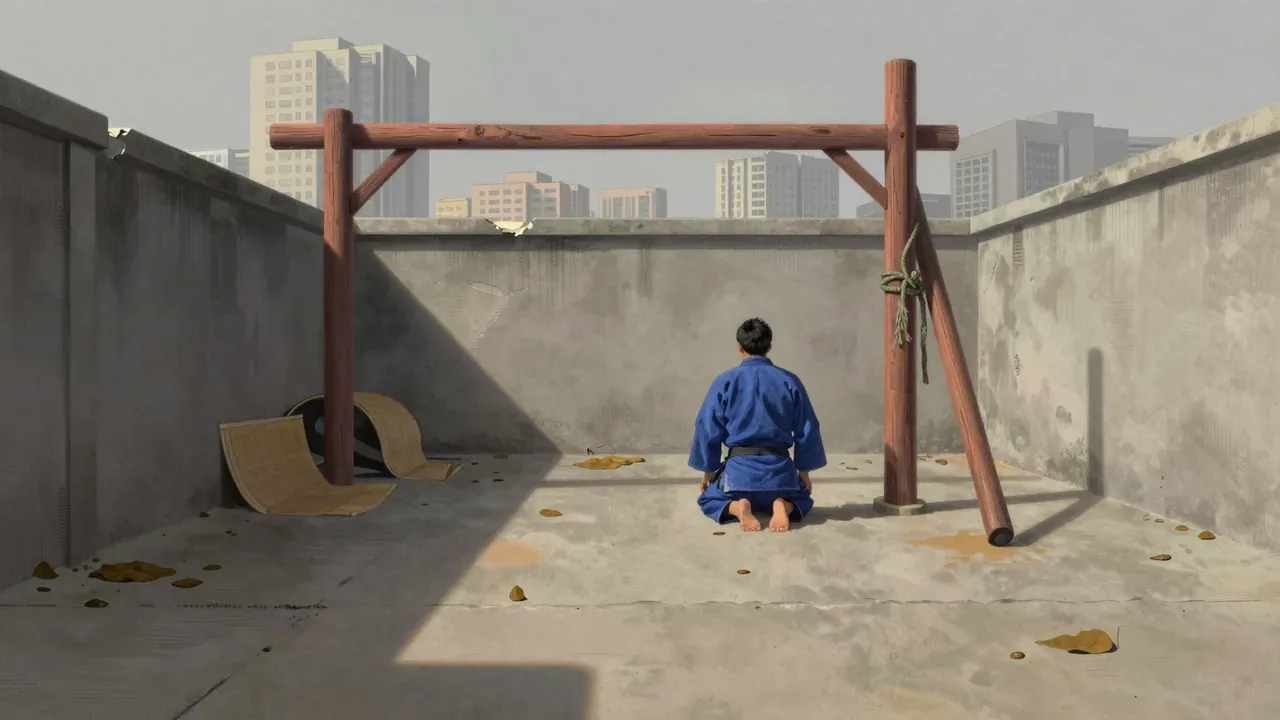
Throw Down is a Hong Kong martial arts film that frames judo not as spectacle but as ritual, discipline, and delayed reckoning. Johnnie To sets it in a world of karaoke bars, decaying industrial lots, and shuttered dojos — places where physical skill persists in the margins of urban drift. The film attempts something rare: to treat blindness not as metaphor but as condition — a slow, irreversible erosion of agency that must be met with precision, memory, and trust. It borrows structural cadence from Kurosawa’s Sanshiro Sugata, not in plot but in its insistence on moral weight accruing through repetition, restraint, and the quiet accumulation of gesture. There is no tournament arc, no rising underdog montage; instead, the narrative tightens around a single question — what does it mean to fight when you can no longer see your opponent? That question anchors the film’s formal choices: long takes, shallow focus, deliberate blocking, and sound design that privileges breath, grip, and cloth over impact. It is not about victory, but about fidelity — to craft, to mentorship, to time itself. (158 words)
The rhythm of it
The story moves with the gravity of a recollection rather than the urgency of a contest. Louis Koo’s Sze-to Bo speaks little, moves deliberately, and carries his retinal decline like a debt he has stopped denying. Aaron Kwok’s Tony is less a rival than a conduit — his energy calibrated to Bo’s depletion, his guidance literal and tactile. Tony Leung Ka-fai’s Lee Ah-kong arrives with old grievance and unspent pride, but his fury never swells into caricature; it stays grounded in posture and timing. Cheng Siu-keung’s cinematography avoids flash: light falls flat on concrete walls, lingers on dust motes in sunbeams, keeps faces half-obscured in doorways. Peter Kam’s score uses sparse piano phrases and muted strings, never underscoring but punctuating silence. The judo sequences are shot at eye level, often from mid-distance, refusing to fetishise the body or accelerate time. Fight choreography prioritises balance, leverage, and recovery — not speed or impact. Even the final duel, fought blindfolded, unfolds in real time, its tension built through hesitation, misstep, and recalibration. Nothing here is staged for awe. Everything is staged for consequence. (159 words)
The weight of it
What lands is the film’s refusal to sentimentalise resilience. Bo’s blindness is not overcome; it is accommodated, worked around, then accepted as the ground of action. The moment Lee Ah-kong sees Bo’s uncovered eyes and stops fighting is not cathartic in the usual sense — it is humbling, almost embarrassed, and deeply respectful. That beat works because it follows from everything before: the way Bo trains Ching by touch alone, the way Tony guides him across uneven ground without commentary, the way Mona sings not to be discovered but to steady herself. The film trusts its audience to register meaning in stillness — in Bo’s hand resting on a tatami mat, in the pause before a throw, in the quiet after a shout. The dojo’s restoration is not shown as triumph but as continuity: flyers handed out on a street corner, not banners raised over a rebuilt hall. Even the music lands precisely because it does not rise — it sustains, repeats, holds space. These choices cohere. They make the film feel less like a story being told than a practice being observed — one that values duration over climax, repetition over revelation. (157 words)
The gaps in it
What does not land is the framing of Mona’s subplot. Her escape from coercion and pursuit of singing feels structurally grafted, not woven — her scenes lack the same economy of gesture or weight of implication as the judo passages. Her arc resolves too neatly, her agency dependent on Bo’s intervention rather than her own sustained action. The karaoke setting, while visually textured, remains atmospheric rather than functional: it introduces characters but contributes little to the central inquiry into sight, memory, and embodied knowledge. Similarly, Boss Savage (Cheung Siu-fai) functions as shorthand for moral rot without developing beyond type — his menace lacks the granular specificity given to Lee’s pride or Cheng’s frail conviction. The film’s pacing also falters in the middle third, where exposition about Bo’s past and Cheng’s history is delivered in voiceover that flattens tone rather than deepening it. These are not failures of craft but of calibration: moments where the film steps outside its own logic of restraint and reaches for narrative convenience instead of earned implication. (156 words)
The idea in it
The themes that matter are endurance as habit, mastery as memory, and vision as negotiation rather than possession. The film treats judo not as combat sport but as a language of mutual recognition — one that requires both parties to consent to risk, to read intention through micro-shifts in weight and breath. Bo’s diminishing sight forces him to rely on proprioception, sound, and trust — all forms of perception that require time and repetition to refine. His mentor Cheng embodies this: his authority lies not in strength but in presence, in the way he occupies space without needing to fill it. The ruined dojo is not a symbol of failure but of suspended practice — waiting not for renovation but for re-engagement. Even the title, Throw Down, resists bravado: it names an act of submission, of laying down force to meet another on equal terms. The film’s quietest theme is interdependence — how Tony guides Bo not to restore sight but to extend agency; how Ching learns judo not to win but to hold space; how Lee concedes not from weakness but from seeing, finally, what Bo has always known. (159 words)
The viewer it needs
This film is for viewers who value precision over propulsion, who find tension in stillness and resonance in repetition. It suits those accustomed to the pacing and syntax of late Kurosawa, early Ozu, or To’s own Election films — audiences who read composition as argument and silence as substance. It is not for viewers expecting martial-arts spectacle, narrative velocity, or emotional exposition. Those who need clear cause-and-effect chains, psychological exposition, or cathartic release will find it withholding, even inert. A viewer who values thematic clarity over ambiguity, or who reads restraint as evasion, will leave unsatisfied. The film assumes patience as a viewing condition — not as virtue but as prerequisite. Its rewards accrue slowly, through accumulated detail: the texture of a judogi sleeve, the rhythm of a breathing exercise, the way light falls on a cracked wall. Without that baseline tolerance for durational form, the film’s architecture collapses into blankness. That is not a flaw in the film but a boundary in its contract with the viewer. (159 words)
The end of it
Yes, it is worth your evening — provided you watch it as it asks to be watched: without demand for explanation, without expectation of payoff, with attention held lightly but steadily. Its ninety-five minutes unfold with the inevitability of a well-rehearsed kata: every motion justified, every pause necessary. The final image — Bo and Ching handing out flyers — is neither hopeful nor ironic; it is factual, modest, and complete. That ending earns its quietness because the film never promised transcendence, only fidelity. Some will call it austere; others, generous in its refusal to overstate. Those who find its pace oppressive may prefer To’s more kinetic work, like The Mission or PTU. But for those willing to sit within its tempo, Throw Down offers something rare: a film about losing sight that never blinks. It does not ask for admiration. It asks only for attention — and repays it with exactness. (159 words)