The look of it
The Fall of Otrar is a Kazakh historical war film, released in 1991, that dramatises the political collapse and violent conquest of the Central Asian city-state of Otrar in the early thirteenth century. It attempts an epic reconstruction of the events preceding Genghis Khan’s invasion of the Khwarazmian Empire — not as myth or legend but as a grounded, procedural account of diplomatic rupture, institutional decay, and military overreach. The film treats its subject with the gravity of national memory rather than spectacle: its ambition lies in fidelity to regional historiography, architectural detail, and linguistic texture, not in narrative convenience or character psychology. Shot entirely on location in Kazakhstan over four years amid chronic funding shortfalls and Soviet administrative dissolution, it functions as both a late-Soviet artefact and an early assertion of post-Soviet cultural sovereignty. Its scale is structural — built into the set, the duration, the casting of non-professional actors alongside veterans of Kazakhfilm — rather than rhetorical. It does not ask for empathy so much as attention to process: how a city falls, not just why.
The shape of it
The film unfolds through a series of interlocking councils, embassies, executions, and skirmishes, held together by rhythm rather than causality. Dokhdurbek Kydyraliyev’s Undzhu anchors the human dimension with quiet, watchful restraint; Bolot Beyshenaliyev’s Genghis Khan appears less as a conqueror than as a force of bureaucratic inevitability — his lines sparse, his presence calibrated by distance and silence. Ardak Amirkulov directs without flourish: long takes hold on faces mid-decision, on courtyards mid-assembly, on dust settling after a horse departs. The camera rarely moves unless movement serves geography — a slow pan across the rebuilt walls of Otrar, then their second collapse under wind and rain. Sound design is sparse and diegetic: hoofbeats, metal on stone, unamplified voices echoing in vaulted chambers. There are no musical cues to signal emotion, no close-ups to solicit identification. Editing avoids continuity logic in favour of temporal weight — scenes linger past comfort, not to mystify but to insist on duration as evidence. The craft is cumulative, not expressive: each shot adds to the architecture of consequence.
What holds
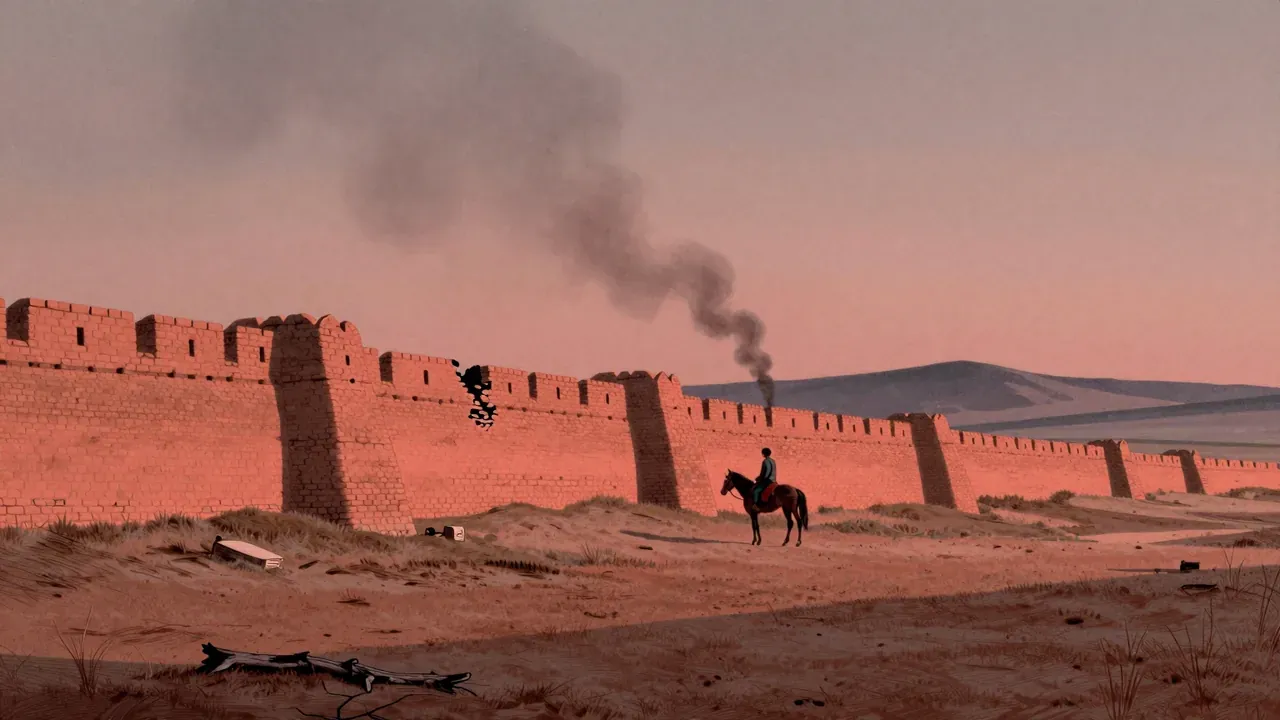
What lands is the physicality of decline: the repeated rebuilding of Otrar’s set, visible in shifts of timber grain and mortar colour between sequences, becomes a motif in itself — not metaphor but record. The film’s refusal to separate politics from logistics — food stores, messenger routes, water access, garrison rotations — gives its warfare a granular authenticity rare in historical epics. Sabira Atayeva’s Terken Khatun carries authority not through speech but through stillness in crowded rooms, her gaze holding space while men debate. The climactic siege is not shown in montage but in a single, static wide shot of smoke rising beyond the eastern wall, followed by thirty seconds of silence broken only by wind and distant, unidentifiable cries. This restraint avoids catharsis but secures gravity. The film’s most persuasive moments are those where nothing happens visibly — a council chamber emptied, a sealed letter left unopened on a desk, a horse tethered outside a gate that will not open again. These are not omissions but assertions: history often proceeds in pauses, not pivots.
What gives
What does not land is the attempt to dramatise internal motive. Characters speak in declarative statements that serve exposition more than psychology; their decisions feel dictated by chronicle rather than conviction. The figure of Muhammad II of Khwarazm (Abdurashid Makhsudov) remains opaque — neither tyrant nor tragic reformer, but a cipher whose actions exist only to trigger response. The film’s commitment to historical fidelity comes at the cost of dramatic friction: there are no betrayals that surprise, no alliances that shift meaningfully, no moral ambiguity that unsettles. Some sequences — particularly extended debates among elders in the city square — risk monotony not from poor performance but from structural repetition: same framing, same vocal register, same spatial relationship. The absence of music also works against cohesion in longer stretches, leaving tonal drift where the script expects solemnity. These are not failures of execution but consequences of method: the film prioritises archival coherence over narrative propulsion, and that choice alienates viewers expecting psychological or emotional escalation.
What stays
The themes that matter are sovereignty as infrastructure, not ideology; memory as labour, not nostalgia; and empire as weather — ambient, persistent, indifferent. The film treats statehood not as a set of declarations but as a network of granaries, watchtowers, courier relays, and tax ledgers — all of which erode before the first arrow flies. It presents colonial violence not as sudden rupture but as the acceleration of existing fractures: drought, factionalism, miscommunication, deferred maintenance. The fall of Otrar is less about Mongol ferocity than about the exhaustion of local capacity to absorb stress — a theme legible in the production history itself, where budget cuts, set destruction, and administrative collapse mirror the events on screen. There is no heroism here, only stewardship — and its failure is measured in ruined walls, abandoned wells, and untranslated letters. The film’s quietest theme is time: not linear progression but layered duration, where the same riverbank hosts three different constructions of the same gate, each one less stable than the last.
Who it meets
This film is for viewers who value historical texture over narrative velocity, who find patience a mode of engagement rather than a barrier, and who approach cinema as archaeology — willing to brush dust from surfaces to read what lies beneath. It suits those familiar with Soviet-era Central Asian literature or with the historiography of the Khwarazmian collapse, but it does not require that knowledge: its clarity is visual and spatial, not expository. It is not for viewers who rely on character arcs for orientation, who expect emotional payoff within scene boundaries, or who treat historical films as allegories for contemporary politics. Those who associate ‘epic’ with scale of feeling rather than scale of consequence will find it withholding. A viewer who values tight plotting, psychological revelation, or sonic richness would reasonably reject it — not as flawed, but as mismatched to their expectations. Its worth depends on whether one measures a film by what it delivers or by what it refuses to deliver.
What it costs
Yes, it is worth your evening — but only if you accept its terms: that duration is argument, silence is syntax, and repetition is evidence. Its 176 minutes do not pass quickly, nor are they meant to; they accumulate like sediment. The 4K restoration sharpens the grain of the original 35mm negative, making visible the cracks in plaster, the fraying of banners, the sweat on brows during council sessions — details that deepen rather than distract. To call it ‘slow’ mistakes its pace for passivity: every frame is weighted, every pause calibrated. It rewards attention not with reward but with recalibration — of how we imagine power, how we read ruin, how we sit with unresolved endings. Those who leave dissatisfied have not misread it; they have simply arrived with different criteria. Its value lies not in accessibility but in insistence — on history as material, not story; on cinema as witness, not interpreter.