The story it tells
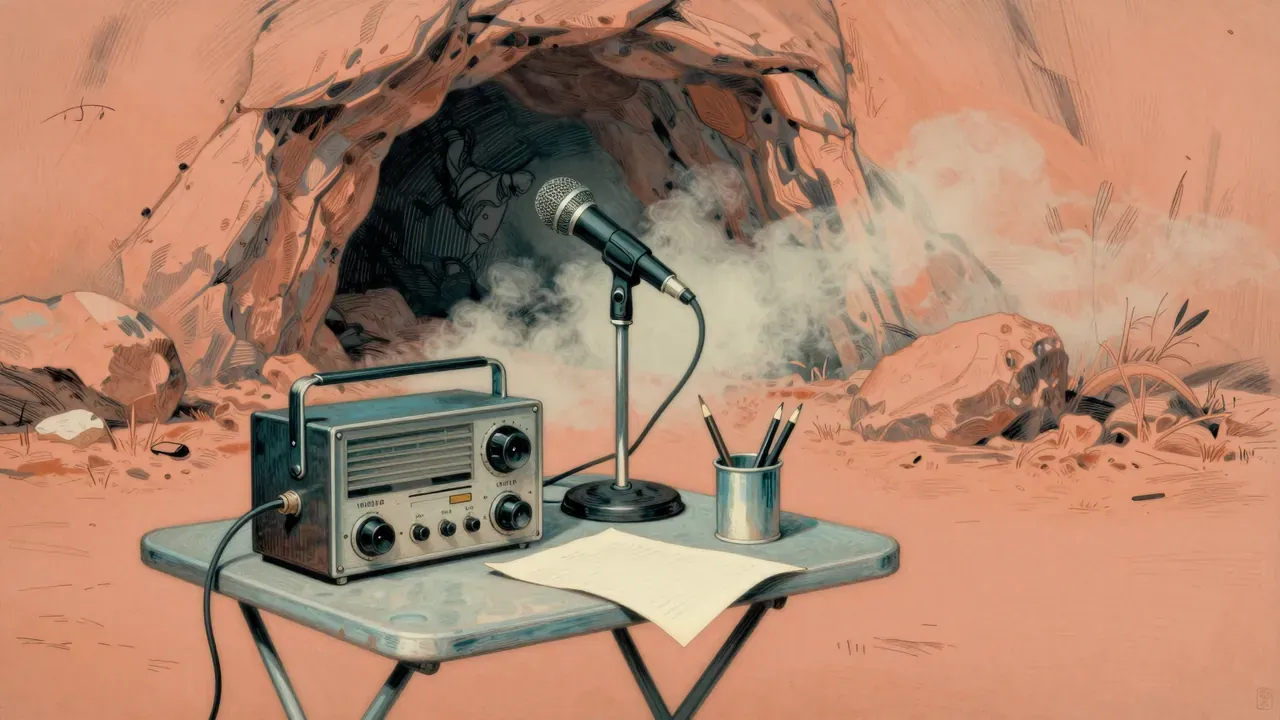
Ace in the Hole is a 1951 American drama directed, produced, and co-written by Billy Wilder. It follows Chuck Tatum, a disgraced newspaper reporter who engineers a prolonged media spectacle around a man trapped in a New Mexico cave. The film attempts to dissect the mechanics of moral collapse—not as personal failing alone, but as systemic collusion between ambition, institutional inertia, and public appetite for spectacle. It is not a procedural about rescue or journalism ethics in the abstract; it is a tightly wound demonstration of how easily truth becomes secondary to narrative control when incentives align. Wilder does not ask whether exploitation happens, but how readily it is enabled: by a sheriff seeking re-election, a contractor deferring to authority, a wife weighing financial gain against loyalty, and a press corps that watches rather than intervenes. Its aim is surgical: to show corruption not as villainy but as incremental, rational, and mutually reinforcing. It treats the American frontier not as mythic space but as terrain where civic infrastructure is thin enough for one man’s cynicism to become the organising principle of an entire event. Word count: 148.
The way it moves
The story unfolds with unrelenting cause-and-effect logic: each decision tightens the noose on Leo Minosa while loosening Tatum’s grip on his own conscience. Kirk Douglas plays Tatum with physical precision—his posture shifts from weary dismissal to predatory alertness, then to hollowed-out exhaustion—but avoids caricature by anchoring every choice in professional calculation, not malice. Jan Sterling’s Lorraine is rendered without exposition: her silence, her hesitation before wearing the fur stole, her final hitchhike out of town—all register as consequences, not symptoms. Charles Lang’s cinematography keeps the New Mexico exteriors bleached and flat, the cave interiors claustrophobic and grainy, refusing visual poetry in favour of documentary weight. Arthur P. Schmidt’s editing sustains tension through duration: shots linger just past comfort, crowd scenes unfold without musical cue or editorial punctuation. Hugo Friedhofer’s score is sparse, functional—used only where silence would mislead. There are no flashbacks, no voiceover justification, no redemption arc. The craft serves the premise without ornament: this is how a story becomes a carnival, step by step, shot by shot. Word count: 152.
The look of it
What lands is the cumulative effect of complicity. The film makes no argument about ‘bad apples’; instead, it shows how ordinary people—deputy sheriffs, insurance salesmen, photographers, even priests—cede agency in small increments until they are performing roles written by someone else’s agenda. The carnival site, built at vast expense 19 miles west of Gallup, functions as both setting and metaphor: a temporary city erected not for celebration but for extraction, complete with parking lots, roadside stands, and a band playing ‘We’re Coming, Leo’. That song, sung with forced cheer, lands precisely because it is so tonally wrong—its jauntiness exposing the grotesque dissonance between form and function. The final image—a drunken Tatum collapsing beneath an embroidered ‘Tell The Truth’ sign—is not ironic flourish but structural inevitability: the lie has become the architecture, and the truth is now just decor. Even the National Film Registry selection in 2017 feels less like rehabilitation and more like archival confirmation of what the film always insisted: this is not exaggeration, but extrapolation. Word count: 150.
Where it holds firm
What does not land is the film’s assumption that its audience shares its contempt for the press as institution rather than practice. The script treats journalistic competition as passive—a backdrop of idle reporters chewing fingers—rather than engaging with how rival papers might actually behave: filing competing angles, leaking official contradictions, or challenging the sheriff’s version of events. This flattens the media ecosystem into a monolith, making Tatum’s dominance feel less earned than imposed by narrative fiat. Similarly, the character of Herbie Cook begins with moral clarity but abandons it too swiftly, without the friction of doubt or internal negotiation; his disillusionment reads as plot necessity, not psychological progression. The film also undercuts its own critique by presenting Tatum’s downfall as solitary and terminal, when in reality such behaviour often persists across outlets and eras. Its moral framework is absolute, but its sociology is thin: it maps sin well, but not structure. Some viewers will find this lack of institutional counterweight alienating—not because the film is wrong, but because its vision of power is too concentrated, too theatrical, to sustain belief beyond its immediate frame. Word count: 154.
What it means
The themes that matter are self-deception as professional habit, spectacle as economic engine, and truth as a commodity whose value depends on scarcity and timing. Ace in the Hole treats journalism not as a profession but as a trade—like drilling or insurance—with its own supply chains, pricing models, and expiration dates. The film’s enduring relevance lies in its refusal to locate corruption in motive alone: Tatum does not need to hate Leo to prolong his entombment; he needs only to believe the story is worth more alive than dead. Likewise, Lorraine does not need to love Tatum to wear the fur stole—she needs only to calculate that visibility buys time, and time buys leverage. The film’s quietest theme is geography: rural New Mexico is not exotic backdrop but functional condition—the distance from editorial oversight, the thinness of local governance, the absence of competing narratives—all make the carnival possible. It is not about place as character, but place as permission slip. These are not period concerns. They describe how attention economies operate wherever infrastructure is porous and accountability diffuse. Word count: 149.
Who it is for
This film is for viewers who treat narrative as evidence, not entertainment—those willing to sit with sustained discomfort and resist the urge to assign blame to individuals rather than systems. It rewards attention to framing, pacing, and subtext over plot resolution or emotional payoff. It is not for those who require moral anchors in protagonists, or who expect catharsis to arrive via confession, punishment, or revelation. People who read news as chronicle rather than construction may find its tone exhausting or punitive; those who see media as inherently adversarial may regard its depiction of journalistic passivity as implausible. A viewer who values character complexity over likability, and thematic rigour over narrative generosity, will find it indispensable. Someone who expects cinema to offer solace, or who measures worth by uplift, will leave unrewarded—not because the film fails, but because it declines to perform that function. Word count: 149.
Why it lasts
Yes, it is worth your evening—if you approach it as a case study, not a story. Its 111 minutes do not pass lightly: the pacing is deliberate, the tone unrelenting, the ending devoid of release. But it repays attention with precision: every shot, line, and edit advances its central thesis without redundancy. Those who watch expecting irony or satire may misread its severity as bleakness; those who watch for craft will find Lang’s lighting, Schmidt’s cuts, and Wilder’s scripting operating in strict concert. It is not a film to enjoy, but one to reckon with—and reckoning takes time. Anyone who has ever scrolled past tragedy while waiting for the next update, or mistaken virality for significance, will recognise its architecture. Its value lies not in what it says about 1951, but in how thoroughly it describes mechanisms still in operation. To dismiss it as dated is to miss that its subject is durability, not nostalgia. Word count: 149.